
Why is foreign travel still difficult? Indian passport slips to 84th place

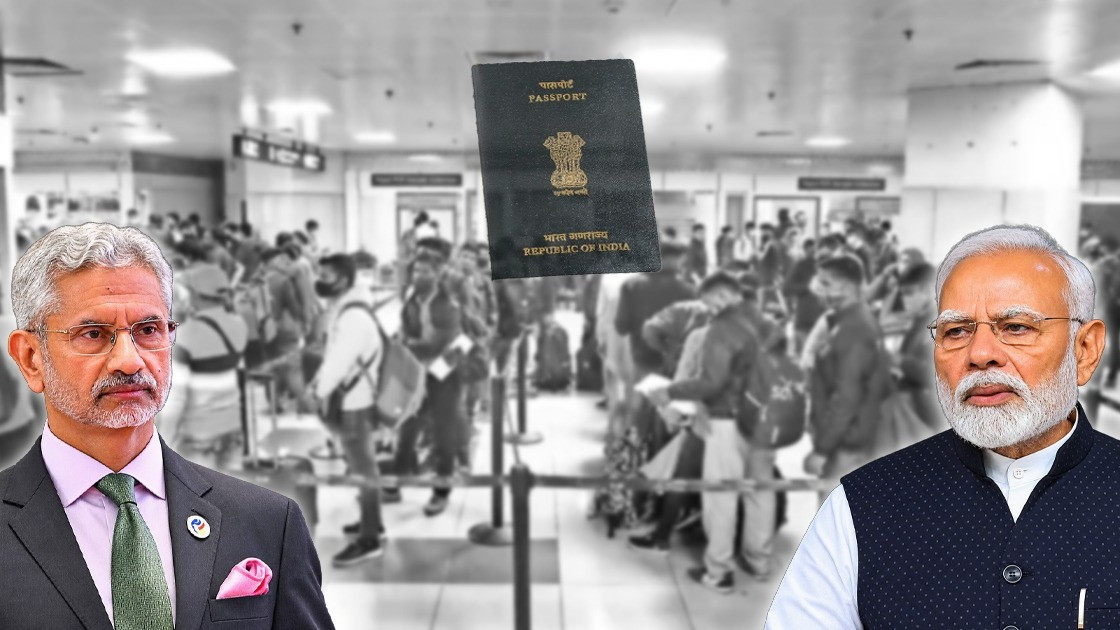
The Indian passport has slipped to 84th place in the Henley Passport Index for October 2026.
How easily a country’s passport opens the doors of the world to its citizens is an important measure of international mobility. This is why fluctuations in the Indian passport’s ranking are a subject of discussion. In the October 2026 Henley Passport Index, the Indian passport has slipped to 84th place. The passports of Algeria and Mauritania are also ranked alongside India’s. In January 2026, the Indian passport stood at 80th place on the list.
Visa-free travel for Indian passport holders, which was earlier available to 57 countries, is now limited to 55 countries. Malaysia has also recently suspended visa-free access for Indian citizens, a move that is set to take effect from January 1, 2027. According to Malaysian officials, several agents brought Indian citizens into the country with the promise of employment, but they became undocumented after their 30-day stay expired, leaving them at risk of exploitation and arrest.
Singapore is at the top of the list, with its citizens enjoying visa-free travel to 193 countries, which means they are not required to complete paperwork before travelling. The key to understanding this difference lies in the distinction between rank and score. Rank shows a passport’s position relative to others, while the score indicates how many destinations are accessible under the specified arrangement. If India’s score remains unchanged but those of other countries change, India’s rank can shift. A higher rank, therefore, does not always mean access to new countries. However, from an immigration perspective, it is better for travellers in any case.
The Henley Index uses data from the International Air Transport Association, or IATA, as well as its own research. It compares travel access on the basis of ordinary passports. Its calculations include visa-free entry, visas on arrival and electronic travel authorisations. But an e-visa that requires approval before travel is not counted in the same category. It is therefore not entirely accurate to describe all 55 destinations as visa-free countries.
The difference between an electronic travel authorisation and an e-visa is important for travellers. Both processes may be conducted online, but their legal and administrative nature differs. Moreover, the facility to travel without an advance visa does not guarantee entry or permission to work. Passport validity, the purpose of travel and other requirements of the country concerned continue to apply. Henley itself does not describe its data as a legal guarantee of entry.
The most direct impact of the Indian passport’s limited access is on travel planning. Where a visa is required in advance, travellers may need additional time for the application, documents, fees and approval. This difference is felt more acutely when a business meeting, conference or family visit is planned at short notice. Even those who are financially well-off can face administrative hurdles, while the cost of applying can be an additional burden for travellers with limited resources.
It would be incomplete to attribute the reasons solely to the government’s diplomatic success or failure. According to Henley, changes in visa policies are influenced by several factors, including diplomacy, security and immigration rules. But the available rankings do not, by themselves, establish which factor caused any particular change in India’s position.
Political debate can also be confusing when different indices are conflated. Some indices look only at travel access, while others include additional aspects or different entry categories. It is therefore not a reliable comparison to infer a decline by setting an earlier ranking from one organisation against a later ranking from another. Shifting geopolitical conditions around the world, under which the prospect of war rises and recedes, as well as the government’s claims that India is emerging as a global leader, raise citizens’ hopes that they too will enjoy some of these benchmarks and facilities when travelling internationally. It is the government’s responsibility to openly present the facts to citizens on why, despite all the claims, travel-related facilities for Indian travellers are not improving.
In the coming days, useful goals for India could include easier travel to more countries, simpler visa procedures and clear information for travellers. Instead of focusing only on improving the ranking, it should be assessed how many people’s real needs are met by a new facility. Different arrangements could be useful for tourism, business travel and family visits. A country with a population of nearly 150 crore and an economy on a growth path should have a passport that ranks better, as India is not on the brink of war and is not a weak nation by ordinary measures, although it is part of the Global South.
The debate on the Indian passport should centre on citizens’ convenience. The question is how many countries they can visit at lower cost, with less uncertainty and through simpler procedures. This ranking begins a discussion in which tangible improvements to citizens’ travel experience will be the most important measure.