
What does the BJP want in the name of delimitation?

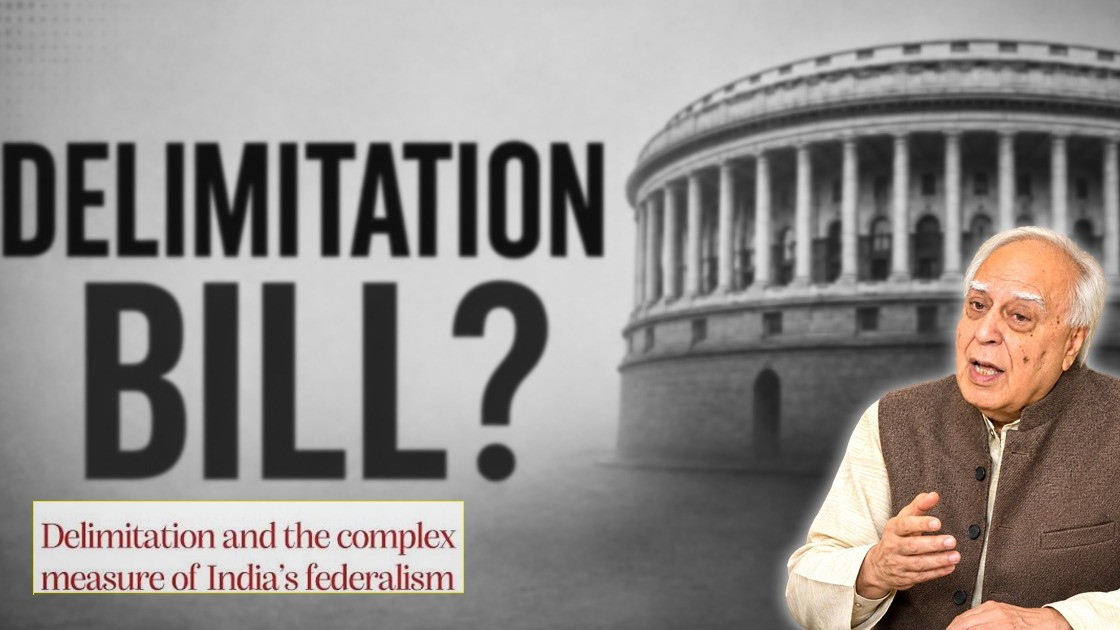
He expressed concern that the delimitation carried out through this exercise could give the BJP a long-term political advantage.
The discussion over increasing the number of Lok Sabha MPs has now become a debate on representation, federal balance and electoral fairness. Rajya Sabha MP and former Union Minister Kapil Sibal has warned opposition parties not to be tempted by the government’s proposal to increase the number of Lok Sabha seats in every State by 50 per cent. At a press conference on November 24, he said he feared that delimitation carried out through this proposal could give the BJP a long-term political advantage.
According to Kapil Sibal, the government is offering an equal percentage increase in the existing seats to secure the Opposition’s support. Calling this a political inducement, he said the Opposition should look beyond the immediate benefit of additional seats. He alleged that if constituencies are drawn in a manner favourable to the ruling party, the Opposition’s electoral prospects could weaken in the future. He made similar allegations about delimitation in Assam and Jammu and Kashmir.
It is important to distinguish between two separate processes. The first concerns the total strength of the Lok Sabha and the allocation of seats among States. The second is the process of determining the boundaries of constituencies within each State. According to details published by the Election Commission, a constitutional provision keeps the current allocation of seats among States unchanged until the first Census after 2026. Therefore, the question of a major reallocation is linked not only to political consensus but also to the constitutional process.
The arithmetic of an equal percentage increase also needs to be examined carefully. For example, a 50 per cent increase in Uttar Pradesh’s 80 seats would take the number to 120, while Gujarat’s 26 seats would rise to 39. A larger State would get more new seats in numerical terms. But if every State’s seats increase in exactly the same proportion, its percentage share in the Lok Sabha would remain roughly the same. It is in this context that the government is being accused of benefiting States in north India.
The more significant aspect of Kapil Sibal’s concern is the fairness of constituency boundaries and how they are drawn. The areas in which voters from a community or political group are included can affect electoral contests. However, more seats do not, by themselves, ensure a party’s permanent victory. Candidates, local issues, alliances and changing voter preferences also remain decisive. He has said that the government is deceiving citizens and that democracy will not survive in India if the Bharatiya Janata Party succeeds in its attempt at delimitation. According to him, if this happens, the Bharatiya Janata Party will remain in power in the country forever. He appealed to political parties not to let this happen, saying that if we allow it, history and the people will not forgive us.
Women’s reservation is another important part of this debate. The 106th Constitutional Amendment, passed in 2023, provided for one-third reservation for women in the Lok Sabha, State Assemblies and the Delhi Assembly. Article 334(a) links its implementation to delimitation after the publication of the relevant Census figures. The law providing for women’s reservation is therefore already in place; the new discussion concerns the process of implementing it and possible constitutional changes. The Opposition has repeatedly demanded that women’s reservation be delinked from delimitation.
Kapil Sibal claimed that the government wants to secure the support of 362 members in the Lok Sabha for a constitutional amendment. The constitutional interpretation of this figure needs clarification. Under Article 368, an amendment requires a majority of the total membership of each House and the support of at least two-thirds of the members present and voting. If all 543 members vote, two-thirds would be 362. But this is not a fixed number in every situation. An amendment changing the parliamentary representation of States also requires approval from at least half of the States. On the Nationalist Congress Party (Sharad Pawar)’s alliance with the Bharatiya Janata Party, he said politicians should think about future generations, who are India’s real future, instead of thinking about becoming Chief Ministers or the benefits of being in government.
He also questioned why the winter session of Parliament had not been announced and why the monsoon session had not been prorogued. Article 85 does not allow more than six months to elapse between the last sitting of one session and the first sitting of the next. An adjournment sine die and prorogation by the President are separate processes. Kapil Sibal said the government’s failure to announce dates for the winter session was unconstitutional.
The challenge before the Opposition now goes well beyond accepting or rejecting the proposal for additional seats. It should seek clear details on State-wise shares, the Census basis, the timeline for women’s reservation and the criteria for delimitation. The government, too, needs to make the full plan for such far-reaching changes public. Kapil Sibal’s warning sharpens the debate, but trust will be built only if decisions are based on transparent data, adequate parliamentary discussion and meaningful participation by the States. Ahead of the Assembly elections in the States, this debate draws attention to the need for a transparent law-making process, with public welfare at its centre, not political interests.