
Foreign exchange reserves drop by $14 billion: Is external pressure rising on the Indian economy?

According to RBI data, foreign currency assets fell by $7.90 billion to $583.45 billion, while gold reserves decreased by $6.18 billion to $98.61 billion.
- The decline of over $14 billion in India's foreign exchange reserves within a week has raised concerns in economic circles.
- According to data released by the Reserve Bank of India (RBI) on November 20, 2026, the country's foreign exchange reserves fell to $705.34 billion for the week ending November 13.
- In the previous week, on November 6, it was $719.55 billion.
- Thus, in just seven days, there was a decrease of $14.21 billion.
- This is the lowest level in nearly three months. The bulk of the decline is attributed to a reduction in foreign currency assets and gold reserves.
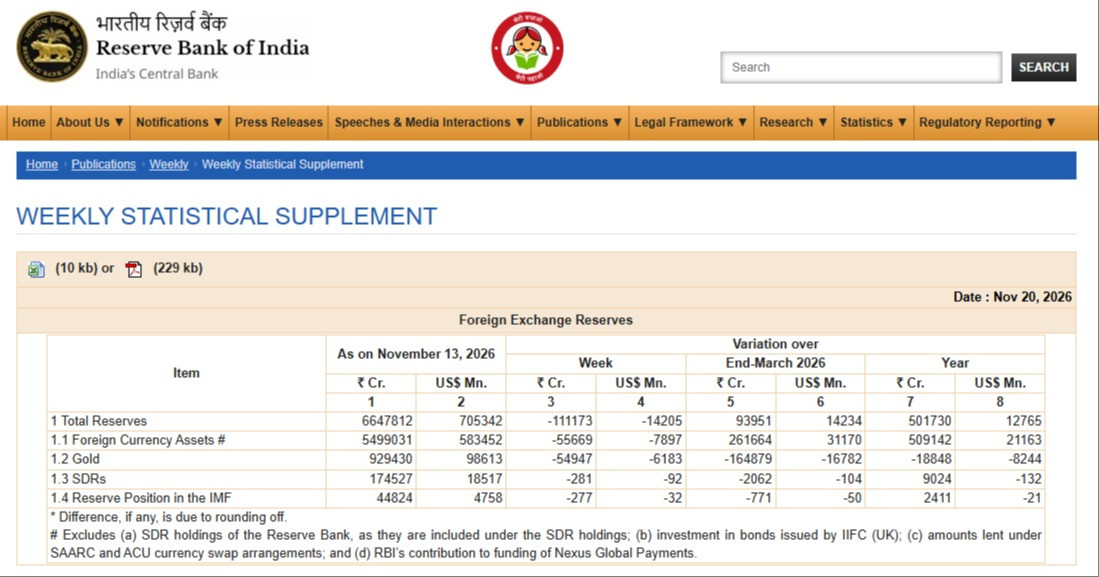
According to RBI's data, foreign currency assets decreased by $7.90 billion to $583.45 billion, while the value of gold reserves fell by $6.18 billion to $98.61 billion. There was a decrease of $9.2 crore in Special Drawing Rights (SDR) and $3.2 crore in India's reserve position with the International Monetary Fund (IMF). This means that the decline in foreign currency assets and gold holdings accounted for the largest share of the total decline.

However, to understand this decline, it is essential to note that a decrease in foreign exchange reserves does not always mean that an equivalent amount of dollars has left the country. Foreign currency assets also include holdings in other currencies such as euros, pounds, and yen. When the dollar strengthens against these currencies, their value in dollars decreases. Similarly, the value of gold reserves is affected by fluctuations in gold prices in the international market. Therefore, part of the decline in reserves may also result from changes in market valuations.
This time, the decline was influenced by both actual dollar sales and changes in valuations. According to some market analysts, there were dollar sales during the reporting week, while the decline in gold prices further exacerbated the total decline. This makes it clear that the figures for foreign exchange reserves should not be understood solely based on a week's fluctuations but should be considered in conjunction with the underlying economic factors.
The Importance of Foreign Exchange Reserves for India
Foreign exchange reserves are a crucial indicator of a country's external economic stability. They include foreign currency assets, gold, SDRs, and the reserve position in the IMF. For a country like India, their importance is heightened because it requires a significant amount of foreign currency for imports of crude oil, natural gas, electronic equipment, machinery, fertilizers, and many other essential goods.
When pressure increases on the rupee or there is a sudden surge in demand for dollars in the market, the RBI can use its reserves to intervene in the foreign exchange market. The aim is not to maintain the rupee at a fixed level but to control excessive volatility and reduce instability in the market. Adequate foreign exchange reserves also reassure foreign investors and international financial institutions that India has the capacity to meet its external obligations and import payments.
India has made significant improvements in its foreign exchange reserves over the past three decades. During the 1991 balance of payments crisis, the country had such limited foreign exchange resources that it became difficult to pay for even a few weeks of imports. At that time, India had to pledge gold and seek international financial assistance. Economic liberalization and the expansion of exports, the service sector, foreign investment, and remittances from non-resident Indians gradually changed this situation.
Today, India's foreign exchange reserves are much stronger compared to that period. In the first week of September 2026, they reached a record level of approximately $785.7 billion. By November 13, there had been a decline of about $80.4 billion. Nevertheless, a reserve of $705.34 billion is still a substantial amount. According to the RBI's assessment in October 2026, the reserves available as of October 16 were equivalent to approximately 10.6 months of the country's goods imports. Therefore, it would not be accurate to view the current decline as an indication of an imminent payment crisis, but if pressure continues, it could certainly become a matter of concern.
Pressure on the Rupee and Global Markets
The role of the rupee's exchange rate and global financial conditions is also significant behind the decline in foreign exchange reserves. The strength of the US dollar, rising interest rates on US bonds, and global investors' aversion to risk can put pressure on the currencies of emerging economies. When foreign investors withdraw money from the Indian equity and bond markets, they convert their investment amounts into dollars. This increases the demand for dollars and puts pressure on the rupee.
By mid-November, the position of the rupee was also under pressure. In the week ending November 13, it weakened against the dollar and approached the level of ₹94. However, on November 20, the rupee made a remarkable recovery, closing at ₹92.67 against the dollar. Factors behind this improvement included the return of foreign investment in the Indian stock market, a softening of oil prices, and the unwinding of bets placed on a decline in the rupee. The inflow of foreign investment in Indian stocks also remained strong in November.
Oil Prices: A Major Challenge for India
One of the biggest challenges facing India's external economic situation is the price of crude oil. India imports a significant portion of its needs. When oil prices rise in the international market, India's import bill increases, leading to a higher demand for dollars. This can widen the current account deficit and put pressure on the rupee. Ongoing tensions in West Asia and uncertainty regarding any agreement between the US and Iran have also created instability in the oil and financial markets.
If tensions in West Asia escalate and oil supplies are affected, India may face pressure on multiple fronts. Expensive oil can increase inflation, raise transportation and production costs, and increase the government's import bill. This can impact everyone from ordinary consumers to industries and government finances. On the other hand, a softening of oil prices could provide relief for India.
Future Challenges
In the coming months, India’s foreign exchange reserves will face several challenges.
The first challenge is related to global interest rates and the strength of the dollar. If US interest rates remain high, US assets may continue to be attractive to foreign investors. This could impact capital flows into emerging markets like India. A reduction in foreign investment or sudden withdrawals could increase pressure on both the rupee and foreign exchange reserves.
The second challenge is to keep the current account deficit under control. India's import bill, especially for energy, gold, and electronic goods, is quite large. If there is not sufficient growth in exports, the gap between imports and exports could widen. However, India's service exports, particularly in IT and business services, play a crucial role in alleviating this pressure. Therefore, expanding export markets and increasing domestic production capacity should be part of the long-term solution.
The third challenge is related to external debt. According to RBI data, at the end of June 2026, India's total external debt was $778.2 billion. This was 20.8 percent of the gross domestic product. This ratio is not extremely concerning in itself, but it is essential to keep an eye on short-term debt and external debt that is due in the next twelve months. At the end of June 2026, short-term external debt based on original maturity was 23 percent of foreign exchange reserves. The ratio of debt due in the next twelve months based on remaining maturity was significantly higher than this. This means that while it is necessary to have adequate reserves, the upcoming external currency obligations must also be taken into account.
The fourth challenge is the volatility in the valuation of gold and foreign currency assets. India has increased its share of gold in its reserves, which is a way of diversification in the long term. However, a sharp decline in gold prices could also reduce the dollar value of the reserves. Similarly, weakness in other major currencies against the dollar could affect the valuation of foreign currency assets.
The government and the RBI face the challenge of balance. Continuously spending dollars to artificially maintain the rupee at a certain level would not be a prudent strategy. On the other hand, a sharp decline in the rupee could increase imported inflation and put pressure on companies borrowing in foreign currency. Therefore, the RBI must strike a balance between intervening in the market as needed, maintaining adequate reserves, and avoiding unnecessary volatility in the currency market.
Overall, the fall of foreign exchange reserves to $705 billion is not an immediate crisis for India. The country still has sufficient foreign currency resources, and the capacity for import payments remains strong. However, a reduction of nearly $80 billion from record levels indicates that the pressure from global conditions is real. In the coming times, oil prices, U.S. interest rates, the direction of foreign investment, export momentum, and the exchange rate of the rupee will determine how strong India's external economic balance remains. The challenge is not just to maintain reserves at a large figure, but to create an economy that can sustain a stable supply of foreign currency and payment capacity despite global shocks.