
Foreign exchange reserves see biggest drop, market crashes

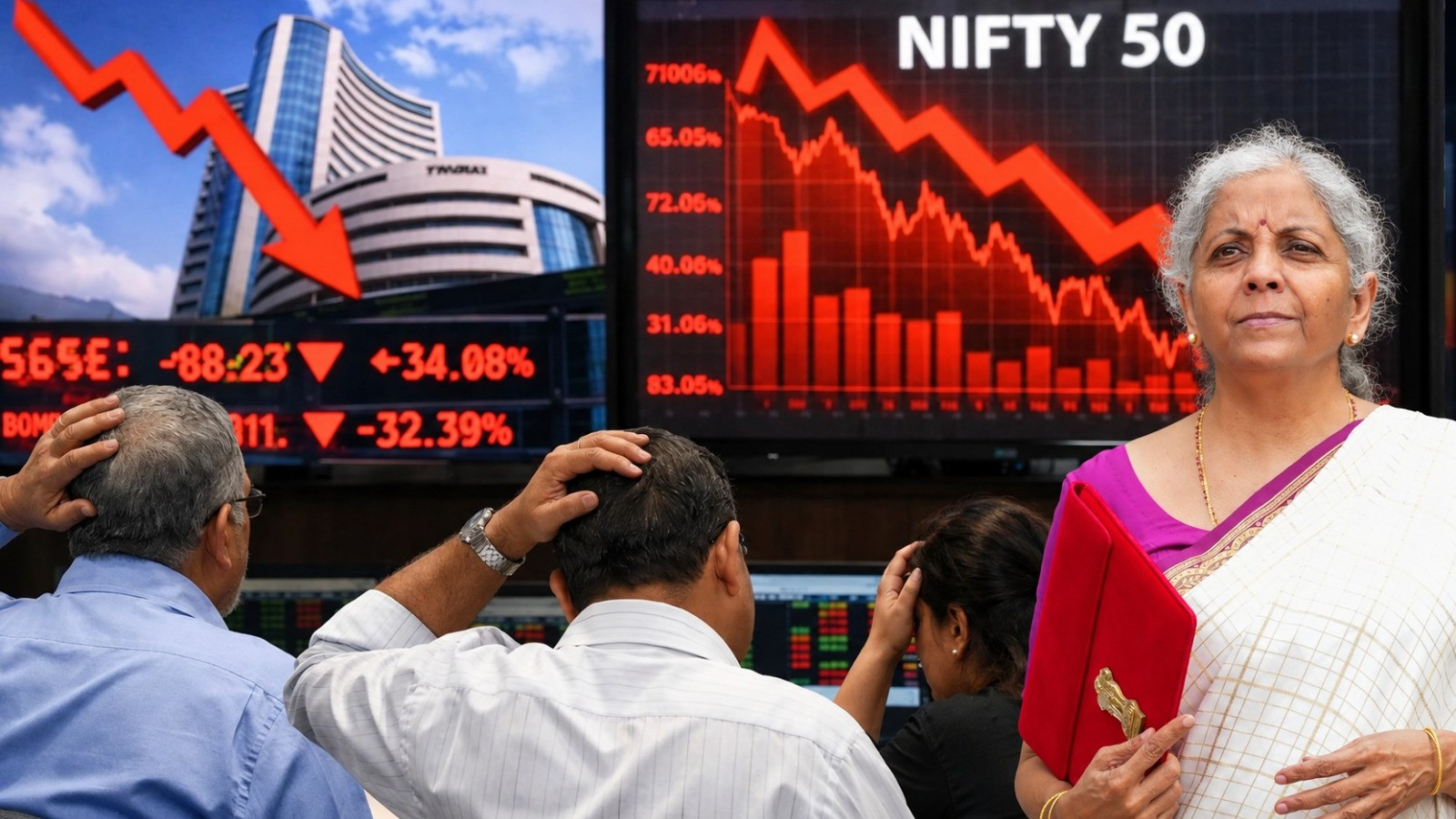
Investors have lost ₹14 lakh crore in just four days.
The Modi government appears to be weakening on every front these days. A nationwide movement against paper leaks has emerged, followed by reports of fraud from within the Election Commission. Now, another concerning news has surfaced. According to a report by Bloomberg, India's foreign exchange reserves have decreased by $14.88 billion. This is the largest weekly decline in nearly two years. The stock market recorded significant declines on both Monday and Tuesday.
According to the figures provided in the report,
the foreign exchange reserves fell to $765.9 billion for the week ending September 18. This is the largest weekly decline since November 2024.
This reduction in foreign exchange reserves comes at a time when the Reserve Bank of India (RBI) is selling dollars to support the rupee. The rupee has been the worst-performing currency in Asia this year. The decline in the rupee had already begun before the war between the U.S. and Israel in Iran; the crisis in West Asia has further increased the pressure on it. Experts have warned that if the crisis in West Asia continues, the rupee could fall below 100 against the U.S. dollar.
Meanwhile, the major indices of the Indian stock market recorded significant declines for the second consecutive trading session on Tuesday. The Nifty 50 opened at 22,732, falling to a low of 22,569 within the first few minutes. At this level, the total decline in the Nifty over the last two sessions has reached approximately 571 points.
According to the business news portal Mint, the condition of the stock market is significantly worse than the previous session. In less than four days, the Sensex has fallen by over 2,700 points. During this period, the market capitalization of companies listed on the BSE has decreased from ₹483 lakh crore to ₹469 lakh crore.
This means that during this period,
investors have lost ₹14 lakh crore. The three main reasons behind this decline are the surge in crude oil prices following the deadlock in talks between the U.S. and Iran, a rise in U.S. bond yields, and continuous withdrawals by foreign investors from the domestic market.
On September 23, the BSE Sensex closed at 74,828. It opened lower on September 24, dropping 1,247 points to close at 73,580. However, on September 25, the Sensex closed up by 315 points at 73,895, but by the close on Monday, September 28, it had already suffered a blow of 1,124 points. The Sensex closed at a multi-month low of 72,771.
On Tuesday, September 29, it fell over 700 points to reach a low of 72,064. However, trading is still ongoing. The all-time high for the Sensex is 86,159, which was achieved in December 2025. Similarly, the Nifty has fallen from 23,446 to 22,569 over the last four sessions. During this period, the Nifty has plunged by 877 points. This year, the Nifty has declined by more than 15 percent.
The main factors behind this market pressure are the rising crude oil prices, high U.S. bond yields, and the selling by foreign investors.
Following the deadlock in talks between the U.S. and Iran, oil prices have surged. On Monday, Brent crude rose nearly 2% to around $106.50 per barrel. Concerns about oil supply increased after U.S. President Donald Trump rejected Iran's proposal to reopen the Strait of Hormuz and end the conflict.
Meanwhile, the most concerning news for the Indian economy is that foreign portfolio investors (FPI) are selling off Indian stocks in September. As of September 25, FPIs had sold approximately ₹25,682 crore worth of equity through the stock market.
According to a report by Money Control, as per the data from the National Stock Exchange (NSE), on Monday, foreign institutional investors (FII) sold shares worth ₹5,353.22 crore in the Indian stock market. This is the largest net selling in a single day in September. Foreign investors withdrew ₹5,353.22 crore from the Indian stock market in one day. This is the largest single-day withdrawal by foreign investors since August 31, when they sold shares worth ₹7,985.88 crore amid index rebalancing.
In Monday's trading, FII bought shares worth ₹9,047.56 crore and sold shares worth ₹14,400.78 crore. On the other hand, DII bought shares worth ₹15,918.32 crore and sold shares worth ₹10,729.30 crore.
In September, the selling by foreign investors has increased. In the 19 trading sessions of this month, they have been net sellers for 14 days and net buyers for only five days. Based on the daily cash market data from the NSE, their total net withdrawal in September has reached approximately ₹23,885 crore. During this period, the net buying by domestic investors has been about 2.4 times the withdrawals by foreign investors. So far this year, FII has recorded a total net selling of ₹3,74,378.55 crore, while DII has recorded a total net buying of ₹6,08,278.85 crore.
According to market experts,
the market is under pressure due to rising bond yields worldwide, high crude oil prices, expectations of weak quarterly results from companies, weakness in the rupee, and the likelihood of interest rates remaining high for an extended period.
Bond yields are rising not only in the U.S. but globally. The yield on the U.S. 10-year bond has crossed 5 percent, the highest level since 2007. The yield on Japan's 10-year bond is at its highest since 1996, and France's yield is at its highest since 2008. Due to better returns, investors are pulling money out of stocks and other assets and investing in bonds.
Meanwhile, the rise in crude oil prices following the U.S.-Iran conflict has raised concerns about inflation again. India imports about 85 percent of its domestic oil needs. Therefore, expensive crude oil could put pressure on economic growth and increase the fiscal deficit due to rising inflation.