
Supreme Court questions legal basis of UPI charges

Justice Bagchi inquired whether it is a tax or a fee, and if it's not a fee, what is the executive's basis for collecting it?
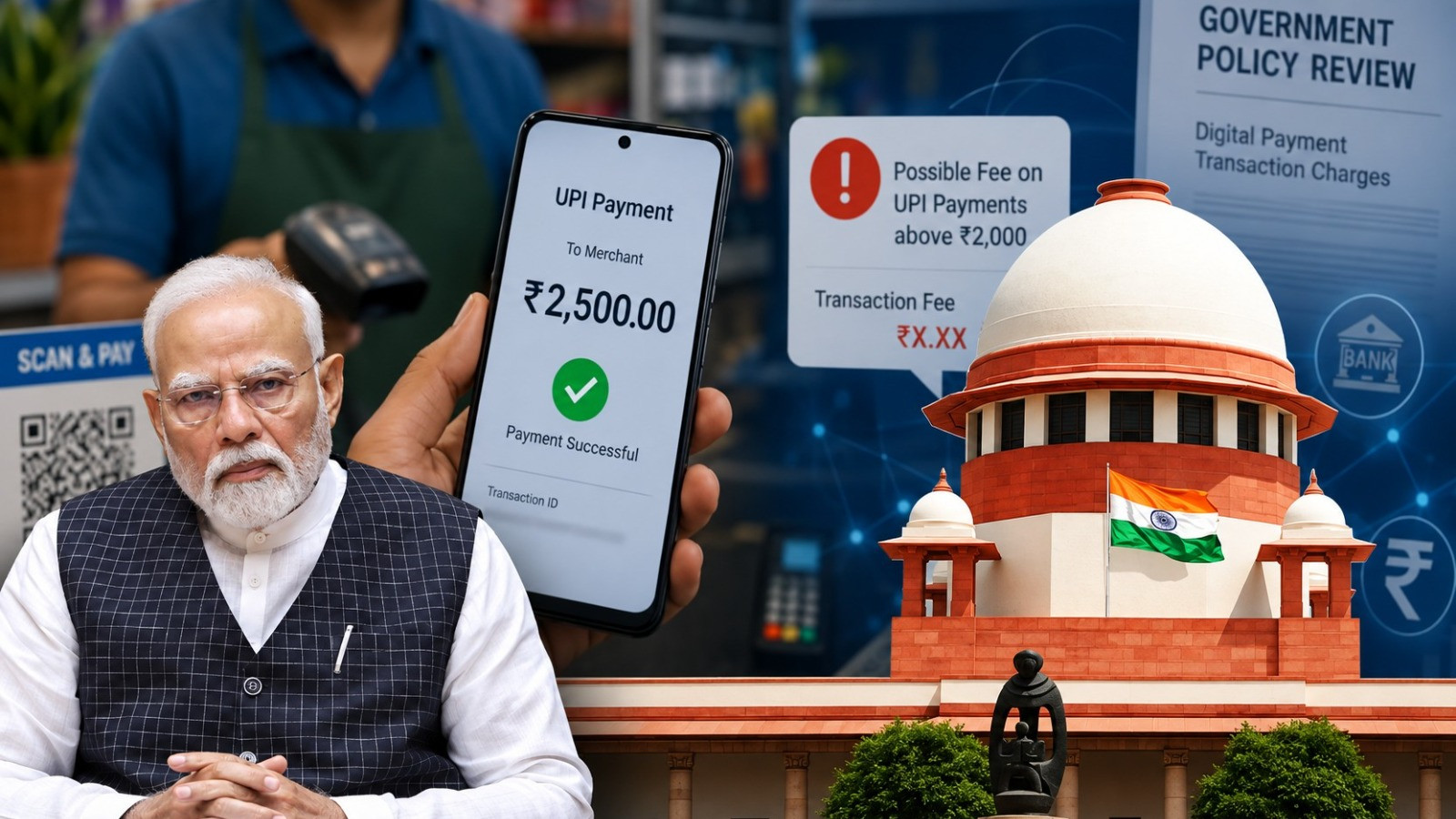
The Supreme Court on Monday asked the central government to file an affidavit explaining the basis for imposing charges on individuals making payments over ₹2,000 to merchants via UPI.
Live Law reported that a bench comprising Chief Justice of India D.Y. Chandrachud, Justice Joymalya Bagchi, and Justice V. Mohan was hearing a petition by advocate Anjan Dutta. The petition challenges the notifications issued by the Ministry of Finance on September 14 and 15, which announced charges on commercial UPI transactions exceeding ₹2,000.
At the outset of the hearing, Additional Solicitor General N. Venkataraman stated that the charges would come into effect from October 15. According to him, 96 percent of transactions would not be affected, and the charges for essential services would be capped at ₹5. He said, “This is neither a tax nor a fee.”
In response, the Chief Justice remarked,
“We need these facts in the affidavit. This is a more technical issue.”
Justice Bagchi asked,
“Is this a tax or a fee? If it is not a fee, what is the basis for the executive to collect this amount? What service is being provided?”
The Additional Solicitor General replied that,
“This cannot be termed as government recovery, as not a single rupee of this charge is being taken by the Government of India. According to him, this is a settlement charge between payment aggregators and banks. He explained that banks incur costs in completing electronic transactions. Charges apply to credit and debit card transactions, while UPI payments were exempted from this. He stated that charges are necessary to keep the payment system running smoothly.”
Justice Bagchi then referred to Section 269SU of the Income Tax Act. This section mandates merchants with a specified turnover limit to provide customers with the facility of electronic payments. He inquired who receives the charges on UPI transactions and what the legal basis for imposing them is. He clarified that the court's question pertains not to the scope of the charges but to their legal nature.
The bench issued notices to the central government, Reserve Bank of India (RBI), and National Payments Corporation of India (NPCI). The petitioner's lawyer argued for a stay on the decision, stating that it could lead to an increase in transactions related to black money. However, the bench declined to grant a stay for now. The petition has made the central government, RBI, NPCI, and the UPI and Services Steering Committee parties to the case.
The petitioner argues that,
“The charges on commercial UPI transactions could have a widespread impact, as merchants may pass on the additional costs to customers.”
The central government has proposed a framework allowing the imposition of a Merchant Discount Rate (MDR) on certain higher-value commercial UPI transactions. Under this framework, payments between individuals and those related to small merchants remain free. This move follows amendments to the Payment and Settlement Systems Act, 2007, and notifications issued by the Ministry of Finance in September 2026.
The notification issued by the Ministry of Finance on September 14, under Section 10A of the Act, specifies RuPay debit card payments and UPI transactions up to ₹2,000 as electronic payment methods on which banks and payment system providers cannot charge direct or indirect fees from the payer or payee. This notification protects transactions up to a certain limit from charges; it does not impose charges on every UPI payment.
The government later clarified that UPI transactions between individuals, i.e., P2P payments, regardless of the amount, will remain free. Payments to merchants up to ₹2,000 and transactions falling under the zero MDR provision for small merchants will also remain free. The MDR is the fee associated with processing payments made to merchants. It is collected within the payment system and distributed among partner entities such as banks and payment service providers. It is not a tax collected by the government or NPCI.
Under the announced arrangement,
some person-to-merchant, i.e., P2M, UPI transactions over ₹2,000 will incur MDR at a standard rate of 0.4 percent. For transactions of ₹75,000 or more, the charge will be capped at ₹300. A fixed MDR of ₹5 will apply to transactions over ₹2,000 in essential and low-margin sectors such as railways, telecommunications, insurance, fuel, and agriculture. The rate for transactions related to the capital market will be 0.02 percent, with a maximum cap of ₹300.
According to the government, approximately 96 percent of merchant transactions will remain unaffected by this change. These are either below ₹2,000 or fall under the zero MDR provisions for small merchants. For small merchants receiving up to ₹1 lakh per month via UPI QR code under the P2PM category, the MDR will also remain zero.