
BRICS leaders endorse New Delhi declaration, oppose unilateral military actions

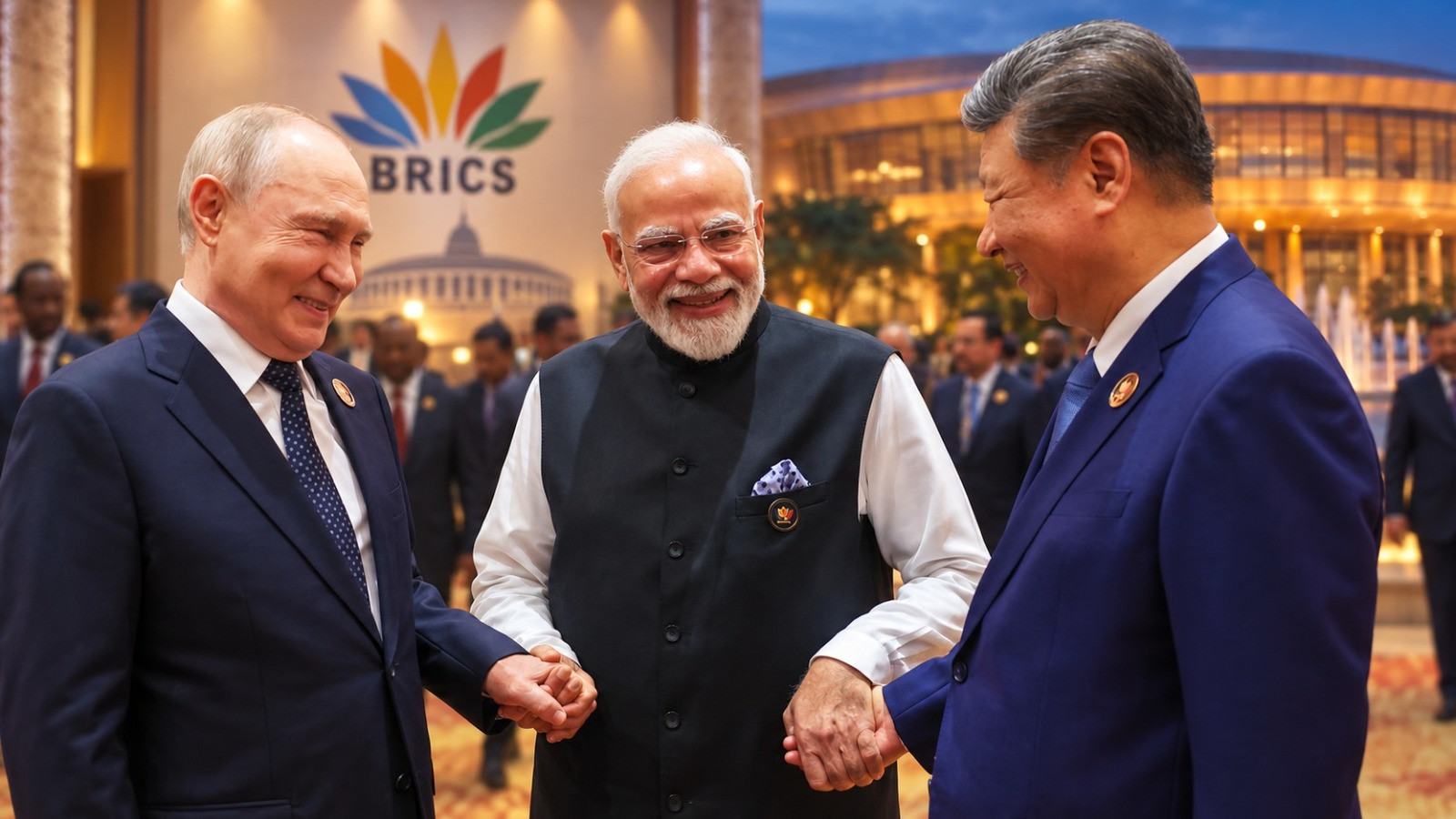
All member countries condemned unilateral military actions amid ongoing conflict in West Asia.
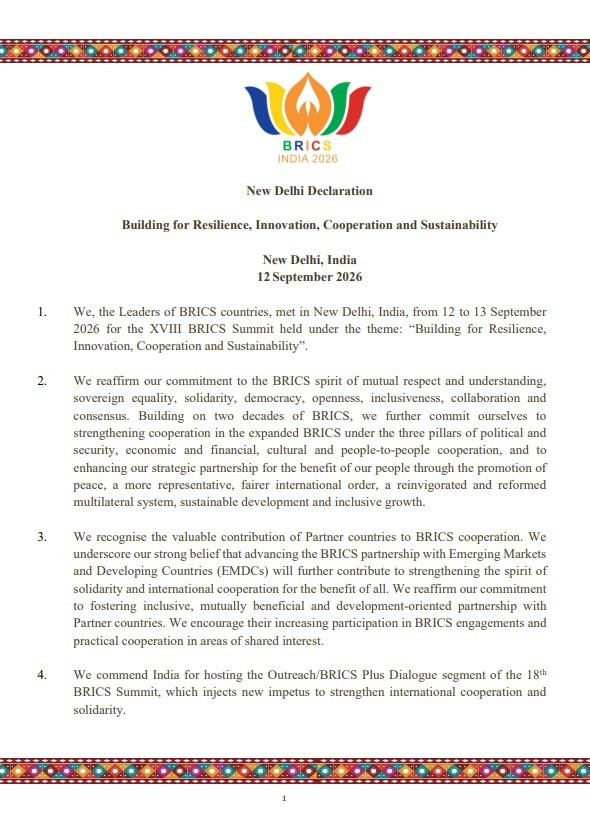
During the BRICS Summit held in New Delhi, the leaders of the member countries unanimously adopted the 'New Delhi Declaration' on Saturday. Prime Minister Narendra Modi announced the adoption of this joint document during the conference held at Bharat Mandapam.
The declaration emphasizes comprehensive reforms in major multilateral institutions, including the United Nations Security Council, strong action against terrorism, and the peaceful resolution of international disputes.
The declaration states,
“Comprehensive structural reforms in multilateral institutions, including the United Nations Security Council (UNSC), are demanded. It condemns terrorism and opposes unilateral military actions amidst ongoing military conflicts in West Asia. It also emphasizes ensuring the safety of maritime passengers and commercial vessels.”
The New Delhi Declaration states that given the current global circumstances, changes in the structure of multilateral institutions have become necessary. BRICS countries have called for increasing the participation of developing countries and the 'Global South' in global institutions, citing the need for 'structural changes' in the United Nations Security Council.
The declaration condemns all forms and manifestations of terrorism in strong terms. Member countries emphasized that double standards should not be adopted in combating terrorism and that the international community should work together against this challenge. The two permanent members of the United Nations Security Council present at the conference—China and Russia—reiterated their support for India and Brazil's aspirations to play a significant role in the United Nations and the Security Council.
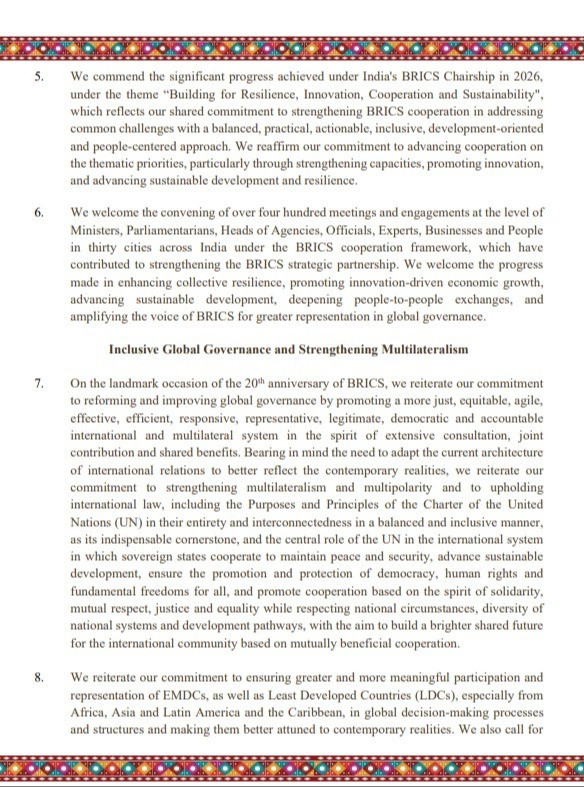
The declaration states that,
“Trade between BRICS countries should be increased in local currencies instead of the US dollar. Additionally, there is a demand for greater representation of developing countries from Africa, Asia, Latin America, and the Caribbean in the United Nations Security Council.”
The New Delhi Declaration reaffirms BRICS' commitment to a more representative, just, and inclusive global order. The group emphasized strong multilateralism and greater participation of emerging and developing economies in global decision-making. BRICS supported reforms in the United Nations and its Security Council, stating that developing countries should have a more effective voice in international institutions. China and Russia reiterated their support for India and Brazil's aspirations to play a significant role in the United Nations and the Security Council.
On global conflicts, BRICS expressed deep concern over rising tensions in West Asia. The group called on all parties to exercise maximum restraint, protect civilians and civilian infrastructure, and adopt dialogue and diplomacy for lasting peace. The declaration also emphasized maintaining the uninterrupted availability of global trade, supply chains, and energy.
On the Gaza issue, BRICS demanded adherence to the ceasefire, ensuring unhindered access to humanitarian assistance, and preventing the forced displacement of people. The group also reiterated its support for the two-state solution and full membership for Palestine in the United Nations.
The declaration condemned all forms of terrorism. BRICS specifically condemned the terrorist attack in Pahalgam on April 22, 2025, which resulted in the deaths of 26 people. The group called for strict action against cross-border terrorism, terrorist financing, and safe havens for terrorists. It also demanded accountability for those involved in terrorist activities and their supporting networks.
On the economic front, BRICS reiterated its commitment to deepening cooperation among member countries. The group stated that it would work towards enhancing coordination between various payment and messaging systems for cross-border payments and increasing the use of local currencies in trade payments and investments.
BRICS supported efforts to make cross-border payments faster, cheaper, more accessible, transparent, and secure. It also agreed to advance the 'BRICS Economic Partnership 2030'.
BRICS nations demanded equal and balanced geographical representation in the United Nations Secretariat and other international organizations. The group stated that developing countries have consistently received less representation, especially in senior and decision-making positions.
The declaration called for greater participation of women in leadership positions, particularly women from emerging markets and developing countries. BRICS stated that appointments of executive heads and senior officials of the United Nations should be based on transparency, inclusiveness, and broad geographical representation, in accordance with Article 101 of the UN Charter.
Prime Minister Narendra Modi stated that the Global South must now become not just a rule follower but a 'rule maker' to address various global challenges.
In the inaugural session of the summit, Prime Minister Modi said that BRICS has carved out a distinct identity on the global stage and that this group is not against anyone. His statement is being viewed as a message to the US and other Western powers.
Prime Minister Modi said,
“Today, the Global South stands at the forefront of global crises but is at the back of the decision-making process. We must transform the 'pyramid of privileges' into a 'platform of partnership'—where every country's voice is heard, every member has a stake, and the development of humanity is at the center of every effort. In this direction, my proposal is that we jointly prepare 10 proposals for reforming global governance and shape them into a BRICS reform roadmap by the next summit.”