Ganesh Shankar Vidyarthi: The warrior of the pen remembered
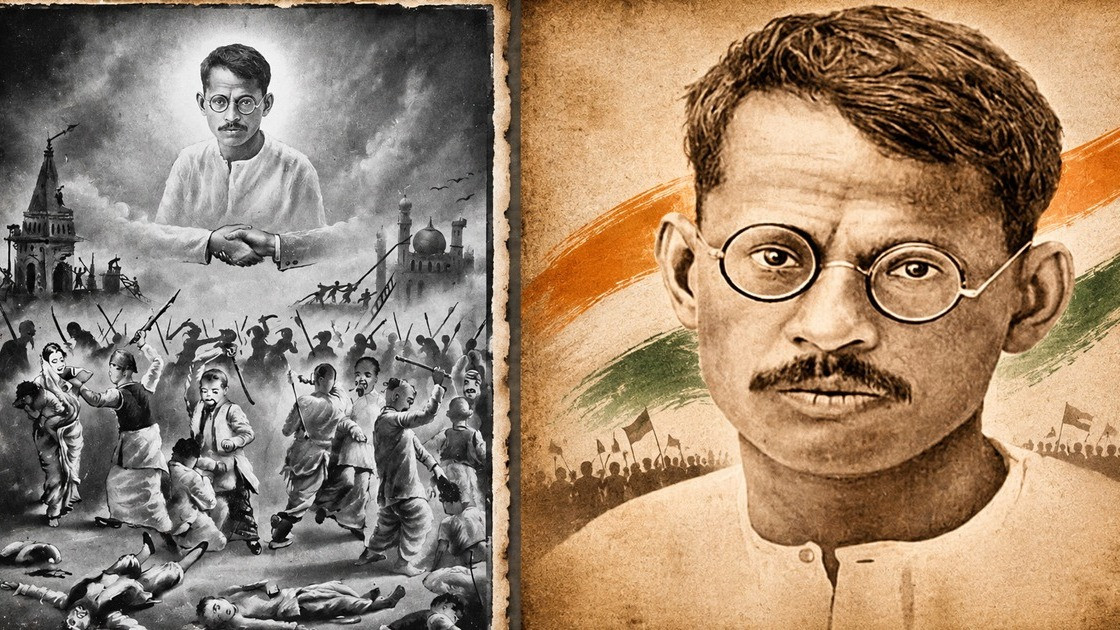
In 1931, Ganesh Shankar Vidyarthi bravely ventured out to stop riots in Kanpur, only to be killed by brutal rioters.
Today is the birth anniversary of Ganesh Shankar Vidyarthi. Ganesh Shankar Vidyarthi was a fearless journalist standing for the truth. In the 1920s, when horrific riots broke out across the country, especially in northern India, due to the British policy of promoting communalism, Vidyarthi, a disciple of Gandhi, wrote against them. However, when the fire reached close, mere writing was not enough.
Martyrdom
In 1931, communal frenzy in Kanpur escalated to the point where violent actions began from both sides. Addressing the Karachi Congress, Mahatma Gandhi said –
“I am quite sure that if the spirit of Bhagat Singh is watching what is happening in Cawnpore today, he would feel deeply humiliated and ashamed.”
To stop the riots, Ganesh Shankar Vidyarthi set out alone. The barbaric rioters killed him as well. Even in that madness, the crowd did not recognize their own savior, and this unparalleled priest of non-violence became a martyr on March 26, 1931. His body was never found amidst the chaos.
Upon receiving the information, Mahatma Gandhi, while speaking at the Karachi Congress, said–
“It is a matter of fortune that Ganesh Shankar Vidyarthi, who was completely free from any communal prejudice, who was an institution in himself and one of the foremost workers of this country, sacrificed himself to establish peace. His great example should be an inspiration for all of us. We should learn a lesson from this shameful incident in Kanpur.”
Days later, the body found was mutilated. On March 29, the public paid tribute. The riots may have stopped, but this banner of communal unity became a martyr.
An Exemplary Life
Born on October 26, 1890, in a middle-class family in Allahabad, Ganesh Shankar Vidyarthi received his early education in Madhya Pradesh and decided to pursue journalism in Kanpur in 1913. Before publishing ‘Pratap’ and ‘Prabha’, he had also translated two novels by Victor Hugo.
Along with journalism, he was also involved in farmer-laborer movements and was a member of the ‘Kisan Sabha’ in Kanpur. Communal unity was paramount in his concerns, and he remained actively engaged in promoting Hindu-Muslim unity. He had an active association with the Congress and served as a member of the United Provinces Legislative Assembly between 1925-29. He was also elected president of the provincial Congress and was made the first 'dictator' of Uttar Pradesh (then United Provinces) to lead it during the Non-Cooperation Movement.
Pratap: A College of Journalism and Patriotism
The significance of ‘Pratap’ can be gauged from the fact that during his stay in Kanpur, Bhagat Singh used to write articles under the name Balwant Singh in ‘Pratap’. Vidyarthi had also helped Ashfaqulla Khan, who was on the run after the Kakori Conspiracy, and published the biography of Ram Prasad Bismil. He visited Bhagat Singh, Batukeshwar Dutt, and other revolutionaries during their hunger strike in jail.
In his twenty years of journalism and political life, he had to go to jail five times, sometimes for writing against British authority and sometimes for political activities.
Vidyarthi stood firmly against communal organizations like the Hindu Mahasabha, RSS, and Muslim League, and against British authority, presenting a challenge to today’s power-serving and communal media.
A Shameful Postscript
His education was from Mungawali in Madhya Pradesh. The attendance register of the primary school he attended is still preserved, which records his name. There is also a government Ganesh Shankar Vidyarthi College named after him there.
Long before, there was a proposal to install his statue at a prominent intersection there. The statue was made. However, due to controversies, it remained in the storeroom for years. Writers, journalists, and intellectuals from there and nearby areas continuously worked to establish it. Ultimately, the statue was installed, but the administration's attitude towards it is still not very favorable.