
Can Kharge, Sonia and alliance leaders persuade Pawar and Stalin?

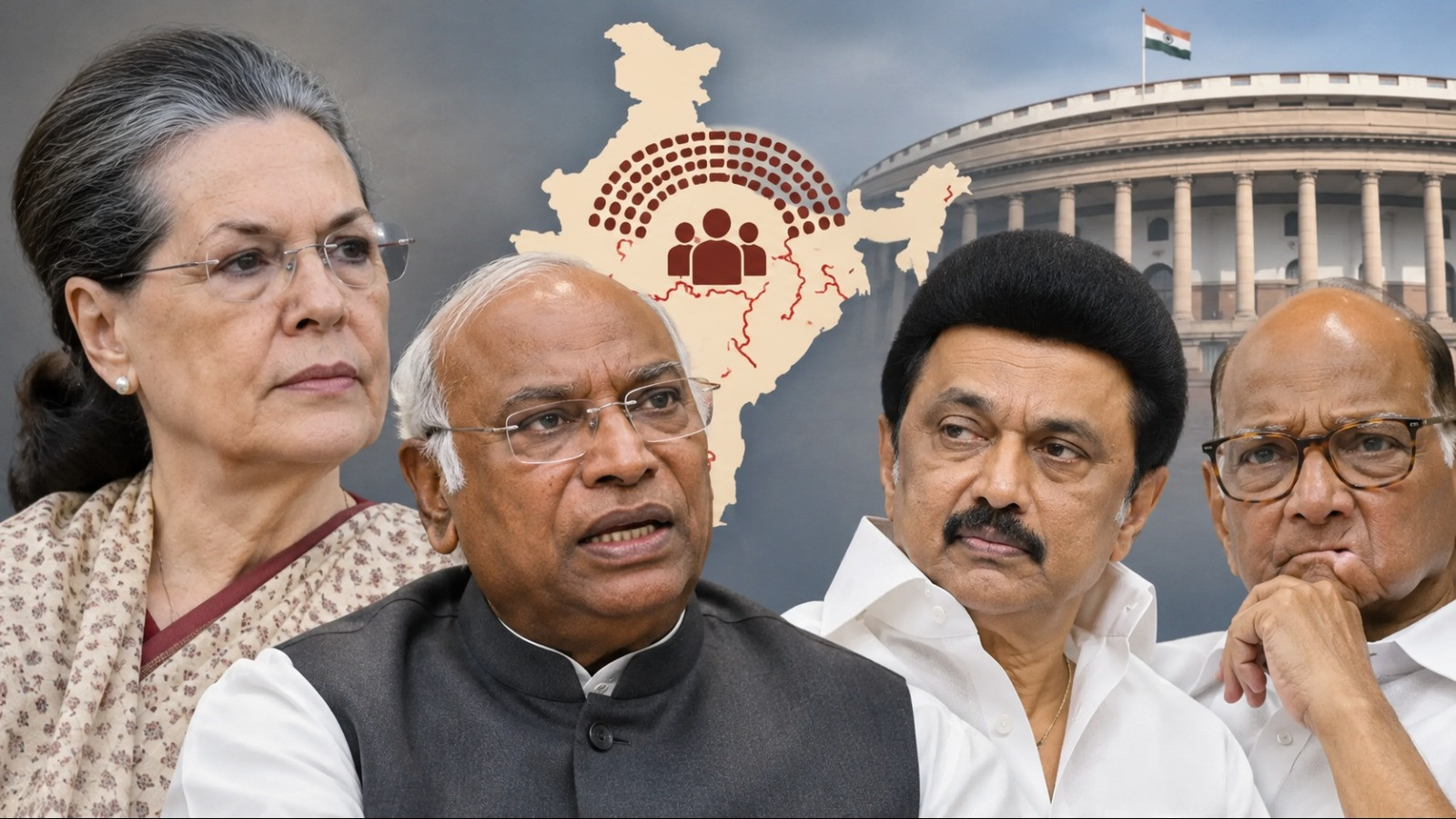
Efforts to unite Opposition parties on the issue of delimitation have gathered pace. Congress president Mallikarjun Kharge will meet DMK president and Tamil Nadu Chief Minister M.K. Stalin in Chennai today. The political initiative aims to develop a common position among Opposition parties on delimitation and bring regional parties together on one platform. Senior Congress leader Sonia Gandhi and Kharge have left for Chennai. Efforts are also being made to bring Sharad Pawar on board.
The question of delimitation is not limited to redrawing the boundaries of constituencies. It also involves issues such as the representation of States in Parliament and Assemblies, political influence and the federal balance. This is why the subject has become an important political question for Opposition parties. The Congress is seeking to give the concerns of parties in different States a common political direction on this issue.
Kharge’s proposed meeting with Stalin is being seen as an important step towards Opposition coordination. The DMK is the leading political force in Tamil Nadu and has maintained a clear position on issues concerning the State’s interests. The Congress leadership will seek to understand the DMK’s concerns and suggestions on delimitation and build consensus among Opposition parties.
Efforts to bring Sharad Pawar on board are also important to this initiative. Pawar’s political experience and influence in Maharashtra could give the Opposition coordination exercise a broader base. However, it is not yet clear what kind of formal meeting or joint announcement all Opposition parties will make on the issue. For now, the Congress leadership is seeking to step up dialogue with regional parties and strengthen their support.
It is learnt that several leaders and MPs from Stalin’s party and Pawar’s party are unhappy with this move. They are also under considerable pressure.
Delimitation means redrawing the boundaries of constituencies. It could affect which constituencies voters in different regions and States are included in, and the structure of representation in Parliament or Assemblies. This is why any process related to delimitation has wide-ranging political significance.
Opposition parties’ concerns centre on how the proposed arrangement will ensure a balance of representation among States. Some parties, particularly in southern India, have viewed the issue through the lens of population, representation and federal balance. They are concerned that the political voice of States should not be weakened under any new arrangement.
Opposition unity on this issue would mean more than simply criticising the government. It would also have to make clear the principles on which it wants the delimitation process to be based, how States’ concerns should be addressed and how consensus can be built among all parties. If the Opposition settles on a common position, it will be able to present its case in a more organised manner in Parliament and in public debate. Yesterday, Rahul Gandhi’s press conference focused on the question of representation for minorities and Dalits.
For the Congress, this initiative is important at both the organisational and political levels. The party wants to strengthen coordination among Opposition parties at the national level, but regional parties have their own political bases and priorities. The Congress will therefore have to take the initiative while giving equal importance to the concerns of its allies.
The meeting with Stalin is part of this dialogue. The DMK and the Congress have their own context of political cooperation, but the support of other regional parties will also be necessary to build wider consensus on issues such as delimitation. The effort to bring Sharad Pawar on board is significant in this regard, so that Opposition unity is not confined to one State or one alliance.
The Congress leadership will also have to decide how to take the dialogue forward. It is not yet clear whether there will be meetings with individual parties, a joint statement or a joint political initiative on delimitation. But Kharge and Sonia Gandhi’s visit to Chennai indicates that the party wants to advance discussions on the issue.
The biggest challenge for Opposition parties will be to turn their differing concerns about delimitation into a clear, common demand. Merely registering opposition may limit the political message. By contrast, if the parties can agree on common principles on representation, federal balance and the participation of States, their position could be more effective.
It would be premature to expect a final agreement or joint announcement from today’s meeting. Even so, it could signal the direction of Opposition dialogue and its next steps. The positions of the DMK and Sharad Pawar will influence how broad the Congress initiative can become.
Delimitation could become an important part of the national political debate in the coming period. The Congress is seeking to ensure that the Opposition does not appear divided on the subject. Kharge’s visit to Chennai and efforts to reach out to regional leaders are part of this strategy. It remains to be seen whether this dialogue can bring Opposition parties to a common political platform and a clear position.