
SC panel to investigate use of pellet guns against protesting students

The court has directed Delhi Police to provide necessary security to the girl and her family.
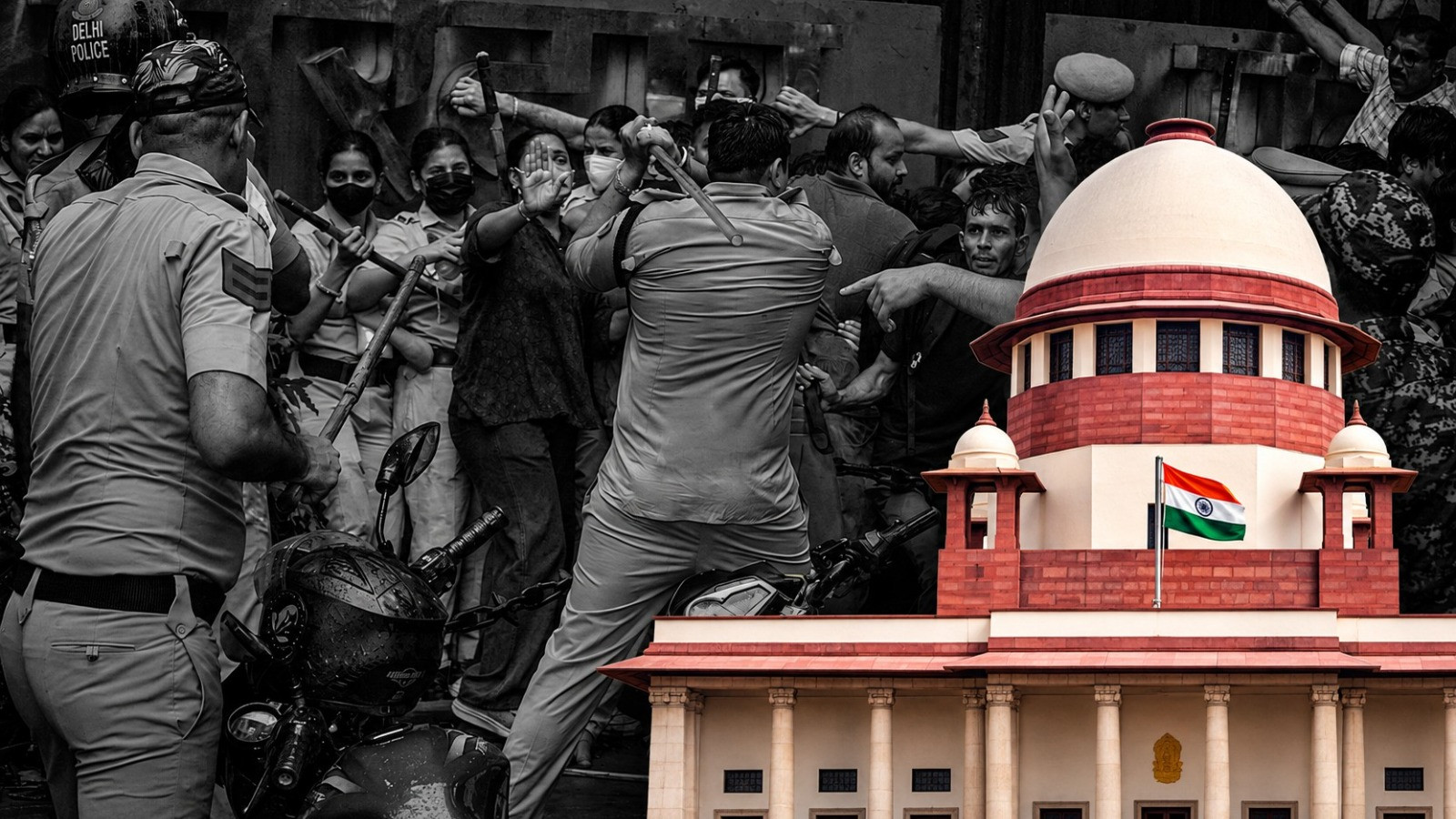
The Supreme Court has directed its five-member High-Powered Enquiry Committee (HPEC) to investigate serious allegations related to the protests at Jantar Mantar on July 20 on a priority basis. According to a report by Live Law, the bench comprising Chief Justice Suryakant, Justice Joymalya Bagchi, and Justice V. Mohan has instructed the committee to first investigate these four issues in a detailed order issued after the hearing on September 10:
- Investigation into the use of pellet guns on protesters
- Allegations of violence and harassment targeting female protesters
- Injuries sustained by police personnel during the protests
- Investigation into excessive violence and property damage by both sides
The Supreme Court has instructed the inquiry committee that,
it should ensure the safety and confidentiality of sensitive and vulnerable witnesses. Their identities will not be disclosed if necessary. The court also suggested that a separate online portal could be created for collecting evidence and documents from witnesses and others.
The court clarified that,
the inquiry committee will provide recommendations only by investigating the facts related to the events. The Supreme Court will decide on major constitutional questions related to law and order itself. This includes the issue of using facial recognition technology by police and investigative agencies.
The court has directed the Delhi Police to assess the threats to the 14-year-old girl involved in the protest and her family. Additionally, the court has instructed the Delhi Police to provide necessary security to the girl and her family. The petition alleges that the girl and her family received death threats and faced harassment, but the Delhi Police did not take action against the accused.
The court has ordered the Delhi Police to quickly investigate the allegations of threats and harassment and file a status report before the next hearing. According to a report by Live Law, some petitioners had sought the reconstitution of the five-member inquiry committee, but the Supreme Court rejected this. The court expressed displeasure over the apprehensions and biases shown towards the committee even before its investigation began. The bench stated that,
the committee has been formed to assist the court with fairness, transparency, and without any bias. The committee is not constituted to support one side.
It is noteworthy that during the hearing on September 10, advocate Prashant Bhushan raised questions about the committee with the support of senior advocates Gopal Shankaranarayanan and Dr. A.M. Singhvi.
Advocate Prashant Bhushan stated,
specifically objecting to one member of the committee—a retired Director General of Police (DGP) from a northeastern state—claiming that he is close to a senior official of the central government. However, on the same day, the court clarified that it would not consider such arguments.
The applicants also demanded that a former Chief Justice be appointed as the head of the committee in place of former Supreme Court Justice Subhash Reddy. In the order uploaded on Tuesday, the court clearly rejected the allegations against the committee as being based on “conjectures and prejudiced assumptions.”
The court stated,
after reviewing the material of the application, we are compelled to comment with some concern that there has been undue haste and premature suspicion expressed regarding the High-Powered Enquiry Committee (HPEC).
Denying changes to the committee's structure, the bench stated that,
the HPEC has been constituted to assist the court with the highest standards of fairness, transparency, and neutrality. The court clarified, “The HPEC has not been constituted to advocate for the interests of one side or the other.
The court also issued several directives to facilitate the functioning and evidence collection process of the HPEC. The committee has been instructed to provide security to sensitive and vulnerable witnesses, keep their identities confidential, and maintain utmost confidentiality regarding their statements and evidence. The committee has also been permitted to create a separate online portal for witnesses and other concerned parties to submit documents and evidence.
The court clarified that the nodal lawyers appointed under its previous order will primarily assist in court proceedings related to administrative matters. They will not act as a medium for communication between the HPEC, the court, and various parties. The Supreme Court registry has been directed to provide the nodal lawyers with paper books and other necessary materials related to the case.