
It's essential to save rivers, not just worship them

While rivers are revered as mothers in India, they are among the most polluted.
In 2015, Holly Jean Buck spoke about the concept of Charming Anthropocene. Amid various environmental changes, there has been a persistent concern about how we can improve our environment. This concept attempts to apply political thinker Jane Bennett's theory of Enchantment to environmental discourse.
In very simplified terms, Buck believes that if we fall in love with the enchantment of our surrounding environment, we will form a connection with it and be more concerned about the ecology around us, motivating us to protect and improve it.
This sounds very good in theory, but in India, we have been doing this for a long time; considering rivers as mothers and the inclusion of trees in our rituals and customs is part of our social routine. Despite all this, our rivers are among the most polluted in the world, and even though we contribute 18 percent to the world's population, our contribution to drinkable water is only 4 percent.
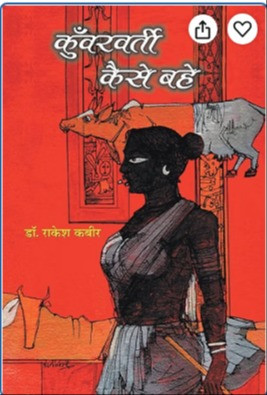
How often do we concern ourselves with our ecology in our daily lives? Is there ever a time when saving a river becomes as significant and necessary as saving a family member's life? Rakesh Kabir's poetic concern is precisely this: “How do the Kunwarvarti flow?” In Rakesh's poetry, climate change and its adverse effects do not come as mere news that can be set aside after a day. These changes and their consequences are the core threads of Rakesh's poetry. Even when he speaks romantically, there is a river in the background that is changing or has changed because we humans have altered it.
The rivers are so
agitated this year that
who knows what will happen
to the reckless lover
of the sea.
In this collection of poems, there is the Chambal, which is flaunting the redness of the setting sun, there are storms, clouds, floods, and amidst all this, the poet is searching for the thread that binds them all together. In the course of development, villages have turned into cities or have become half-settled islands on the outskirts of cities. In this cycle of development, those living in villages have become the fuel for the machine that runs the city; the city has grown larger, but who cares about the water that is asking where it should go?
The village pond, poor thing,
gets surrounded by the city on all sides.
First, the river dies,
then the pond also dies.
The suggestion Buck is talking about is one that Rakesh's poetic self agrees with, yet uses it as a critical measure of societal scrutiny. Why do we need rivers and ponds? Is it because they are members of our family, we depend on them as they are an essential part of our ecology, or do we want to leave them as accumulated capital for our future generations? Rakesh's poetic mind wants to say all this, but when he looks around, the anger within him transforms into a deep satire, as there is no other way to express this reality that we all have turned a blind eye to.
We also need drains
to let the dirty water flow into the river.
We are civilized people.
We need to let our filth flow.
We need rivers, drains, ponds, and rivers.
Don’t teach us ‘to care for water’.
In this collection, the poet speaks from various locations because his words are infused with our concern for water and trees, and to make us look towards that, he calls us from different tones and places. On one hand, there is the concern of the citizen of water that his republic is being destroyed, and on the other, he reports the frogs that no longer come to sing in the rainy season; they have sunk somewhere in the underworld. The poet not only identifies these changes but also questions the politics of our time, whose job was to save trees and water and keep them healthy, but who merely leaves after giving speeches during floods. What if rivers could speak to us? What would they say to us? Would they scold us for our actions, or would they tell us they also have the right to live, or like some ancient relative of our home, one day they would sadly leave for somewhere else?
At the confluence of the Ganga and Yamuna.....
all the rivers held a great gathering
and proposed that
we should return to our homes
and leave all the land
for the sake of ‘solid development’.
.......
This proposal was passed unanimously,
and one day all the rivers
sadly turned back.
There are countless stories behind the myths of rivers; will we ever know whose life’s truth is shimmering behind the transformation of rivers into myths? Just as the poet Vidrohi talks about recording the statements of women who have been killed, Rakesh is asking in an important poem from his collection,
I don’t know who she might have been,
that unmarried girl
who was turned into a goddess
by crafting a unique story.
When we begin to maintain that intimate connection with rivers, they become like grandmothers to us, from whom we ask how they got their names. What layers of reality lie behind that name, which has transformed the unmarried girl buried in the pond into the myth of the Kunwarvarti? As we traverse through the collection, I find myself wanting to hug the tree outside my house tightly; the tree is silently smiling, and I am murmuring Rakesh's question like a vow -
When a river turns into a seasonal drain,
the sacrifice of the Kunwarvarti becomes meaningless.
Keep reading the mantras,
keep worshipping.
Dead rivers, self-destructive Kunwarvarti
do not get revived.
----------------------

Rakesh Kabir, Gyan Ganga Prakashan 2019
Vivek Kumar Shukla
लेखक हिन्दी साहित्य के अध्येता हैं, एक उपन्यास प्रकाशित। फ़िलहाल डेनमार्क की ओर्हुस यूनिवर्सिटी में पढ़ाते हैं।