
Election Commission issues notice to Bharat Ratna scientist CNR Rao

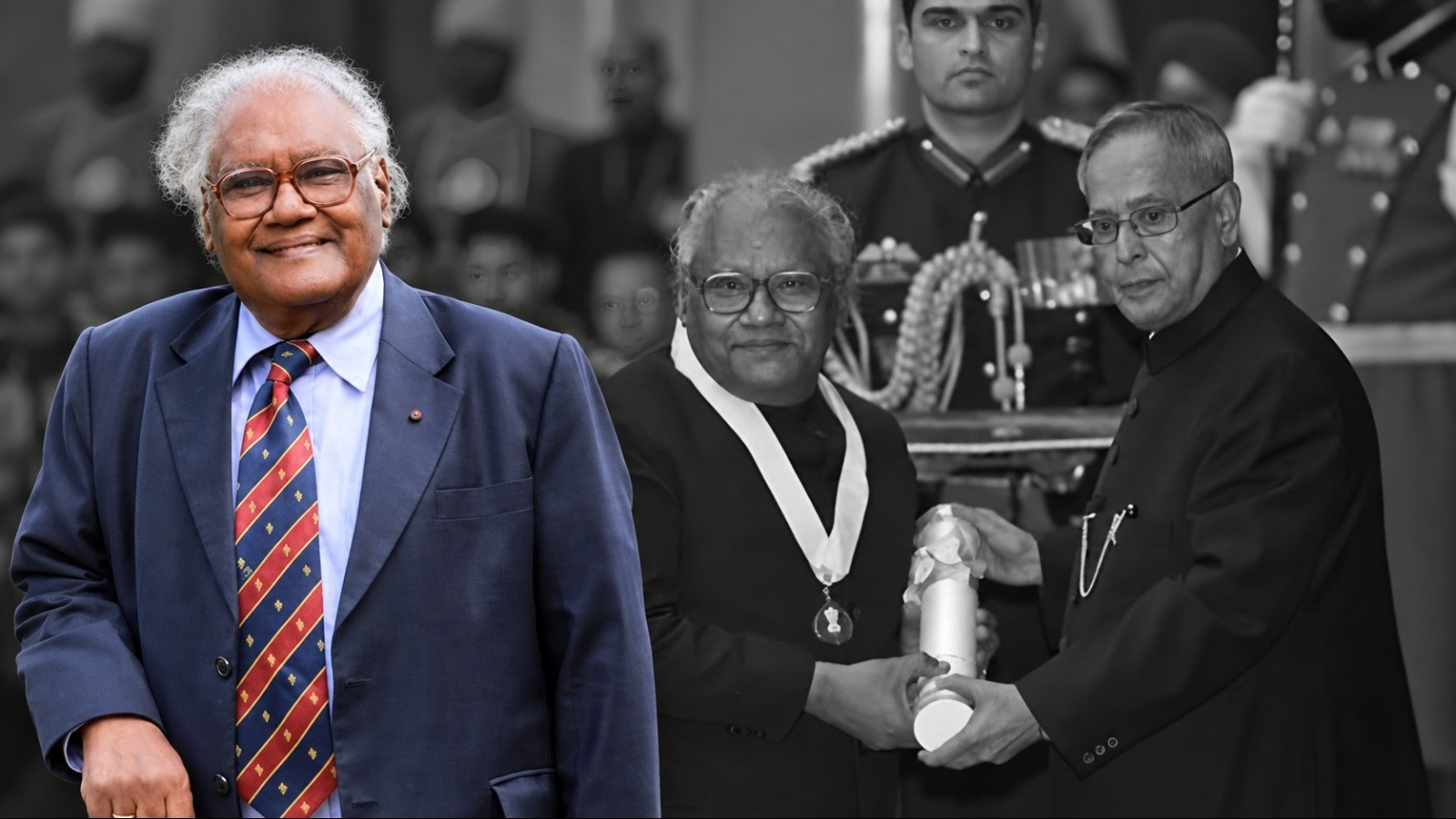
The issuance of a notice to 92-year-old Bharat Ratna awardee Professor CNR Rao has sparked controversy.
A controversy has arisen after a notice was issued to 92-year-old renowned scientist Professor C.N.R. Rao, who has been honored with the Bharat Ratna, under the Special Intensive Revision (SIR). Following criticism, officials from the Election Commission of India (ECI) have decided to verify the matter by visiting his residence in Bengaluru.
According to a report by The Hindu, an official from the election commission, speaking on the condition of anonymity, stated that,
Rao is not required to appear in person at the designated center. The officials will visit his home for the necessary verification. The notice cites ‘discrepancy in his own name’ as the reason. His name was recorded as ‘Prof. C.N.R. Rao’ in the previous voter list, while the current record shows ‘Proff. C.N.R. Rao’. This means that an extra ‘F’ has been mistakenly added to the word ‘Prof’.
In 2014, C.N.R. Rao was honored with the country’s highest civilian award, the Bharat Ratna, and was summoned to appear at the SIR hearing center located near the Indian Institute of Science in Malleshwaram.
Professor C.N.R. Rao was awarded the ‘Bharat Ratna’ in 2014 for his contributions to solid-state and materials chemistry.
The Congress party raised questions on Wednesday, stating that,
“If a person honored with the Bharat Ratna can be issued a notice so carelessly, what must be happening to the common elderly voters in Karnataka who do not have any major institution supporting them?”
Inayat Ali, General Secretary of the Karnataka Congress unit, said,
“Such errors could quietly remove the names of thousands of genuine voters from the voter list without anyone noticing.”
Karnataka is among the 19 states and union territories where the third phase of the Special Intensive Revision, or SIR, is currently underway.
In another case, this week the election commission withdrew a notice issued to Padma Shri awardee Harekla Hajabba due to a name discrepancy. He was asked to appear at the gram panchayat office with original documents on September 11. After the notice became public, officials visited Hajabba's home and withdrew it. They informed him that further information would be provided after investigating the matter.
In the 2002 voter list, his name was recorded simply as ‘Hajabba’, while all subsequent documents list his name as ‘Harekala Hajabba’. This full name is also recorded on his Aadhaar card, ration card, passport, and voter ID, as well as on documents related to the Padma Shri and other awards. Harekla Hajabba, a resident of New Padapu in Mangaluru, used to sell fruits. He established a primary school in his village with the earnings he saved from selling oranges. He was awarded the Padma Shri in 2020 for his contributions to education.
During the SIR campaign that began on June 30 in Karnataka, around 43.81 lakh notices are expected to be issued to voters falling under the categories of ‘no mapping’ and ‘discrepancies’. The process for addressing claims and objections will continue until October 22, while the final voter list will be published on October 27.
The election commission announced the third phase of SIR in May for 16 states and three union territories. After its completion, the entire country, except for Himachal Pradesh, Jammu and Kashmir, and Ladakh, will fall under this process. Approximately four lakh booth-level officials have been tasked with verifying 36.73 crore voters door-to-door. Draft voter lists in various states are to be published between July 5 and October 21.
In the first two phases of SIR, nearly 59 crore voters from 13 states and union territories were included. This campaign, which began in June last year in Bihar, aims to remove names of fake, duplicate, ineligible, deceased, and allegedly illegal immigrants from the voter list.
The SIR process in West Bengal has been one of the most controversial exercises in recent years. The election commission announced on April 10 that nearly 90 lakh names would be removed from the voter list, with approximately 27 lakh names removed under the category of ‘logical discrepancies’. The difference in total votes between the Bharatiya Janata Party, which came to power in West Bengal for the first time, and the Trinamool Congress was also around the number of names removed under SIR.
The first phase of this process was conducted in Bihar in 2025. Subsequently, in the latter part of 2025 and during the first half of 2026, the second phase was expanded to 12 states and union territories. Since the inception of the SIR, there have been concerns that this process could lead to the removal of actual voters' names from the electoral rolls, which could also impact election results.
In May, the Supreme Court upheld the validity of the SIR. However, the court clarified that the Election Commission cannot decide whether a person is an Indian citizen based on this process.