
Delhi HC demands response from MCD-DU on Satya Niketan incident

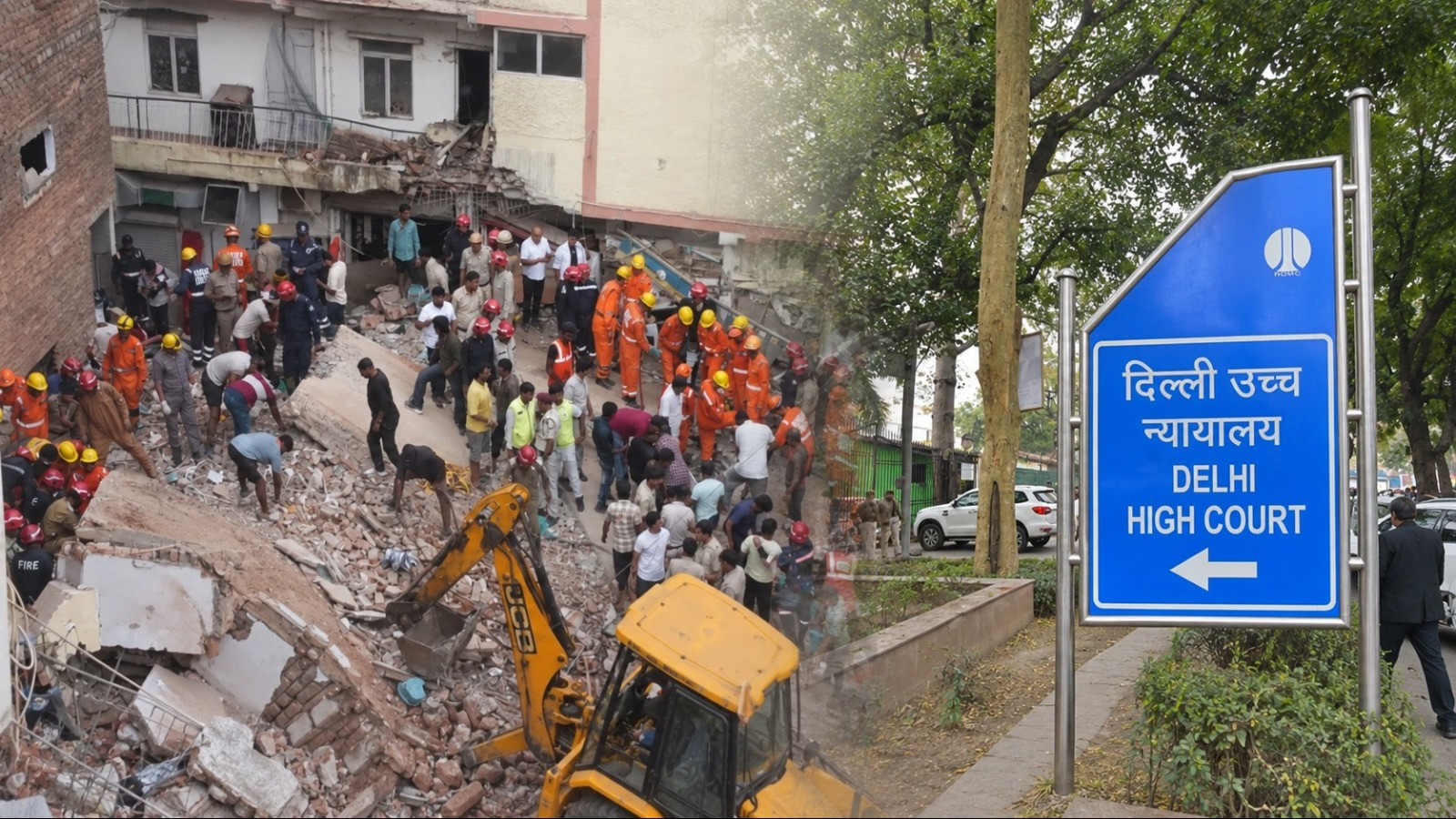
Delhi High Court termed the building collapse in Satya Niketan as 'extremely unfortunate' on Monday.
The Delhi High Court termed the building collapse incident in Satya Niketan on Monday as "extremely unfortunate." Seven people died in the incident, and several others were injured. The court raised questions about the responsibilities of the building owners, as well as the Delhi Municipal Corporation (MCD) and Delhi University (DU).
The High Court stated that,

Delhi University has failed to provide adequate housing for students coming from outside. This is why students are forced to stay in private paying guest (PG) accommodations.
The bench of Chief Justice Devender Kumar Upadhyaya and Justice Tejas Karia directed the authorities to expedite rescue and relief operations for those trapped in the debris. According to news agency PTI,
The court said that,
The responsibility for this incident does not lie solely with the owners of the collapsed building. The court also questioned the role of the MCD and DU.
The bench noted that due to the lack of adequate housing facilities, students coming from outside Delhi have to live in private PGs. The court made these remarks during the hearing of a public interest petition related to the building collapse.
The bench instructed the authorities to double their efforts in the rescue and relief operations to save lives.
Solicitor General Tushar Mehta, representing the central government, Delhi government, Delhi police, and MCD, informed the court that every possible step is being taken to rescue those trapped in the debris. He stated that the government is continuously monitoring the situation and that the relief operation may take some time. Mehta assured that the officials would make decisions in the interest of all concerned and that no effort would be spared in the rescue work.
The High Court has given all concerned officials 10 days to file separate responses to the petition. The next hearing in the case will be on September 25.
This public interest petition was presented for urgent hearing, after which the High Court agreed to hear it on Monday itself.
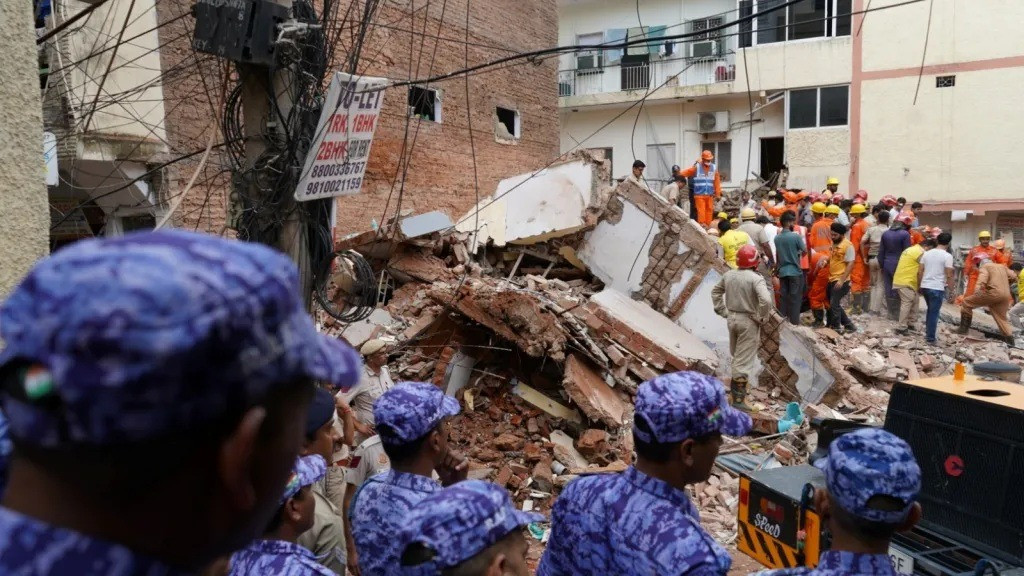
This building in Satya Niketan was located near the South Campus of Delhi University and was operating as a boys' PG. The building collapsed suddenly while repair work was underway on Sunday. Seven people died in the incident, while several others were injured.
It is noteworthy that earlier on Monday, the owner of the collapsed building, Hariram, was arrested from Bhiwadi in Rajasthan. Officials stated that the Delhi police had formed 10 different teams to locate him, and he was apprehended shortly after. A case has been registered against Hariram and others at the South Campus police station for culpable homicide not amounting to murder, negligence in building maintenance, and endangering the safety of others.
Seven people died in this incident on Sunday, while several others were injured. The search for missing persons and rescue operations are still ongoing. An FIR was registered against Hariram immediately after the incident. Meanwhile, the Delhi administration has stated that strict action will be taken against illegal buildings in the area. Earlier in the day, five officials, including the Deputy Commissioner of the South Zone of the Delhi Municipal Corporation (MCD), were suspended.
But the question has once again arisen, which the Delhi government has repeatedly failed to answer—how safe are the buildings where thousands of students reside?
While Delhi has a double, if not triple, engine government. The central, state, and now even the mayor of the MCD is from the BJP. So who will take responsibility for this incident? Who is responsible for the death of six students?
This building located near the South Campus of Delhi University was being used as a paying guest house. It had a basement and five floors above it. It is reported that repair work was underway in the basement when the entire building suddenly collapsed around 1:30 PM. By evening, six people had died, and several others had been rescued from the debris. Rescue teams were searching for those who were still feared to be trapped in the rubble.
Satya Niketan is not an isolated case. There are dozens of such areas in Delhi that have gradually turned into student colonies due to the city's universities, coaching centers, and private educational institutions. Areas like Katwaria Sarai, Saket, Munirka, Ber Sarai, Mukherjee Nagar, Malviya Nagar, Kamla Nagar, Kingsway Camp, Model Town, and Roop Nagar are filled with students during the academic session. Almost identical residential and commercial structures have developed in all these places. Satya Niketan is also part of this larger problem.
It is true that the government cannot provide housing for every student coming to Delhi or every young person preparing for competitive exams. It is also not feasible for every family to bear the cost of university hostels or specially constructed private accommodations. However, the lack of affordable rooms cannot be an excuse for unsafe buildings. In student-dense areas, every square foot of housing has commercial value. To earn more, buildings are divided into small rooms, more people are accommodated than capacity allows, and spaces like basements and rooftops are also used for purposes for which they were not designed.
The situation becomes even more serious when old buildings undergo repeated modifications without proper structural inspections. Sometimes basements are altered, walls are removed, and additional floors and rooms are constructed. The electrical and water systems are also subjected to pressures many times greater than their capacity.
The repair work underway in the basement at the time of the incident in Satya Niketan will naturally become part of the investigation. However, the actual cause of the accident should be determined not by hasty conclusions but through a detailed structural investigation.
In July 2024, three students preparing for the civil services examination died when water filled the basement of a coaching center in Old Rajendra Nagar. Following this tragedy, inspections, sealing operations, and a nationwide debate on the safety of coaching institutions began. Yet, nearly two years later, questions regarding compliance with regulations and administrative actions in that area remain unresolved. The CBI has also accused three junior officials of the MCD of negligence in the performance of their duties.
Subsequently, in May of this year, a building collapsed in Saidulajab near Saket. Six people died in this incident, including five young individuals who had completed their medical and engineering studies. This event once again drew attention to the issue of illegal construction.
According to reports,
The police had already informed about the illegal construction taking place in that four-story building before it collapsed. After the incident, the MCD began action in the area, and officials stated that notices had been issued to hundreds of potential illegal buildings in the Mehrauli-Chhatarpur area. Once again, the same old cycle was repeated—first a tragedy, then an investigation, and afterward action.
The Delhi Development Authority (DDA) developed this colony in the 1970s and 1980s as small and simple houses for low-income families. Its original structure was completely different from the neighboring Shanti Niketan and Anand Niketan. These two colonies, built in the 1960s, were high-class cooperative residential societies where mainly senior government officials and affluent individuals resided.
In contrast, Satya Niketan and its neighboring area, Arkpur Bagh Mochi, were built with low-rise houses on small plots.
According to former DDA planning commissioner Sabyasachi Das, only ground and first-floor construction was permitted under the original building regulations in Satya Niketan and similar colonies. This restriction was also imposed due to the proximity of the area to the airport.
Das stated,
Instead of granting separate approvals for the plans of each house in such colonies, the DDA provided all beneficiaries with a standard plan so that they would not have to hire an architect. However, in many cases, people entrusted the work to local builders who made arbitrary changes to these plans.
A DDA official stated that under the arrangement, such rehabilitation colonies were transferred to the Delhi Municipal Corporation (MCD) after about 90 percent of the construction was completed.
The character of Satya Niketan began to change rapidly after 1973, when Delhi University established its South Campus across the road. With the expansion of educational institutions like Shri Venkateshwar College, Jesus and Mary College, and Atmaram Sanatan Dharma College, the area became a convenient and attractive residential option for students. Initially, this change occurred gradually. Local residents began renting out rooms in their homes to students. However, over time, the increasing demand for housing transformed homes into commercial rental properties.
Das said,
“It started with students being kept as tenants. Extra beds and tables were added to the rooms to meet their needs, and shared toilets were created.” Later, without the necessary permissions, the houses began to expand upwards and around. Family homes were converted into paying guest or PG accommodations and rental units. Additional floors and rooms were created to accommodate more students on the same plot.
The Delhi Master Plan-2021 had allowed running hostels and PGs on residential plots adjacent to mixed-use roads with specified widths, considering the increasing demand for such housing. However, locals say that rules, especially those related to road widths, are often not followed.
The significant changes in Satya Niketan have also raised serious questions about the structural safety of buildings. The MCD stated that it is still being investigated whether any construction or repair work was ongoing in the building at the time it collapsed on Sunday. However, locals claim that some work was being done in the building's basement.
A senior MCD official stated that,
“The building violated the prescribed height limit of 17.5 meters.” The official said, “We are investigating whether the building weakened due to continuous rain and water seepage or whether repairs or other construction work played a role in its collapse.”
Professor VK Paul, Director of the Delhi School of Planning and Architecture, said,
“There were no clear signs of danger before the building collapsed, and it fell completely. This indicates that it was likely constructed without engineering standards. The vibrations caused by the building's collapse would certainly have affected the surrounding buildings as well.”