
Congress alleges ₹10,000 crore tax evasion through fake parties

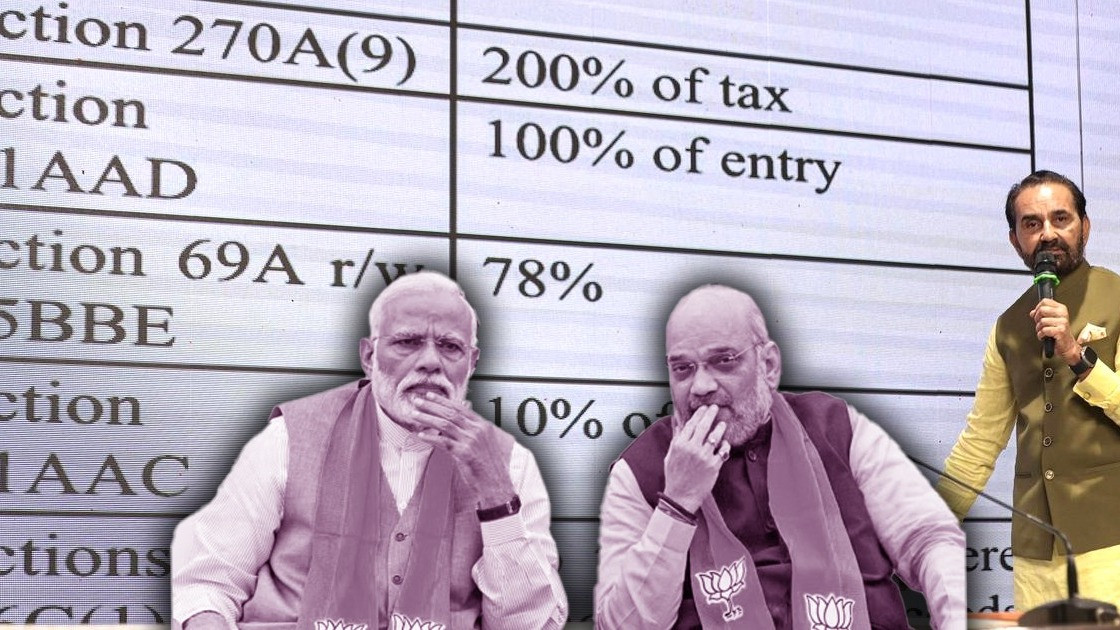
Congress claims that it appears a scheme to convert black money into white is underway under BJP's protection.
The Congress party launched an attack on the Modi government on Wednesday, alleging tax evasion and money laundering of around ₹10,000 crore through 3,260 registered unrecognised political parties (RUPPs). The party has demanded an investigation into the matter by a Joint Parliamentary Committee (JPC). There has been no immediate response from the government regarding the Congress's allegations.
Congress General Secretary Jairam Ramesh questioned on the social media platform 'X',

“Who is the ‘Chanakya’ behind these 3,260 fake political parties, and who is the real mastermind of this scam? The Modi government must answer the nation. Prime Minister Narendra Modi has failed to bring back black money from abroad, and the promised ₹15 lakh to the people has not materialised. It now appears that under the protection of the BJP, there is a plan to convert black money into white within the country.”
Jairam Ramesh raised the question of why the government has not taken action against the concerned parties and tax evaders despite the emergence of tax evasion and money laundering cases through fake political parties. He stated that Congress leader Shaktisinh Gohil has claimed tax evasion of over ₹10,000 crore through 3,260 registered unrecognised political parties. Despite this, no action has been taken, such as imposing a 200% penalty on the guilty or initiating criminal proceedings.
Jairam Ramesh also mentioned the freezing of Congress's bank accounts and the income tax notices received by the party ahead of the 2024 Lok Sabha elections. He said,
“The major opposition party in India, Congress, has had its bank accounts frozen and has been served heavy tax notices with the intention of financially weakening it. Then why is there no investigation into these 3,260 alleged fake political parties and the tax evasion cases associated with them?” He added, “It is possible that these parties are under the protection of BJP leadership and that this entire scam is being carried out with the government's silent approval.”
Addressing a press conference in Delhi, Congress leader Shaktisinh Gohil claimed that,
“The 3,260 registered unrecognised political parties in the country are being used for income tax evasion. Under Section 80GGC of the Income Tax Act, individuals and under Section 80GGB, Indian companies can benefit from tax deductions on donations made to eligible political parties as per specified conditions. Gohil alleged that these provisions have been misused to show donations worth thousands of crores in the names of fake parties.”
He claimed that,
“These 3,260 registered unrecognised political parties have raised around ₹10,000 crore in donations.”
Gohil further stated that,
“The government should have acted after a report from a non-governmental organization came out in 2025, but that has not happened. He said that companies committing fraud under the law can be fined up to 200%, criminal cases can be filed, and there is a provision for imprisonment of up to seven years upon conviction. Despite this, no action has been taken against a single individual so far.”
Gohil alleged that,
“Some chartered accountants may also play a crucial role in this tax evasion. Income tax officials had mentioned taking action against such chartered accountants, but no orders have come from above.”
He claimed that,
“This is because they are part of the government's own ‘C team’. The Income Tax Appellate Tribunal has also stated that such tax evasion is detrimental to the country. This black money will weaken the country's economy and security. Is the Election Commission colluding with the BJP in this matter?” Gohil also questioned the changes made in the appointment process of the Chief Election Commissioner.
He said that earlier, the committee associated with the appointment of the Chief Election Commissioner included the Prime Minister, the Leader of the Opposition in the Lok Sabha, and the Chief Justice of India. In the new arrangement, a central minister nominated by the Prime Minister has been included in place of the Chief Justice. The Congress has alleged that this has increased the government's influence.
The Congress has demanded the formation of a Joint Parliamentary Committee to investigate this alleged scam. Other major demands of the party include—
- Impose a 200% penalty on the guilty under the relevant provisions of the Income Tax Act.
- File criminal cases against the chartered accountants involved in the scam.
- Cancel the licenses of chartered accountants found guilty.
- Initiate criminal action against the officials and leaders of fake political parties.
- Make all information related to electoral donations public.
- Disclose how many individuals associated with fake parties later joined the BJP.
According to a report by The Print,
“There has been an extraordinary increase in donations received by unknown and unrecognised political parties in the country over the past few years. According to available audit and contribution reports, it has come to light that these parties received more than ₹10,000 crore in electoral donations between 2022 and 2024. In the year 2015-16, this figure was merely ₹4.37 crore.”
Only five unrecognised political parties in Gujarat declared a total income of ₹2,316 crore between 2019 and 2024. The declared income and donations received by many small and almost unknown parties have exceeded those of some national political parties.
RUPPs, or Registered Unrecognised Political Parties, are political parties that are formally registered with the Election Commission but do not meet the necessary electoral criteria to become recognised at the national or state level. Like other political parties, they can also receive income tax exemptions under specified rules. Questions are being raised regarding potential irregularities and misuse within this system.
According to the Election Commission's notification in October 2025, there were over two thousand such parties registered in the country. The Congress has stated the current number is 3,260. The Election Commission has taken action in previous years to remove those unrecognised parties from the list that have not contested a single election in six years or whose offices could not be found at the given addresses. Such cases are also referred to the Central Board of Direct Taxes (CBDT) for investigation of income tax exemption claims. Despite this, there remains a lack of transparency in the financial transactions of these parties. Many parties do not submit their audit and contribution reports on time.
Former Chief Election Commissioner S.Y. Quraishi stated that,
“The Election Commission does not have the authority to cancel the registration of political parties. He explained that due to a Supreme Court ruling in 2002, the Commission cannot completely deregister any party.”
Quraishi said,
“We do not have an effective way to determine how much money these parties are receiving and how much income they are generating. They should submit returns, but even if they fail to do so, the Election Commission cannot cancel their registration. The government should enact a law to give the Election Commission the authority to cancel the registration of political parties.”
Quraishi stated that there is no explicit term like 'delisting' in the rules. The removal of a party from the list by the Election Commission is not the same as the cancellation of its registration.
National Campaign for People's Right to Information co-convener Anjali Bhardwaj said that the registration of a political party can be used for corruption and money laundering. There is also a risk of money being sent through shell companies.
Anjali Bhardwaj questioned,
“When journalists and common citizens can see discrepancies in the financial status of these parties, what are the Lokpal, Enforcement Directorate, CBI, and other regulatory agencies doing? These political parties submit their income tax returns and reports to the Election Commission. Despite this, the serious discrepancies between their income, donations, and actual political activities are not being investigated thoroughly.”
Former Chief Election Commissioner Quraishi noted that,
“Registering a political party in India is relatively easy. Earlier, it required 30 members, whereas now it is necessary to have at least 100 registered voters. After registration, parties contest elections and may be recognized as state or national parties based on their electoral performance. To become a recognized state party, a party must fulfill one of the specified conditions related to vote percentage and seats. These include winning at least two seats with a minimum of six percent valid votes in the assembly elections or securing at least three percent of the total seats in the assembly. The Election Commission has also set different criteria related to vote percentage and Lok Sabha seats for national party recognition. This includes winning a minimum of four Lok Sabha seats with at least six percent votes in four or more states or obtaining two percent of the total Lok Sabha seats from at least three states.”
Currently, there are six recognized national parties and about 60 recognized state or regional parties in India.