BJP's desperation exposed by Nandigram developments
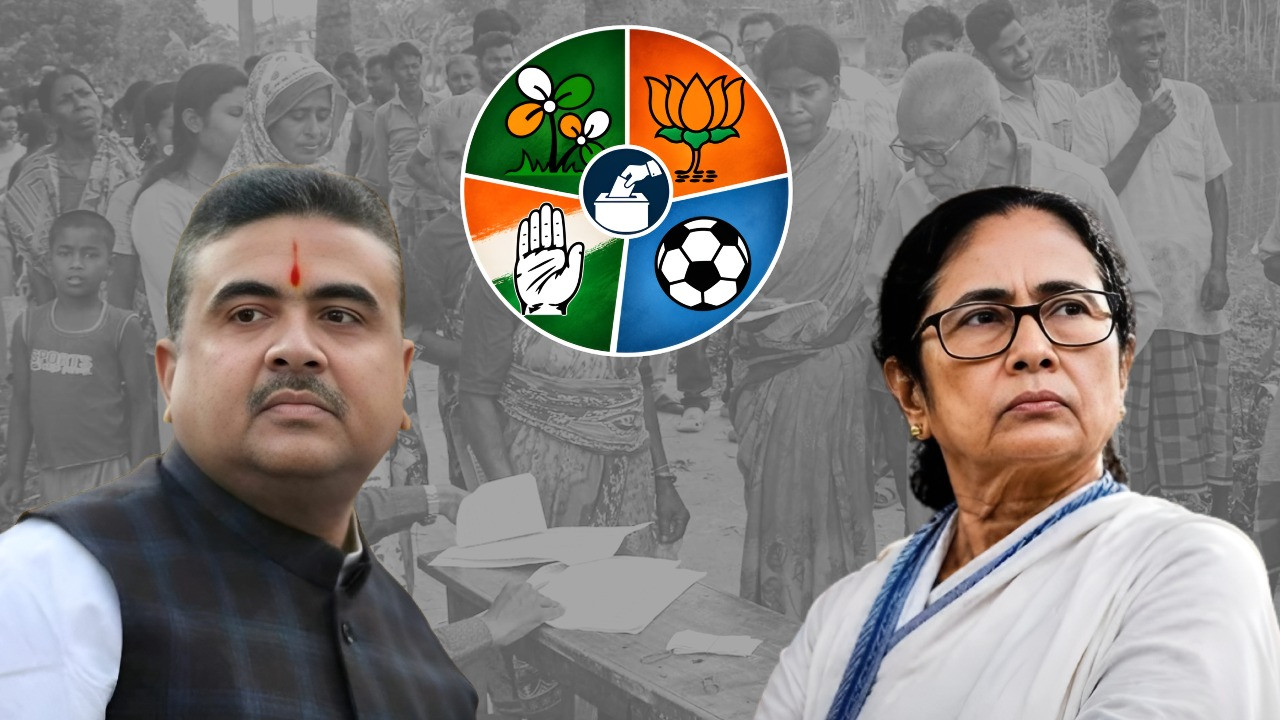
Is there really so much fuss over a single assembly seat?
In West Bengal, events over the past two days have unfolded rapidly.
- First, the Trinamool Congress was stripped of its election symbol.
- Then, its candidate met Chief Minister Suvendu Adhikari and suddenly withdrew his nomination.
- Mamata Banerjee subsequently announced support for the Congress candidate.
- And before the ink on this announcement had dried, Congress candidate Milan Pradhan was arrested in an old case.
The recent sequence of events in West Bengal politics has escalated to the point where the Nandigram by-election is no longer just a contest for a single assembly seat. It has become a test of electoral institutions, the struggles within parties, and the shifting political equations between the ruling party and the opposition.
First, let’s discuss the decision that sparked the entire controversy. On September 17, the Election Commission temporarily froze the Trinamool Congress's traditional name 'All India Trinamool Congress' and its election symbol 'Flower and Grass'. The Commission was faced with a claim over the organizational control of the party and the name-symbol between Mamata Banerjee's faction and the other group. Until a final decision was made, the Commission directed both factions to use separate names and election symbols. Mamata Banerjee's faction was given the name 'Mamata All India Trinamool Congress' and the election symbol of 'Football Player', while the other faction received the name 'Democratic Trinamool Congress' and the symbol 'Envelope'.

This decision is not merely about changing an election symbol. The political identity of the Trinamool Congress has been associated with 'Flower and Grass' for the past 28 years. Therefore, being unable to use this identity right before the elections poses a significant political and organizational challenge for the party. Mamata Banerjee has criticized the Election Commission's decision, calling it politically motivated. On the other hand, the Commission stated that the interim arrangement was necessary due to the dispute over the original party's name and symbol between the two factions.
Shortly thereafter, another major development occurred in Nandigram. Mamata Banerjee's faction had recently nominated Sanchita Pradhan De as their candidate from Nandigram. However, on September 18, she withdrew her nomination. Before withdrawing her nomination, she had met with BJP leader and West Bengal Chief Minister Suvendu Adhikari. Available reports clearly indicate that she withdrew her nomination only after this meeting.

Following this sequence of events, Mamata Banerjee announced her support for Congress candidate Milan Pradhan in Nandigram to strengthen the INDIA alliance. She referred to Congress as a 'sister party' and stated that this decision was aimed at strengthening the alliance. However, Congress leader Adhir Ranjan Chowdhury clarified that Congress had not sought support from Mamata Banerjee, and the announcement of support was her own political decision. Thus, Mamata's move was not only related to the electoral equation in Nandigram but also indicated changing relations among opposition parties.
However, just a few hours later, the situation took another turn. Congress candidate Milan Pradhan was arrested by the West Bengal police in an old case. According to reports, the case is related to a murder incident from the 2007 Nandigram land movement. The timing of the arrest has become a topic of political discussion as it occurred after Mamata Banerjee's announcement of support for Pradhan. Congress has termed this action as political vendetta. On the other hand, it is essential to view the legal basis of the arrest and the judicial status of the old case as a separate question. Concluding that the arrest occurred solely for political reasons based on the sequence of events is not an established fact in itself.
Here, the story of Nandigram becomes interesting and complex. On one hand, there is the Election Commission's interim decision regarding the party's name and symbol. On the other hand, there is the sudden withdrawal of Mamata's faction's candidate from the electoral race. Following that is the support for Congress and then the arrest of the Congress candidate. If these events are viewed separately, each event can have its own institutional and legal interpretation. However, when they occur in such quick succession, political questions naturally arise.
The most significant aspect of these events is perhaps that the Nandigram election can no longer be viewed merely as a direct battle between the BJP and the Trinamool or the BJP and Congress. The party split, the dispute over the election symbol, the withdrawal of the candidate's nomination, the opposition's support, and the arrest in an old criminal case have all made the election much more complex.
In a democratic system, the actions of each institution should be examined based on their timing, process, and available evidence. The Election Commission's decision should be evaluated based on its constitutional and legal basis, the candidate's withdrawal based on their own decision and circumstances, and the arrest based on law and judicial procedure. However, in political democracy, legal processes alone are not sufficient. Public trust in the impartiality of institutions is equally important.
Commenting on the arrest in the 2007 case in 2026, former IPS R. K. Vij wrote
Arresting someone suddenly in an old case, after a long time, without any new evidence, unless the person is absconding, is generally objected to by the court.
What should these actions be called in the context of winning an assembly seat?
Has the BJP realized that it cannot win elections without all these machinations?