
Supreme Court delivers setback to BCI chairman Manan Kumar Mishra

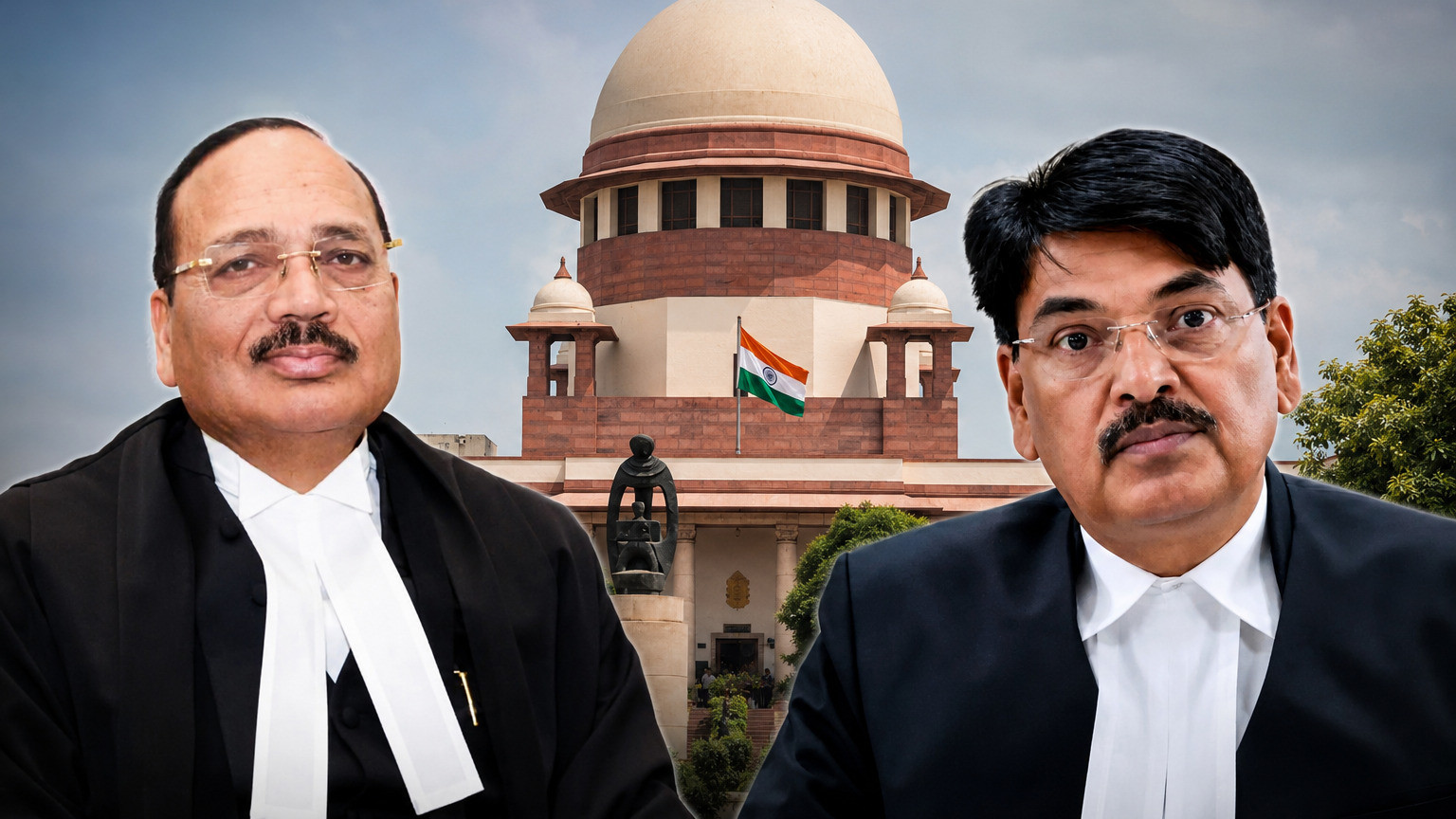
The Supreme Court has curtailed the powers of BCI chairman Manan Kumar Mishra, impacting his decisions.
The Supreme Court reminded the Chairman of the Bar Council of India (BCI), Manan Kumar Mishra, that he is only a pro-tem chairman, not a democratically elected official. Therefore, he can only manage the day-to-day operations of the BCI. The court stated that before making any major policy decisions, the BCI must involve the Attorney General and the Solicitor General in the process.
According to a report by Live Law, the Supreme Court has intensified its oversight of the operations of the Bar Council of India (BCI). The court directed that until the BCI is restructured through new elections, every policy decision taken by the institution must “actively involve” the Attorney General (AG) and the Solicitor General (SG).

A three-member bench headed by Chief Justice (CJI) D.Y. Chandrachud, which also includes Justices Joymalya Bagchi and V. Mohan, clarified that
the position of BCI Chairman Manan Kumar Mishra cannot be considered as a permanent arrangement that will last until 2030. The court stated prima facie that his position is only “pro-tem,” meaning temporary, until a newly constituted BCI elects its office bearers.
The court's intervention came during the hearing of petitions related to the elections of state bar councils. These petitions challenged Mishra's continuation as BCI Chairman and the validity of notifications that extended the terms of the Chairman and Vice-Chairman until 2030.
The Supreme Court's directives came at a time when the court had recently criticized the BCI's intervention in the dispute involving the 2026 batch of NALSAR University of Law. BCI Chairman Manan Kumar Mishra had initially directed state bar councils not to enroll students. This step was taken after protests against the invitation to the CJI at the convocation ceremony. Later, Mishra lifted the ban on enrollment and ultimately ceased actions against the students. Following this, Mishra had apologized to the students for the distress caused by his words or the BCI's actions.
On Wednesday, the bench stated that its immediate concern is not the conduct of any individual, but the institutional functioning of the BCI. The court noted that the elections of state bar councils have been conducted as per its directives, and there is now a need to restore the legal electoral process.
A major issue before the court was the notifications issued by the BCI in 2025,
which stated that the terms of Manan Kumar Mishra and Vice-Chairperson S. Prabhakaran would be extended to five years. It was argued that under Rule 12(2) of the BCI Rules, the term of the Chairman and Vice-Chairman is limited to only two years.
Senior advocate Madhavi Diwan, representing the petitioners, informed the bench that
Mishra was unanimously elected as Chairman on March 2, 2025, and his term was stated to commence from April 17, 2025, and continue until April 16, 2030. She also mentioned that an attempt was made through a resolution on January 9, 2025, to extend the term of the Chairman and Vice-Chairman from three years to five years, while the rules specify a term of only two years.
In response, the bench questioned how such an extension could be effective when the rules specify a two-year term. The court commented,
“Interestingly, it states that the term is being extended from three years to five years, while the rules only provide for a two-year term.”
Diwan also raised questions regarding the provisions of Section 4(3) of the Advocates Act. Under this provision, BCI members can remain in office until their successors are elected. She argued that the provision, which aims to prevent administrative vacancies, has been misused to delay elections and retain current office bearers.
The bench stated that
this provision is only a transitional and temporary arrangement. The court said that now that the elections of state bar councils have been completed, this provision should not remain a matter of dispute.
The court emphasized that the most important thing is that the newly elected state bar councils must exercise their legal authority under Section 4(1)(c) of the Advocates Act to elect their representatives for the BCI. Subsequently, these representatives will elect the Chairman and Vice-Chairman of the BCI.
The bench questioned,
“Is there any doubt that the current office bearers cannot remain in office indefinitely until 2030?”
The court also considered concerns related to the centralization of powers within the BCI. This included allegations of corruption associated with the formation of trusts controlled by current and former BCI office bearers and their operations.
Senior advocate Gopal Shankaranarayanan mentioned the Bar Council of India Trust for Promotion of Education, Legal and Professional Reforms and Improvement in Research (PEARL Trust), established in 2020. He alleged that the trust deed created 11 managing trustees who were made “founding and permanent trustees” separate from their tenure as BCI members.
The bench questioned,
can an elected body like the BCI use its assets to create a Trust in which some individuals remain permanent trustees even after they are no longer members of that body?
Diwan then suggested that until the BCI is restructured, the Attorney General and Solicitor General of India, who are ex-officio members of the BCI, should be involved in every significant decision of the council.
It is noteworthy that recently the Vice-Chairman of the BCI accused Chairman Manan Kumar Mishra of corruption. He demanded an investigation into the transfer of ₹150 crore of funds to a private trust. Y.R. Sadashiv Reddy, co-chairman of the Bar Council of India (BCI), wrote to the council's chairman, demanding his resignation within 15 days. He also sought an independent investigation into the transfer of ₹150 crore of council funds to a private trust, the “appointment of family members” to council positions, and Mishra's continuous tenure since 2012.
Senior advocate C.U. Singh stated that currently, proposals are being issued from the chairman's office without extensive consultation. He mentioned that the participation of both top law officers of the country would provide institutional control during the interim period. In this regard, the court clarified that the Attorney General and Solicitor General do not need to be part of the day-to-day operations of the BCI. However, they should be involved whenever a significant policy decision is to be made.
Senior advocates Maninder Singh and Guru Krishnakumar, representing the BCI, agreed to this arrangement.
The court stated that
the day-to-day operations can continue under the existing arrangement until the new BCI is formed. However, “when a policy decision is made, the participation of a permanently ex-officio member like the Attorney General is essential.”