
Supreme Court halts probe against Rahul Gandhi in assets case

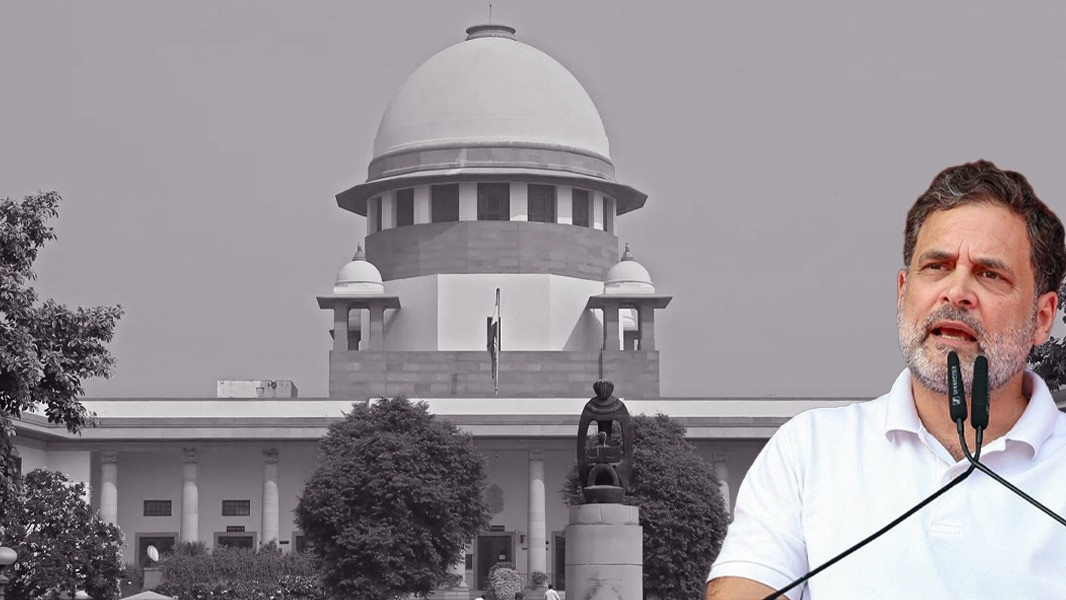
Opposition leader Rahul Gandhi receives relief from the Supreme Court.
The Supreme Court has stayed the Allahabad High Court's order for a CBI-ED investigation against Leader of Opposition in Lok Sabha, Rahul Gandhi, in a case related to disproportionate assets.
Providing significant relief to Rahul Gandhi, the Supreme Court on Monday directed the Allahabad High Court not to proceed further in the matter concerning allegations of disproportionate assets against the Congress leader.
The Supreme Court also instructed the CBI and the Enforcement Directorate (ED) not to file any report in this case against Rahul Gandhi under the directions of the High Court.
A bench comprising Chief Justice Suryakant, Justice Joymalya Bagchi, and Justice V. Mohana considered the arguments of senior advocate Kapil Sibal, representing Rahul Gandhi, and issued notices to S. Vignesh Shishir, a Karnataka resident who had filed the petition in the High Court, along with the CBI and ED. The bench was hearing the petition filed by Rahul Gandhi against the High Court's order. The Supreme Court directed the High Court to defer its next hearing until the Supreme Court hears the matter next.
At the beginning of the hearing, Sibal stated,
"This is an unheard-of procedure in law. It is a kind of witch-hunt, which is not recognised by law. It is extremely unfortunate. Such attempts are being made repeatedly by the same petitioner."
He also questioned Vignesh Shishir's locus standi to file the petition in the High Court. Sibal said that the petitioner did not disclose his credentials and background. The senior advocate stated, "I only want to say that the CBI has done nothing except verify the complaint."
Additional Solicitor General S.V. Raju, representing the central investigative agencies, said that the agencies have had no role in this matter so far. He stated that if the complaint reveals a cognizable offence, then the matter is very serious.
To this, the Chief Justice remarked,
"We are not concerned with that... Suppose someone commits murder, the police do not need permission. But what we see, subject to assistance from both sides, is that if the court wants to issue any directions, it is expected to follow the principles of natural justice."
Shishir, who approached the High Court against Rahul Gandhi, participated in the online hearing and opposed Rahul Gandhi's petition against the High Court's order.
Sibal also questioned the media reports despite the ongoing sealed envelope process. He said, "The second point is that this is a sealed envelope process. Then how are reports appearing in newspapers? This is a sealed process. The judges should have asked how this information reached the newspapers."
Earlier, the Lucknow bench of the Allahabad High Court, expressing dissatisfaction with the CBI's response, had directed a senior officer of the agency to personally file a new affidavit on July 20. It was asked to provide a detailed account of the progress in the investigation of allegations of disproportionate assets against Rahul Gandhi.
The High Court had also stated that if the ED finds any material or documents during the investigation indicating any illegal activity, it would be free to take further action according to the law. The High Court was hearing a petition seeking a CBI and ED investigation into the allegations of disproportionate assets against Rahul Gandhi. This order was passed after a nearly two-hour chamber hearing on the criminal writ petition filed by Shishir.
Rahul Gandhi had earlier challenged the High Court's order in the Supreme Court, which directed the CBI and ED to investigate and verify the allegations of disproportionate assets against him. Shishir had previously filed petitions accusing Rahul Gandhi of holding dual citizenship.
It is noteworthy that earlier, on August 14, the Supreme Court had also quashed the criminal proceedings against Rahul Gandhi, in which he had described Vinayak Damodar Savarkar as a collaborator of the British. The court stated that the necessary approval under the law to prosecute Rahul Gandhi was not obtained.
A bench of Justice Dipankar Datta and Justice Sheel Nagu accepted Gandhi's petition challenging the summons issued by a magistrate in Lucknow. The bench noted that the affidavit filed by the Uttar Pradesh government did not mention that the necessary approval to prosecute Gandhi was granted.
In its order, the bench stated, "We have heard the arguments of the learned counsels for the parties. The affidavit filed by the respondent Uttar Pradesh government does not mention any approval being granted. In such a situation, the orders passed by the magistrate are quashed."