
Migrant surge at Spain-Morocco border, 18 bodies found at sea

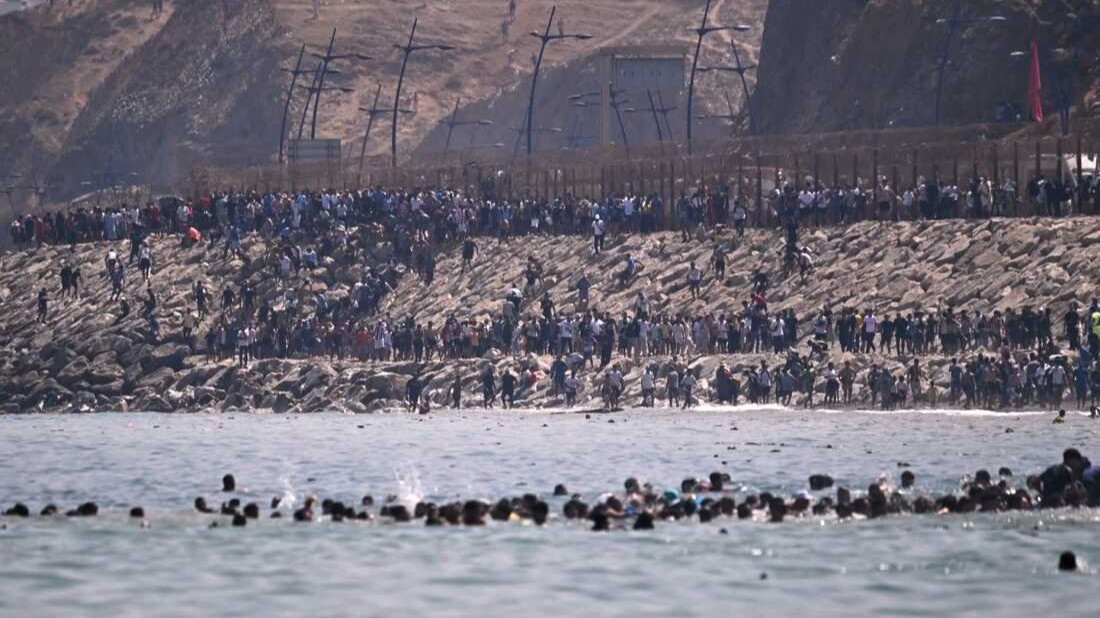
Eighteen migrants died while attempting to enter Spain's Ceuta from Morocco, amid a surge of 49,000 people.
Within a few hours, around 49,000 migrants attempted to enter the small Spanish autonomous enclave of Ceuta from Morocco, resulting in the deaths of 18 people. This unprecedented event has posed a serious political crisis for the Madrid government and has led to sharp criticism from several European Union (EU) countries towards Spain.
Spain and Morocco tightened security at the border of Spain's autonomous region of Ceuta on Friday. Both countries reinforced the border fence, and it appeared that the massive influx via sea and land routes in a single day had been largely curbed. During this period, 18 bodies have been recovered from the sea.
Reuters reported that Spain's National Security Department claimed on its website, citing the Ministry of Home Affairs, that more than 49,000 people illegally crossed the border into Ceuta within 24 hours. However, this statement was later removed from the website without any explanation.
The sudden arrival of such a large number of people in Ceuta, a small Spanish territory on Morocco's northern coast, has caused concern and political differences across Europe. France announced increased checks at its border with Spain, while Italy warned that it might take the step of suspending the Schengen arrangement with Spain. Moroccan security agencies deployed water cannons at Ceuta's entry points and attempted to push people back. After clashes, the charred remains of a bus and seven cars were visible in the area.
The Spanish government stated that efforts would be made to return those who have illegally crossed the border as soon as possible. However, a recent court ruling has imposed some restrictions on the special rules that allowed immediate deportation from Ceuta and Melilla without due process. Spanish Prime Minister Pedro Sánchez was scheduled to visit Ceuta on Friday with Home Minister Fernando Grande-Marlaska.
Ceuta and Melilla are two autonomous cities of Spain located in northern Morocco. They are the only terrestrial borders of the European Union with Africa. Both cities have a population of about 85,000, and they have periodically seen surges of migrants attempting to reach Europe, but the massive influx on Thursday is considered one of the largest incidents to date.
Spain's Minister of Regional Policy, Ángel Víctor Torres, said,
One reason for this sudden increase in infiltration could be the recent decision by Spain's Supreme Court. The court had stated that migrants attempting to reach Ceuta or Melilla by sea cannot be immediately deported under special rules.
Torres told local radio that the government has acted promptly on the situation and will follow the process of eventually returning them while respecting court orders and the rights of the migrants.
A 32-year-old migrant, Ibrahim, said he came from Tangier hoping to cross the border, but when he arrived, the entry gates were almost completely closed. Among those attempting to cross the border were women, children, and people from sub-Saharan African countries besides Morocco.
The Spanish Guardia Civil Police Association (AUGC) stated on the social media platform X that there was not enough police presence at the border on Thursday, making it impossible to stop such a large number of people. The issue of migration remains highly sensitive across Europe. Since the 2015 refugee crisis, when more than a million people from countries including Syria reached Europe, right-wing parties have gained influence on this issue.
France's Interior Minister Laurent Nunez said he has issued immediate instructions to increase checks at the border with Spain. However, he did not clarify how this arrangement would work in practice. Under normal circumstances, there are no border checks between member countries of the Schengen area, but they can be temporarily implemented under special circumstances.
Italy's right-wing Prime Minister Giorgia Meloni said that
her country is prepared to take extraordinary measures to protect citizens and defend borders, even to the extent of suspending the Schengen arrangement with Spain.
Finland's Interior Minister also supported Meloni's proposal, stating that the entire European Union should follow Italy's lead. However, Spain's socialist government says it is tough on illegal infiltration, but it also believes that
migrants strengthen the country's economy. Under this belief, the government launched a large-scale citizenship scheme, under which more than 5 lakh irregular migrants applied for Spanish citizenship in the past year.
Italy's Foreign Minister Antonio Tajani said that the images from Ceuta show that the decision by the Madrid government to grant Spanish (and thus European) citizenship to more than 5 lakh irregular migrants was wrong and encourages human trafficking.
In response, Spain's Foreign Minister José Manuel Albares called Tajani's remarks "unfair". He said that Spain expects solidarity, not political rhetoric, from its partner countries. He also mentioned that Italy's ambassador would be summoned to lodge a protest.