India to import 1 million tonnes of sugar amid ethanol shift

Sugar stock expected to drop by about 20% due to ethanol production shift.
The policy of producing fuel from ethanol has unnecessarily burdened the common people with skyrocketing inflation. It has now become clear that 25 lakh tonnes of sugarcane, suitable for sugar, has been diverted to ethanol, causing sugar prices to rise from ₹48 to ₹67 per kg and jaggery from ₹50 to ₹65 per kg in just the past three months. Rice and maize flour have also become 16% and 11% more expensive, respectively. The price of animal feed has increased by 10.34%.
Now that the crisis has deepened, the central government on Thursday allowed the import of 10 lakh tonnes of raw sugar. This is the first time in the past decade that India is going to import sugar. This decision comes at a time when a decline of at least 20% in the opening stock is anticipated in the upcoming sugar season.
The Directorate General of Foreign Trade (DGFT) has also issued the process for application and allocation of Tariff Rate Quota (TRQ) for the import of 10 lakh metric tonnes of raw sugar. Sugar mills and refiners with operational capacity to convert raw sugar into white or refined sugar can apply. The application period is set from 21st August to 28th August 2026. Applicants must submit a self-declaration of their refining capacity, supported by a copy of the Consent to Operate issued by the State Pollution Control Board.
Priority in allocation will be given to those importers who commit to completing the import by 15th October 2026. Failure to use the allocated quantity within the stipulated time or to return it will be considered a violation of the rules.
How strange it is that until last year we were exporting sugar. We used to have a surplus of sugar. The government had allowed the export of 15 lakh tonnes of sugar in November last year, which was later increased to 20 lakh tonnes. However, in May 2026, the government stopped sugar exports for the 2025-26 season. By then, about 8 lakh tonnes of sugar had already been exported. Now, in contrast, the government has allowed the import of 10 lakh tonnes of raw sugar.
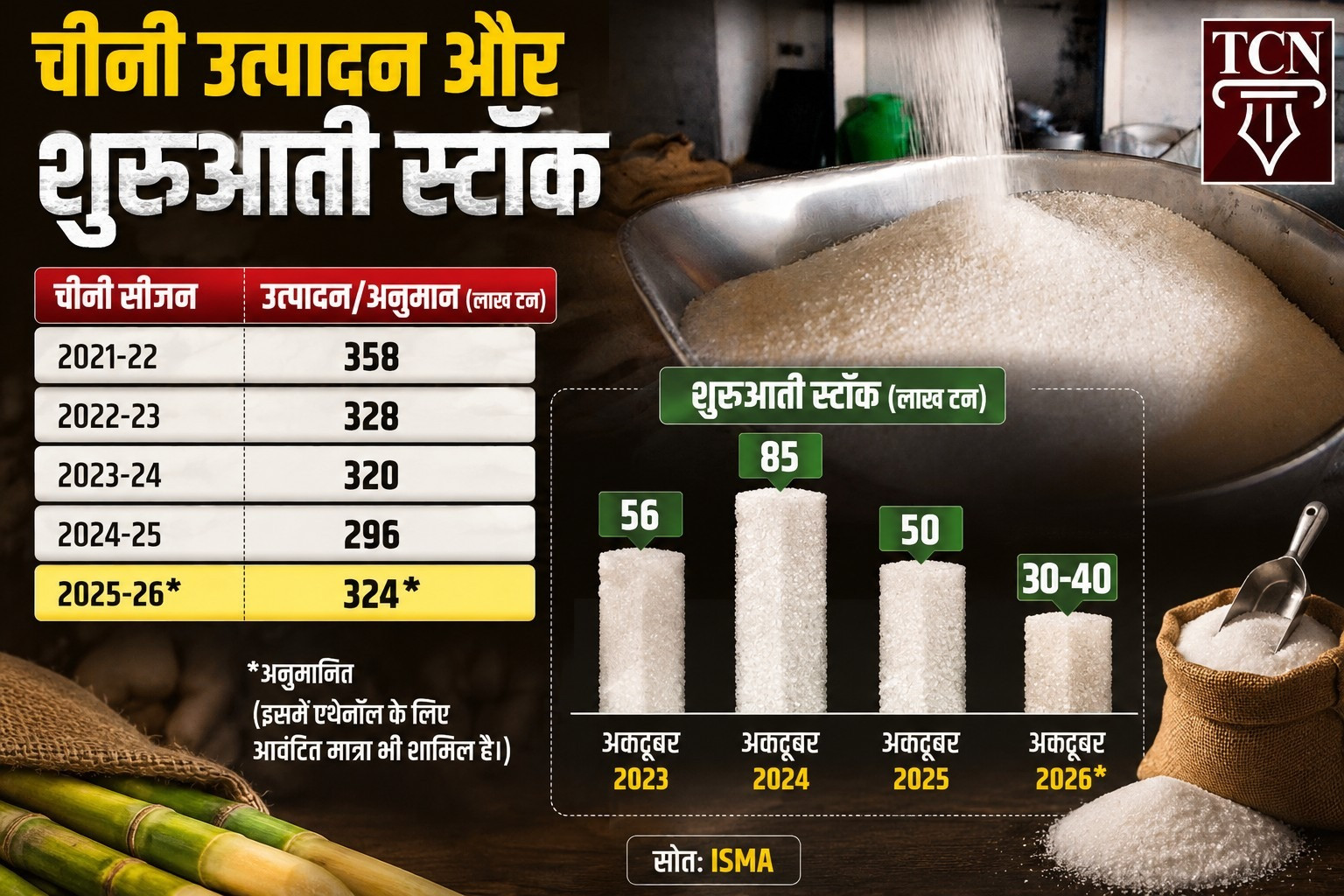
At the beginning of October 2025, the opening stock of sugar in the country was about 50 lakh tonnes. It is estimated to reduce to about 30-40 lakh tonnes by October 2026. Some industry estimates suggest it to be 40-42 lakh tonnes, while some researchers estimate only 32-35 lakh tonnes. The major reason for this decline is the reduction in sugar production. Production has decreased to about 296 lakh tonnes, the lowest since the 2019-20 sugar season. The industry has estimated production of about 324 lakh tonnes for the next crop year.
Just before this decision, the Food Ministry had issued an order stating,
Confectionery companies, soft drink manufacturers, food processing industries, sweet sellers, and other institutional buyers who use more than 10 tonnes of sugar per month will not be able to stock more than 15 days' consumption of sugar. For instance, if an entity uses 12 tonnes of sugar per month, it can stock a maximum of 6 tonnes of sugar at any time. This order will be in effect from 1st September to 30th November 2026.
However, the sugar industry claims that there is no shortage of sugar in the country. Mills have sufficient stock to meet domestic demand until November-December. After that, sugar from the new season will start entering the market.
According to officials, the annual sugar consumption in India is about 280 lakh tonnes. In the third advance estimate for the 2025-26 season released in February, the industry had estimated net sugar production of about 290 lakh tonnes. This did not include about 31 lakh tonnes of sugar used for ethanol production. The final figure for production in the current season is likely to be released next month.
These government decisions come at a time when sugar prices are rising rapidly. According to data from the Department of Consumer Affairs, the average retail price of sugar on 18th August was ₹52.30 per kg. A year ago, it was ₹46.34 per kg, indicating an annual increase of about 13%. The ex-mill prices of sugar have increased even more sharply. The all-India average ex-mill price has risen to about ₹5,400-5,500 per quintal, compared to about ₹3,900 per quintal a year ago. Between August and November, the demand for sugar generally increases due to major festivals like Ganesh Chaturthi, Dussehra, and Diwali.
To curb hoarding and speculation, the government has also imposed stock limits on sugar dealers. Under the order effective from 1st August to 30th November, no dealer can stock more than 4,000 quintals of sugar for more than 30 days from the date of receipt. Dealers are also required to provide information about their stock and update it every week.
Food Minister Prahlad Joshi said,
Bulk consumers using more than 10 tonnes of sugar per month will now not be able to stock more than their 15 days' requirement. The Food Ministry has notified this under the Sugar (Stockholding Limit of Bulk Consumers) Order, 2026.
The Indian Sugar and Bio-Energy Manufacturers Association (ISMA) states that the permission for import has sent a clear message to the market that speculative price increases will not be allowed to continue. According to the association, the import permission is not due to a shortage of sugar in the country but as a precautionary measure to ensure additional confidence and adequate availability in the market during festivals.