
How negligence turned Satya Niketan's PG building into a death trap?

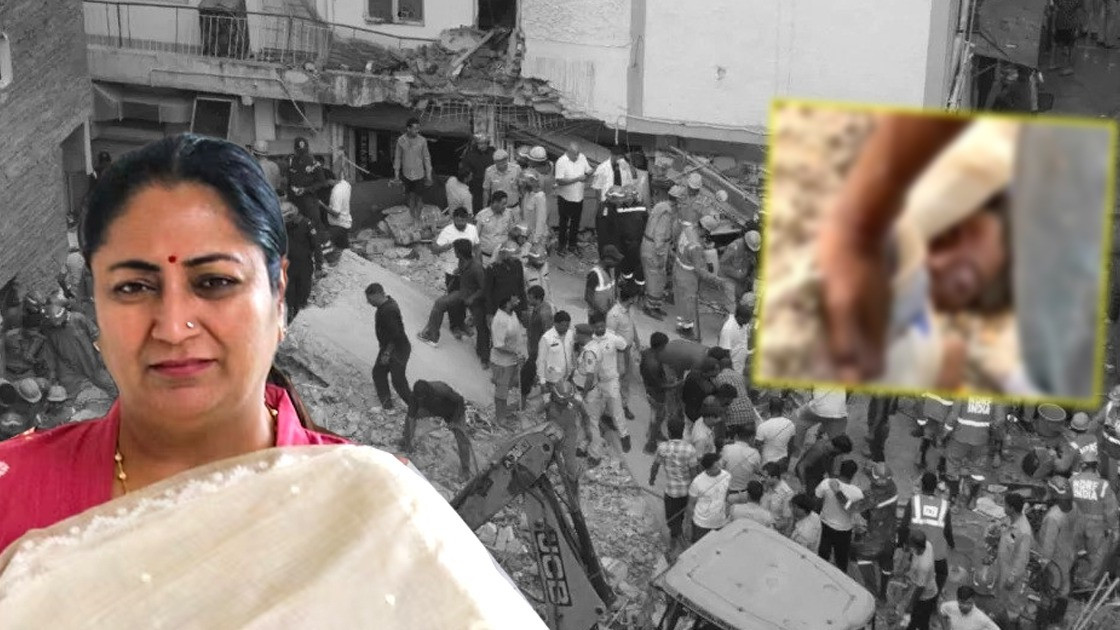
The question arises again: How safe are the buildings where thousands of students reside, as the Delhi government fails to respond?
On Sunday, the collapse of a five-storey boys' PG in Satya Niketan has once again raised the question that the Delhi government has repeatedly failed to answer—how safe are the buildings where thousands of students reside?
While there is a double, if not triple, engine government in Delhi, with the BJP holding power at the Centre, the state, and now even the MCD mayor's office, who will take responsibility for this incident? Who is accountable for the deaths of six students?
This building, located near the South Campus of Delhi University, was being used as a paying guest house. It had a basement and five floors above it. Reports suggest that repair work was underway in the basement when the entire structure collapsed around 1:30 PM. By evening, six people had died, and several others had been rescued from the debris. Rescue teams were searching for those who were still feared trapped under the rubble.

Satya Niketan is not an isolated case. There are dozens of such areas in Delhi that have gradually transformed into student colonies due to the presence of universities, coaching centres, and private educational institutions. Areas like Katwaria Sarai, Saket, Munirka, Ber Sarai, Mukherjee Nagar, Malviya Nagar, Kamla Nagar, Kingsway Camp, Model Town, and Roop Nagar are filled with students during the academic session. Almost identical residential and commercial structures have developed in all these places. Satya Niketan is part of this larger problem.
In the Lok Sabha, Leader of the Opposition Rahul Gandhi commented on the matter, stating,
The lives of students were already filled with struggles—now the situation is life-threatening. Due to the lack of good hostels in colleges or universities, students are forced to live in PGs under one roof in groups of 40, in inhumane conditions. Every student's life is precious and must be protected at all costs.
It is surprising that the RSS and BJP's student organization, Akhil Bharatiya Vidyarthi Parishad (ABVP), is also protesting after this incident. On Sunday, ABVP students demonstrated demanding the resignation of the MCD Commissioner Sanjeev Khirwar and Mayor Pravesh Wahi following the collapse of a paying guest (PG) building in Satya Niketan. On September 6, Delhi police detained ABVP workers who were protesting outside the MCD headquarters at Civic Centre.
ABVP criticized the MCD for neglecting safety standards and negligence in PG accommodations used by a large number of students in Delhi. The protesters entered the MCD premises and sat on a dharna, demanding immediate concrete administrative measures to prevent such tragedies.
The organization stated that students from across the country come to study at Delhi University and other educational institutions in the capital. A large number of them live in private PGs and rented accommodations. ABVP emphasized that it is the primary responsibility of the administration to ensure regular inspections of the structural and fire safety of these buildings and compliance with mandatory standards.
It is true that the government cannot provide housing for every student or every young person preparing for competitive exams coming to Delhi. It is also not feasible for every family to afford the cost of university hostels or specially constructed private accommodations. However, the lack of affordable rooms cannot be an excuse for unsafe buildings. In student-dense areas, every square foot of housing has a commercial price. Buildings are divided into small rooms for higher profits, accommodating more people than their capacity, and spaces like basements and rooftops are also used for purposes for which they were not originally intended.
The situation becomes even more serious when old buildings are repeatedly modified without proper structural inspections. Sometimes basements are altered, walls are removed, or additional floors and rooms are added. The electrical and water systems are also subjected to pressure far beyond their capacity.
The repair work ongoing in the basement at the time of the incident in Satya Niketan will naturally be part of the investigation. However, the real cause of the accident should be determined not by hasty conclusions but through a thorough structural investigation.
It does not take much for the capital to understand that when regulations are enforced not before an accident but after it, the consequences can be devastating.
In July 2024, three students preparing for the civil services examination died when water filled the basement of a coaching centre in Old Rajendra Nagar. Following this tragedy, inspections, sealing campaigns, and a nationwide debate on the safety of coaching institutions began. Yet, almost two years later, questions regarding compliance with regulations and administrative action in that area remain unresolved. The CBI has also accused three junior officials of the MCD of negligence in the performance of their duties.
Later, in May of this year, a building collapsed in Saidulajab near Saket. Six people died in this incident, including five young individuals who had completed their medical and engineering studies. This event once again drew attention to the issue of illegal construction.
According to reports, the police had already informed about the illegal construction taking place in that four-storey building before its collapse. After the incident, the MCD began action in the area, and officials reported that notices had been issued to hundreds of potentially illegal buildings in the Mehrauli-Chhatarpur area. The same old cycle was repeated—first a tragedy, then an investigation, and afterward action.
The scale of administrative action itself indicates how widespread the problem could be. After several fatal incidents in June, the MCD reported that 82 properties were demolished and 43 others sealed in the campaign against illegal and unauthorized construction. These figures are significant, but they also raise a more difficult and uncomfortable question—how many buildings in Delhi today are inhabited that have never been properly inspected? How many violations are visible to landlords, local residents, and officials, but no action is taken until an accident occurs?
The report of the monitoring committee constituted by the Supreme Court in July 2026 also highlighted violations of fire safety regulations in those residential properties being used for mixed or commercial activities.
This is extremely important in the context of student-dense areas, as residential buildings gradually transform into overcrowded PGs, hostels, or commercial complexes. The question is not just whether a building has a valid address or if its rent is being paid. The real question is whether it is being used in accordance with its structural capacity, fire safety, and designated residential capacity.
The rule regarding the maximum number of residents in buildings should not remain limited to paper. Illegal construction and unlawful use of basements cannot be overlooked in the name of high demand for rooms. Open drains, narrow lanes, blocked exits, and dilapidated buildings may seem like minor inconveniences on normal days, but in emergencies, they can become matters of life and death.
The current danger is that the Satya Niketan incident will also follow the same old pattern—an investigation will be ordered, debates will ensue over responsibility, notices will be issued, and after some time, people's attention will shift to another incident.
Delhi has witnessed this cycle even after the tragedies in Old Rajendra Nagar and Saidulajab. Yet, students continue to arrive in the capital, landlords are renting out rooms, and student-dense areas are becoming more crowded than ever.
Students come to Delhi to prepare for exams, study in colleges, start careers, and build their futures. They should not have to measure the risk of living in a building where they sleep at night. The Satya Niketan incident has brought to light a bitter truth that Delhi can no longer ignore. The issue of student housing in the capital is not just limited to affordable rooms or their availability. It is also a matter of safety, accountability, and effective regulation.
After yet another building collapse, the question is very straightforward and painful—how many more student deaths must Delhi wait for before considering safe student housing a basic necessity?
Over the years, the rehabilitation colony of Satya Niketan in South Delhi has undergone significant changes. Originally developed as a low-rise area to accommodate displaced families and workers, it has now transformed into one of the most densely populated and haphazardly constructed areas for students in the capital.
The Delhi Development Authority (DDA) developed this colony in the 1970s and 1980s as small and simple houses for low-income families. Its original structure was entirely different from the neighboring Shanti Niketan and Anand Niketan. These two colonies, built in the 1960s, were cooperative residential societies for the upper class, primarily inhabited by senior government officials and affluent individuals.
In contrast, low-rise buildings were constructed on small plots in Satya Niketan and its neighboring area, Arkpur Bagh Mochi.
According to former DDA planning commissioner Sabyasachi Das, only ground and first-floor constructions were permitted under the original building regulations in Satya Niketan and similar colonies. This restriction was also imposed due to the proximity of the area to the airport.
Das said,
“Instead of approving individual house plans in such colonies, the DDA provided all beneficiaries with a standard plan so that they would not have to hire an architect. However, in many cases, people entrusted the work to local builders, who made arbitrary changes to these plans.”
A DDA official stated that under this arrangement, about 90 percent of the construction in such rehabilitation colonies was transferred to the Delhi Municipal Corporation (MCD) after completion.
The character of Satya Niketan began to change rapidly after 1973, when Delhi University established its South Campus across the road. With the expansion of educational institutions like Shri Venkateshwara College, Jesus and Mary College, and Atmaram Sanatan Dharma College, the area became a convenient and attractive residential option for students. Initially, this change occurred gradually. Local residents began renting out rooms in their houses to students. However, over time, the increasing demand for housing transformed homes into commercial rental properties.
Das said,
“It started with students being kept as tenants. Extra beds and tables were added to rooms to meet their needs, and shared toilets were created.”
“Later, houses began to expand upwards and around without necessary permissions. Family homes were converted into paying guest accommodations and rental units. Additional floors and rooms were created to accommodate more students on the same plot.”
The Delhi Master Plan-2021 allowed hostels and PG accommodations on residential plots adjacent to mixed-use roads, considering the increasing demand for such housing. However, locals say that especially the rules related to road width are often not followed.
The proposed Delhi Master Plan-2047 has simplified some regulations related to PG accommodations, while restrictions in 'A' and 'B' category colonies remain in place. Locals allege that these restrictions are also openly violated.
The significant changes in Satya Niketan have raised serious questions about the structural safety of buildings. The MCD has stated that it is still being investigated whether any construction or repair work was ongoing in the building at the time it collapsed on Sunday. However, locals claim that some work was being done in the building's basement.
A senior MCD official stated that,
“The building violated the stipulated height limit of 17.5 meters.” The official said, “We are investigating whether the building weakened due to continuous rain and water leakage or if repairs or other construction work played a role in its collapse.”
Professor VK Paul, Director of the Delhi School of Planning and Architecture, said,
“There were no clear signs of danger before the building collapsed, and it fell completely. This indicates that it was constructed without engineering standards. The vibrations caused by the building's collapse would certainly have affected the surrounding buildings as well.”