
Chief Economic Advisor criticizes E20 petrol policy

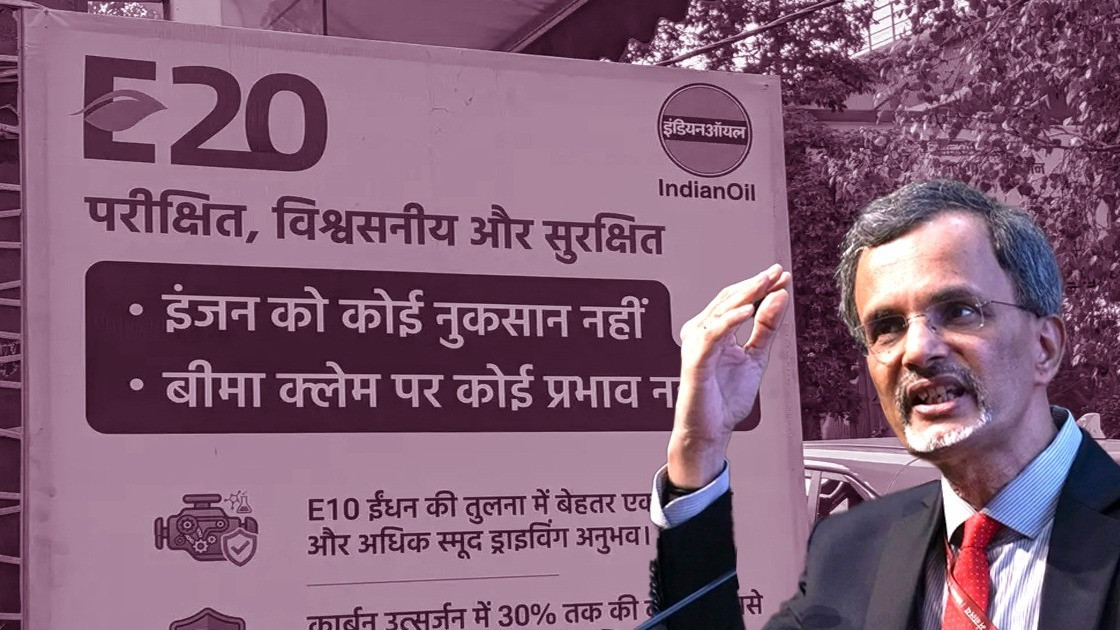
CEA V. Anantha Nageswaran suggests reintroducing petrol with lower ethanol content.
The option of petrol with a lower ethanol content should be made available again in the country. Chief Economic Advisor (CEA) V. Anantha Nageswaran suggested this in an article published on Monday in the Indian Express. This is the first time a senior government official has spoken about providing more options for petrol amid growing consumer discontent against the controversial fuel policy.
E20, which is petrol blended with 20% ethanol, is the only petrol available for sale at petrol pumps across the country from 1 April 2026. This is part of Prime Minister Narendra Modi's plan to reduce dependence on oil imports and help curb pollution. However, this move has raised widespread concerns about vehicle performance and potential damage to auto parts. Many vehicle owners are expressing their dissatisfaction on social media and demanding that the government also provide options for petrol with lower ethanol blends.
Nageswaran wrote in his article published in the The Indian Express on Monday that if petrol with lower ethanol content, such as E10, is made available alongside E20 at petrol pumps, it would address most public concerns. This article was co-authored with Akash Pujari, an advisor in the Department of Economic Affairs. Both clarified that the views expressed in the article are their personal opinions. However, it is rare for top government officials in India to publicly disagree with the government's stance.
A spokesperson for India's Ministry of Petroleum did not immediately respond to Reuters' request for comment. Last month, the government stated that there is no proposal to reintroduce petrol with lower ethanol blends like E0 or E10.
This article follows a Reuters report published last week, which revealed that the country's major automobile companies had privately discussed their concerns about contamination in E20 petrol. A few days later, an industry body representing the automobile sector sent a letter of complaint to the government, which was later withdrawn.
In his article, CEA V. Anantha Nageswaran stated that the available evidence does not support fears of engine damage, but there are genuine concerns about some other effects of E20 on older vehicles.
The article mentioned that there are about 7.5 to 8 crore old two-wheelers in India. Old rubber seals, which were not made ethanol-compatible, pose a separate issue. It will take years to replace these seals to make them ethanol-compatible. Until the programme to adapt vehicles is completed, existing vehicles should be protected.
CEA stated in the article,
There is a rapidly spreading complaint among people that the government's E20 petrol damages engines and depletes fuel quickly. This allegation is being made loudly, but there is no truth in its main claim. However, it would be a mistake to dismiss it entirely, as there is a real problem and an even bigger question hidden behind this noise.
There are about 7.5 to 8 crore old two-wheelers in India that were manufactured before the BS4 standard and run on carburetors. Carburetors cannot adjust themselves according to the extra oxygen present in the fuel mixture. Therefore, when using E20, the engine receives less fuel in proportion to the air it draws, causing the engine to overheat. Additionally, old rubber seals, which were not made ethanol-compatible, start deteriorating when exposed to this fuel, regardless of the engine temperature.
CEA wrote that making petrol with lower blends, such as E10, available again alongside E20 at petrol pumps could address most public concerns. This would reduce the overall consumption of ethanol rather than increase it, and until the programme to make old vehicles ethanol-compatible is completed, the country's existing vehicles would also be protected.
It is noteworthy that a few days ago, major automobile manufacturers in the country warned the central government that E20 petrol could damage the vehicle's engine and that the E20 petrol contains a contaminant, chloride. According to Reuters, internal emails from Maruti Suzuki, Tata Motors, and Mahindra revealed this. Through emails, top officials from Maruti Suzuki, Tata Motors, and Mahindra discussed their concerns about the contaminant chloride in 20% ethanol petrol, i.e., E20, and also warned the central government about it.