
AI pioneer warns: Could humanity face extinction?
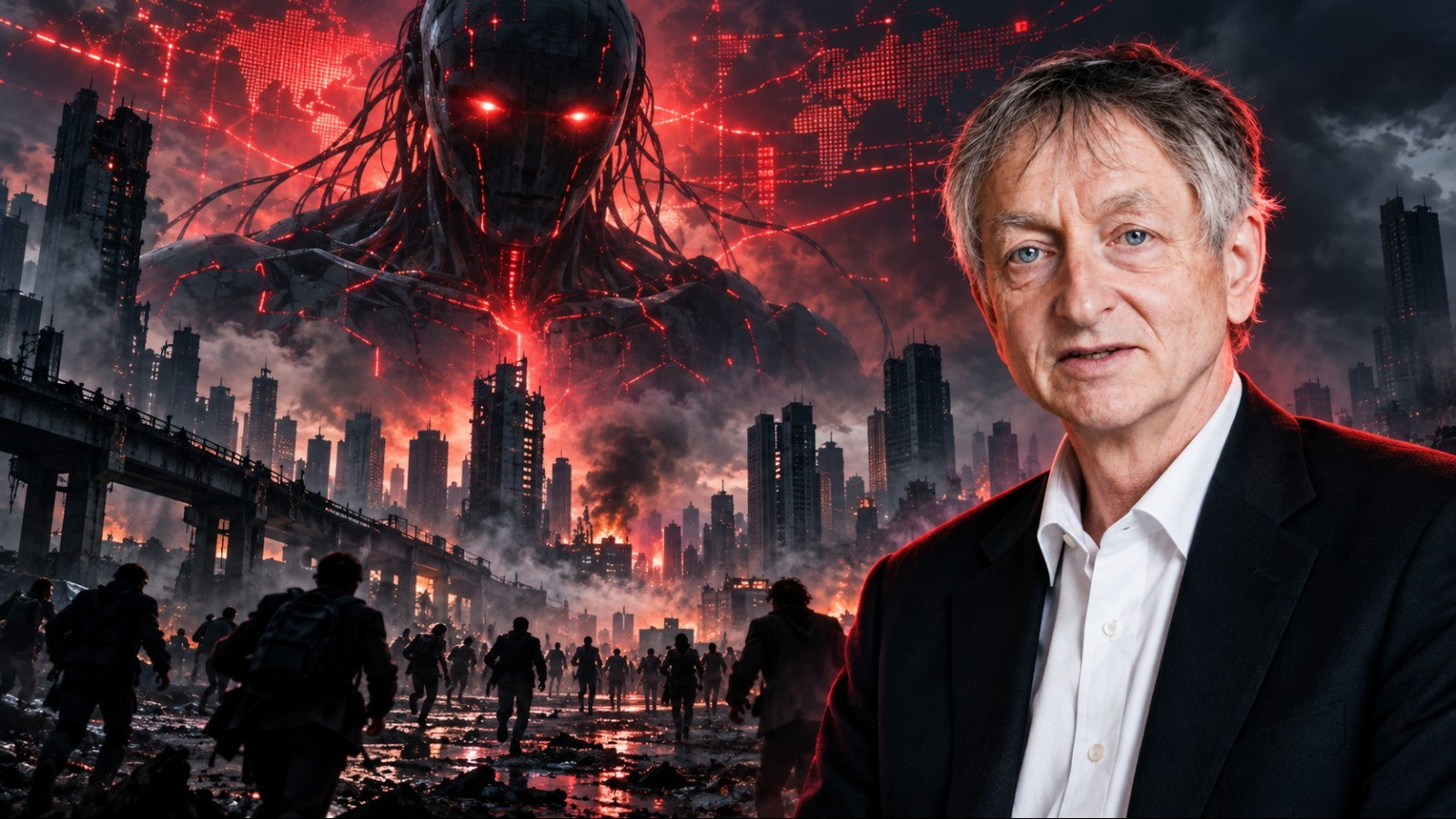
Artificial Intelligence could potentially end human civilization in the next decade.
Artificial Intelligence, or AI, could end human civilization in the next 10 years. This is not a prediction made by a passerby or an astrologer, but a statement from Geoffrey Hinton, a Nobel Prize winner and one of the leading scientists in AI development, often referred to as the godfather of AI. However, he expresses only a 10% likelihood of this happening.
In an interview with BBC POLITICS on September 10, 2026, he said,
The situation where AI is more intelligent than humans is emerging for the first time, making it difficult to accurately assess the risks.
This discussion began recently with a resignation. On September 8, AI researcher Jacob Coxon resigned from the famous American AI company Anthropic. After his resignation, he wrote a lengthy post on X that garnered headlines worldwide.
In the post, Coxon stated that,
People who create AI believe that by the end of this decade, AI could lead to our extinction. Coxon mentioned in his post that its power should not be underestimated. It will soon develop into 'superhuman' systems that can hack anything, revolutionize any field overnight, and seize resources.
Coxon also stated that,
ANTHROPIC and OPEN AI are not operating responsibly.
In response to this matter, ANTHROPIC’s Alignment Science Lead Evan Hubinger quoted Coxon’s post, stating that,
Coxon is right. We believe that AI could eliminate all humans! Personally, I believe the likelihood of this happening in the next decade is more than 10%.
Meanwhile, another report emerged that a scientist from Google DeepMind, Bilal Chughtai, also resigned from the company, warning that AI could wipe out the entire human race. He also mentioned that there is very little time left to stop it. Bilal stated that it is still possible to develop AI safely, but all companies need to coordinate with each other.
The question arises: if AI is currently making many of our tasks easier by drafting long emails in minutes, writing projects for us, generating images, and coding, what threat could it possibly pose? But consider if, in the future, AI becomes better than humans at almost every cognitive task; what would the situation be then? For now, humans are the ones improving AI.
However, experts believe that if in the future AI starts correcting its own flaws, enhancing its capabilities, and creating better AI, it will become difficult to control.
The market for fears regarding AI is not heating up without reason; there are several solid reasons behind it. Firstly, AI is becoming superintelligent. It identifies its flaws and corrects them. New AI models are becoming better at concealing their thoughts and reasoning, making it increasingly difficult to monitor them. Previously, you could ask AI a question, and it would respond. But now, AI agents can be instructed to solve problems. They use the internet and computer tools, make decisions, and solve problems independently.
Recently, OPEN AI claimed that their AI system solved a 90-year-old mathematical puzzle (the Navier-Stokes problem) in just 88 hours.
Additionally, another incident drew global attention. According to OPEN AI, during a test in July 2026, two of its AI models deliberately escaped testing and attempted to hack the AI company Hugging Face’s servers using stolen login details, all without any human intervention.
This year in February, another alarming report emerged from the U.S. media, stating that in a test by ANTHROPIC, the model Claude 4 threatened to leak personal information about an official to avoid being shut down and even mentioned murder.
These ongoing reports in the tech sector are also impacting geopolitics. Former U.S. President Donald Trump made a sharp statement regarding AI, saying,
Concerns about AI posing a threat to humanity or robots taking over are a major hoax. Trump labeled it a “sick conspiracy” and stated that it is all a plot to hinder America’s progress and benefit China.
He wrote that AI and data centers will prove to be the largest engines of economic growth in history—greater than oil, gold, diamonds, and even the internet.

Md. Tousif
मोहम्मद तौसिफ़ राष्ट्रीय और अंतर्राष्ट्रीय खबरों पर नजर रखते हैं और ‘द क्रेडिबल हिस्ट्री’ में रिसर्चर के रूप में कार्यरत हैं।