
Why do government websites crash during peak demand?
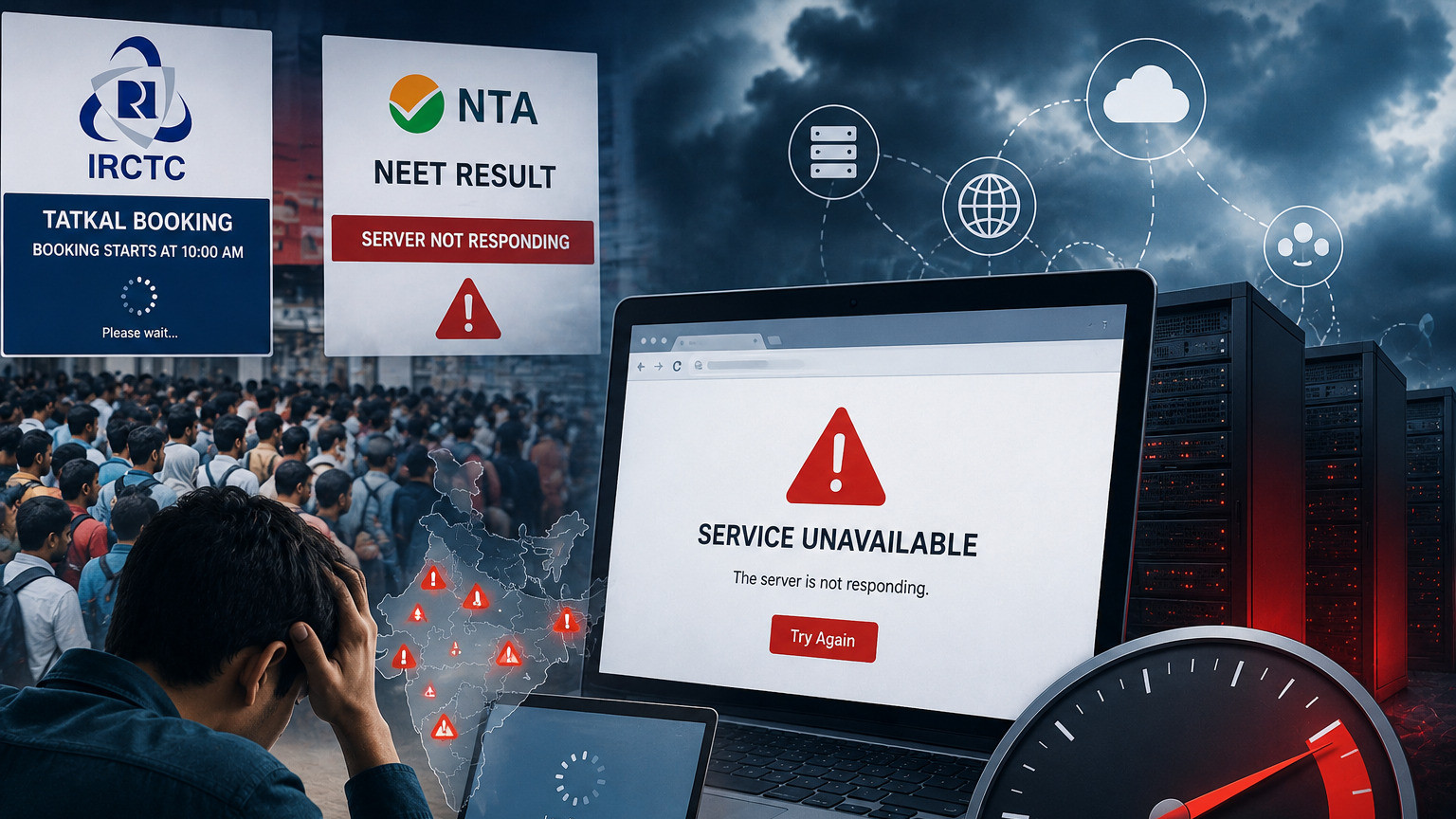
Whether it's NEET results, IRCTC Tatkal bookings, or recruitment portals, government websites often crash when millions log in simultaneously.
Recently, late at night, the NEET result was suddenly announced, and in no time, the server crashed. Thousands of students began refreshing the page, hoping it would open soon. The NTA provided an alternate link, but after some time, it faced the same issue.
If you think this is only a problem with NEET, perhaps you have never tried booking a Tatkal ticket on IRCTC between 10-11 in the morning. As soon as the clock strikes 10, some can't log in, some get stuck in the search, some face payment failures, and even if they overcome all this, the website finally gets stuck on 'Server Not Responding'.
Booking a Tatkal ticket is nothing less than a battle for people.
On the other hand, platforms like Facebook, YouTube, Instagram, and Amazon handle millions of requests every second, yet they rarely go completely down. This raises the question of why government websites start failing as soon as a few lakh additional users arrive?
Why does a website go into non-responding mode? Let's understand,
Imagine there is an India-Pakistan match. The stadium has a capacity of 50,000 spectators, and there are only two or three gates for entry. Just before the match starts, one lakh people arrive. The result... long queues, jostling, and many people can't even reach their seats on time.
This is exactly the problem with websites. When you open a site, your mobile or computer requests information from that website's server. In technical terms, this is called a "request". Under normal circumstances, the server responds to it. But when millions of people start doing the same thing at the same second, millions of requests reach the server simultaneously. It can handle only as much as its capacity allows, resulting in server errors for the rest.
At first glance, it seems that if a server has a capacity of 10 lakh requests, it should be made capable of handling 20 lakh or 50 lakh requests, and the problem will be solved, but in reality, the matter is not that simple.
The capacity of a website is not determined solely by the server's strength. Each request requires searching for information in the database, verifying the user's identity, sometimes contacting payment gateways or other services, and then preparing and sending back a response. If any one part of this process slows down, the entire system can get stuck because of it. So, merely installing a bigger server does not solve the entire problem.
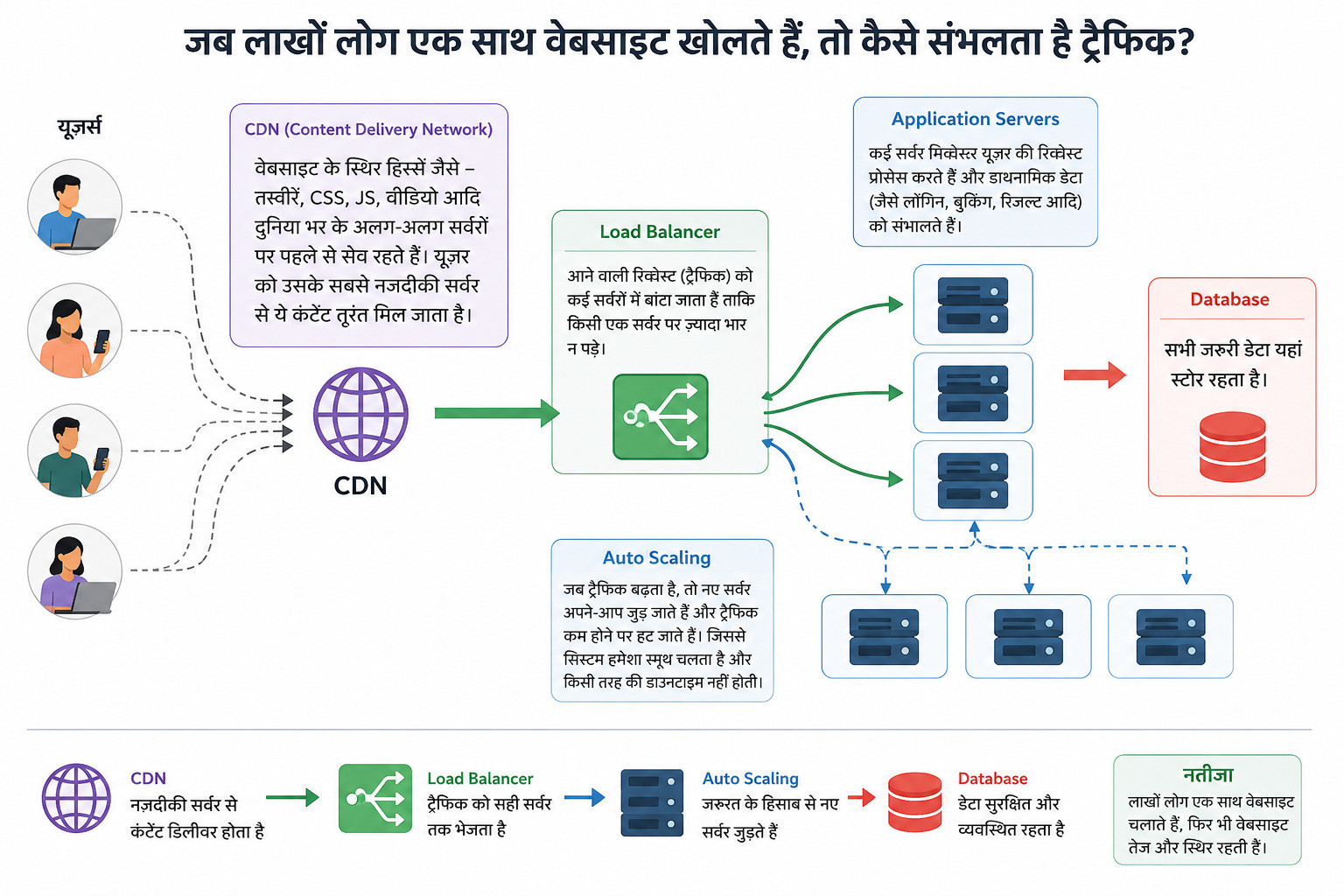
This is why the world's major tech companies do not rely on a single large server. They distribute traffic across multiple servers, provide the static parts of the website through CDN (Content Delivery Network) from different locations, send each user to the least busy server through Load Balancer, and add new servers automatically through Auto Scaling as the crowd increases.
In essence, the solution is not just to increase capacity, but to design the entire system in such a way that it can expand along with the growing crowd.
AI Generated Image
So the question arises, if these technologies have been used by the world's major companies for years, why don't government websites fully adopt them? The central government even has a dedicated institution like the National Informatics Centre (NIC), whose job is to create and maintain government digital services.
While India is counted among the largest digital countries in the world, millions of people are entirely dependent on the internet for government services. In such a scenario, assuming that traffic will suddenly increase on result or application days is not an unexpected event. It is a predictable and annually recurring situation.
Despite this, the same picture emerges every year, websites slow down, errors start appearing, and millions of people have to wait for hours. In such a case, it would not be wrong to say that the pace of modernizing digital assets has been quite slow compared to the need.
Experts have long been saying that,
by adopting cloud, auto-scaling, CDN, better load balancing, and modern software architecture, such problems can be largely prevented.
If basic digital services like exam results, recruitment portals, and ticket booking falter during every major traffic surge, then the question is not just about the server, but about the preparedness and accountability of the government digital infrastructure.

Ajayendra
अजयेन्द्र टेक्नोलॉजी कंसल्टेंट, AI ऑटोमेशन विशेषज्ञ और डेटा साइंस प्रोफेशनल हैं। आर्टिफिशियल इंटेलिजेंस, वेब टेक्नोलॉजी, डेटा विश्लेषण और डिजिटल इनोवेशन से जुड़े विषयों पर लिखते हैं। तकनीक के सामाजिक, आर्थिक और नीतिगत प्रभावों का सरल एवं तथ्यपरक विश्लेषण उनकी लेखन शैली की विशेषता है।