
US Treasury buys Japanese yen worth $5-10 billion

The Federal Reserve Bank of New York sold euros to purchase yen for the US Treasury.
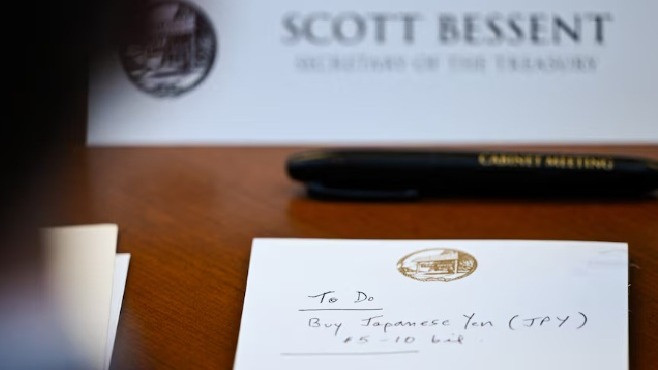
During a Cabinet meeting of President Donald Trump on Friday, U.S. Treasury Secretary Scott Bessent's 'to-do list' was captured on camera, indicating that he was considering purchasing Japanese yen worth $5 to $10 billion. This note was clearly visible in a Reuters photograph taken during the meeting at Camp David. The image has rapidly gone viral on social media.
During the part of the meeting that was being recorded for the media, a notepad from Camp David was visible in a picture taken over Bessent's shoulder.
The underlined words read "To Do" and below it was written— "Buy Japanese Yen (JPY) $5-10 bil." indicating the purchase of Japanese yen worth $5 to $10 billion. Nothing else was visible on the notepad. A card with Bessent's name was also visible just above the notepad on the Camp David conference table. This picture was taken at 11:33 a.m. U.S. time (15:33 GMT).
It is noteworthy that on Friday, the U.S. Treasury purchased yen to support the weakening Japanese currency. Financial Times (FT) reported this information. This is the first time in over a decade that the U.S. has intervened with Japan to strengthen the yen. The yen is currently hovering around a 40-year low.
FT, citing people familiar with the matter, reported that the Federal Reserve Bank of New York purchased yen by selling euros on behalf of the U.S. Treasury. This transaction was conducted through Goldman Sachs and Morgan Stanley. However, the report did not specify the total amount of yen purchased. Earlier on Friday, the U.S. Treasury had informed several banks that it might intervene in the yen market and asked the banks to "be prepared for future action," a source familiar with the matter told Reuters. Meanwhile, during the Cabinet meeting at Camp David, the picture of U.S. Treasury Secretary Scott Bessent's notepad taken by Reuters also became a topic of discussion.
A spokesperson for the U.S. Treasury did not immediately respond to Reuters' request for comment on the contents of the notepad. It was also not clarified whether the U.S. Treasury intervened in the market on Friday to support the yen against the dollar. Earlier on Friday morning, about two hours before the picture was taken, Reuters, citing a source familiar with the matter, reported that the U.S. Treasury had informed several banks that it might intervene in the yen market on Friday.
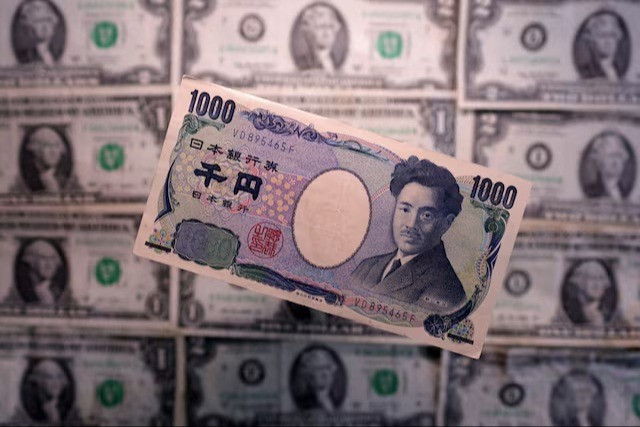
Earlier on Friday, Japanese officials in Tokyo also intervened in the market to support the yen. This was followed by a significant strengthening of the Japanese currency against the dollar during morning trading. Late Friday afternoon, another major strengthening of the yen against the dollar was observed. According to LSEG data,
around 4:14 p.m., the price of one dollar was approximately 158.9 yen, which fell to about 157.6 yen just before 5 p.m. This indicates a decline of about 0.8 percent in the dollar against the yen. The U.S. Treasury has not intervened in the market to support the yen since 2011.
In 2011, following the devastating earthquake and tsunami in Japan, the U.S. joined other G7 countries in a coordinated action to stabilize the Japanese currency. The U.S. Treasury did not immediately respond to the FT report and the picture of Bessent's notepad. There was also no immediate response from the New York Fed and Morgan Stanley, while Goldman Sachs declined to comment.
Meanwhile, Kyodo News reported on Saturday, citing sources, that Japan and the U.S. might announce a joint policy at the beginning of next week to address the weakness of the yen. According to the report, the purpose of this announcement would be to warn the market against speculation putting pressure on the Japanese currency and to bring stability to the currency market. Previously, the U.S. last directly supported the yen in 2011. At that time, following the devastating earthquake and tsunami in Japan, the U.S. intervened with G7 countries to stabilize the markets.