
Communal violence grips Nepal: Curfew in several districts
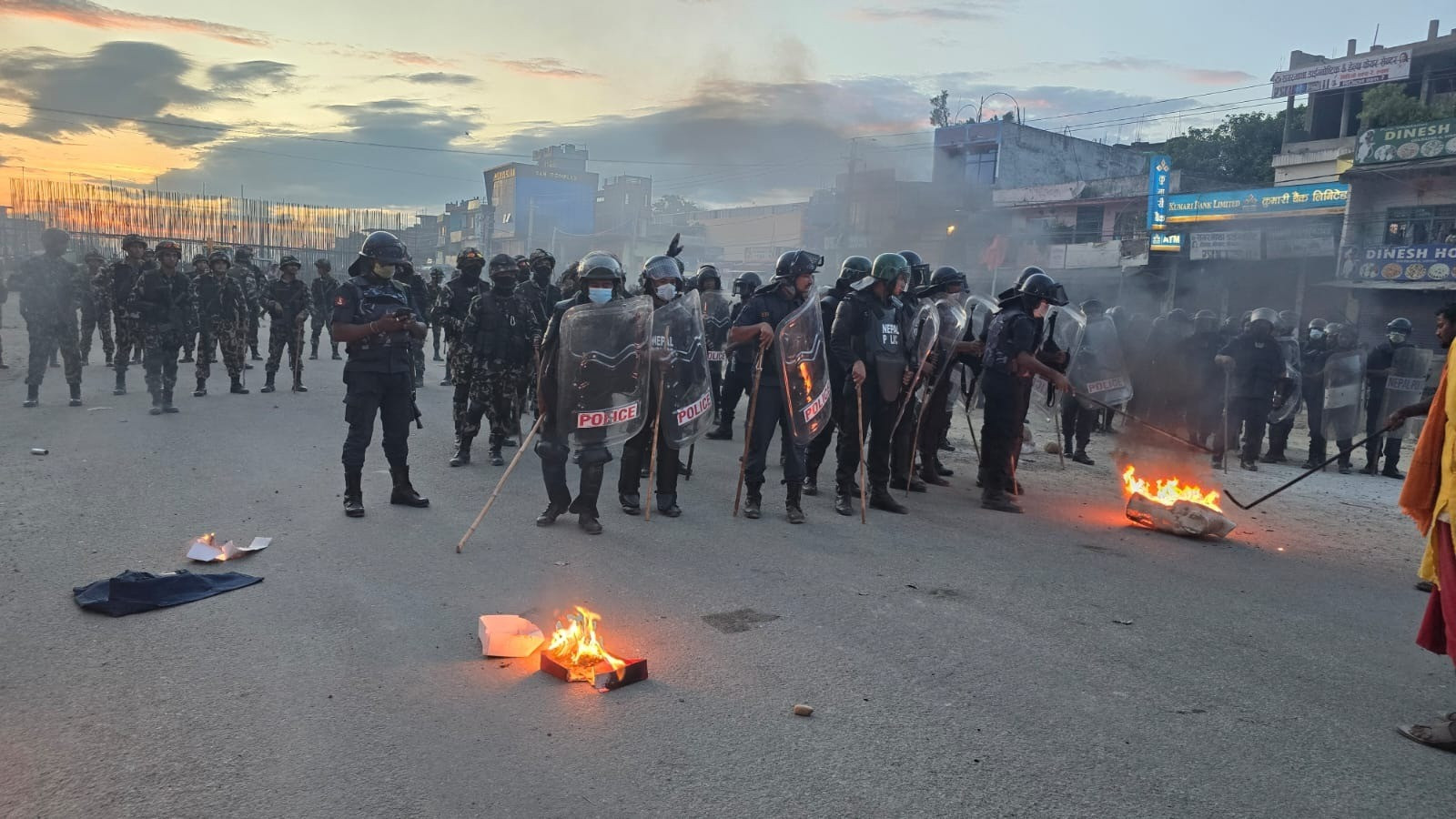
Nepal faces communal violence for three days, leading to curfews after three deaths in multiple districts.
Nepal has been engulfed in communal violence for the past three days. The violence has intensified in three districts of Madhesh Province. Communal tensions, which erupted after a clash in Sunsari, have spread to several districts in the Terai region, resulting in the deaths of three people. Strict curfew measures have been implemented in four districts.
According to a report by Kathmandu Post, a curfew has been imposed in Sunsari, Saptari, Siraha, and Dhanusha since Thursday night, while prohibitory orders have been enforced in Parsa following the spread of violence from the eastern district of Sunsari. To curb the unrest, large numbers of Nepal Police, Armed Police Force, and the Nepalese Army have been deployed. Among those killed in the violence was 17-year-old Ganesh Yadav from Ward 2 of Aurahi Rural Municipality in Siraha, who died after being shot during a clash in Golbazar on Thursday afternoon. Earlier in the day, 20-year-old Jaya Prakash Mehta, who was critically injured in Sunday's violence in Sunsari, succumbed to his injuries at Neuro Hospital in Biratnagar. The unrest began when 24-year-old Om Prakash Mehta from Ward 3 of Devangunj Rural Municipality was shot dead during a confrontation between two communities (Hindu-Muslim) in Sunsari on Sunday night.
What are the reasons behind the communal violence that has erupted in Nepal today? It is not merely due to immediate causes. The conspiracy has been brewing for years. The background is similar to that of Nepal's neighbouring nation - the politics of communal polarisation. According to a detailed report by Frontline, activities of the Rashtriya Swayamsevak Sangh (RSS) have clearly increased in Nepal over the past two years. Combat training has been conducted for "Hindu youths". There has been a surge of RSS-affiliated groups in the plains and hilly areas, and from the autumn of 2023 to the spring of 2024, several communal clashes occurred in the villages and towns of Madhesh Province, often incited by youths from across the border. The aim was to destabilise Nepal so that the government would fall and a Hindu nation could be declared, benefiting Modi before the 2024 Indian general elections. However, Oli's government in Nepal did not fall. Then, in September 2025, the Gen Z movement occurred, with arson in the Parliament building, widespread violence, and vandalism. Politicians were publicly beaten, setting the stage for the formation of Balen Shah's government.
It began in March 2025 with a rally by monarchy supporters at Tinkune Crossing in Kathmandu, demanding the restoration of the monarchy. The RSS believes that a Hindu nation in Nepal is only possible with a monarchy, and it is believed that this rally was organised with encouragement from New Delhi and Lucknow. Protesters engaged in vandalism and arson, clashing with the police. One protester and one journalist were killed, and five people were injured. Amidst the chaos, a prominent supporter of the monarchy—who later fled to Assam to avoid arrest—drove his jeep through the crowd, forcing protesters to move aside while shouting for them to join him, and broke through police barricades. It seemed he was heading towards the Parliament. That day, the Parliament was not attacked.
The RSS has targeted mainstream opinion-makers; they take journalists to their headquarters in Nagpur and organise programmes for intellectuals. A few months ago, RSS activities intensified in Kathmandu. Notably, RSS members handling foreign policy spoke to Nepalese politicians about the country's constitution.
The Modi government opposes Nepal's constitution. This was clear even before the constitution was implemented. Modi and the RSS share the same view as Nepal's monarchy supporters, who cannot bring back the king due to the constitution's commitment to a republic. Monarchy supporters have the backing of the RSS and are involved in today's constitutional crisis.
On 8 September 2025, Gen Z and young citizens in Kathmandu held a protest march demanding an end to corruption. As outsiders joined the crowd, the atmosphere turned violent. The police did not take usual precautions to control the crowd and suddenly fired live bullets, killing 19 people with shots to the head and chest. The next day, violent groups engaged in arson, looting, and killings across the country. The total death toll for that week was 74, many of whom died trapped in burning buildings.
The violence on 9 September 2025 was partly a result of anger over the government's killings the previous day. However, this assumption is only possible if one ignores who was involved and how it all happened. The crowd that systematically set buildings on fire was linked to well-known groups. Besides monarchy supporters—whether in parties or independent—these included Maoist factions and supporters of an opportunistic new politician, Ravi Lamichhane, who was jailed during a fraud investigation. Individuals associated with these groups have been identified personally and in photos and videos. All these groups have been vocal critics of Nepal's constitution and have opposed its secular, republican, or federal structure.
Satish Verma
सतीश वर्मा पेशे से पत्रकार हैं। हिंदी की मुख्यधारा की पत्रकारिता में इन्हें 20 साल से ज्यादा का अनुभव है।