
China censors flood videos from Nepal and Tibet: Report

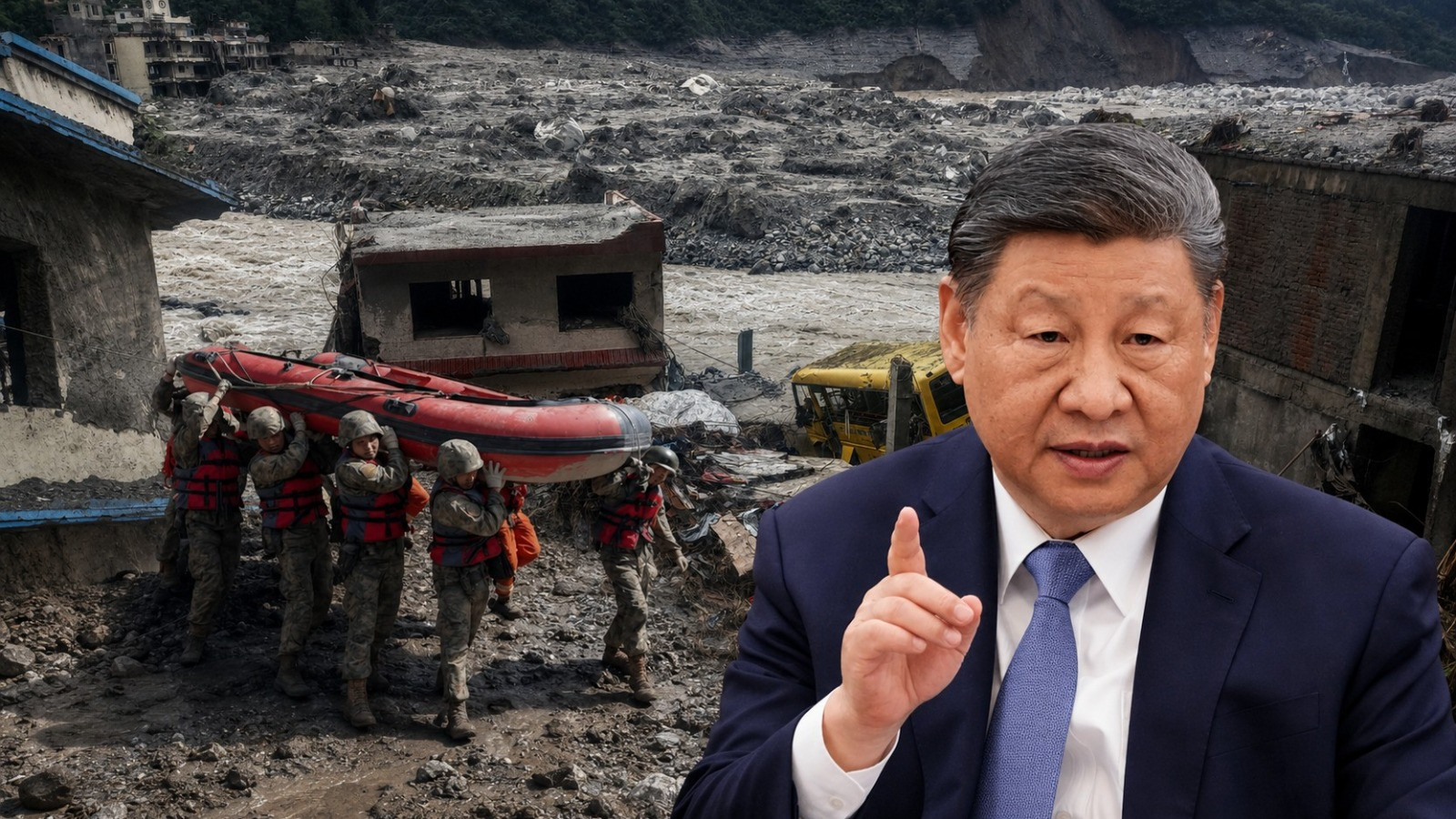
A BBC report claims that China is censoring videos related to floods in Nepal and Tibet.
Relief and rescue operations are ongoing on both sides of the border following the devastating floods in Nepal and Tibet. Meanwhile, a controversy is intensifying on social media regarding how this disaster is being reported.
At the center of the controversy is a report by BBC's China correspondent Laura Bicker. It claims that,

China is censoring videos related to the floods.
Bicker states that Beijing has removed videos showing the Gyirong Port, located at the border, being engulfed by landslides and the swift currents of floodwaters due to fears of instability in the politically sensitive region of Tibet. BBC reporter Laura Bicker wrote,
This horrifying video was one that was almost impossible to ignore. The raging floodwaters at Gyirong Port, one of the major border crossings between Nepal and Tibet, swept away everything in its path. Hundreds of people were seen running for their lives. These scenes captured by CCTV cameras quickly spread on social media and reached television channels around the world. But in China, the picture was entirely different. The state-run news bulletin in China has so far aired only a single still image of the incident.
It has also been difficult to find the complete video of the floods on China's tightly controlled internet, although various aspects of the disaster have been discussed online.
Even more challenging is finding firsthand accounts from survivors who can describe the horror of this sudden flood. More than 1,200 people have reportedly died in Nepal due to this tragedy, and nearly 4,000 are still reported missing.
Beijing has launched a large-scale rescue operation involving hundreds of emergency personnel, which is still ongoing. President Xi Jinping has also chaired an emergency meeting with officials to coordinate relief and rescue efforts. However, when comparing the content that has appeared online in most parts of the world over the past few days with the information available on China's internet, it is almost negligible. State-controlled media has primarily focused on the People's Liberation Army (PLA) relief and rescue operations, President Xi Jinping's leadership during the crisis, and Prime Minister Li Qiang's visit to the disaster-affected area in its coverage of the floods in Tibet.
Tibet, which Beijing has controlled since the 1950s, has long opposed the rule of the Chinese Communist Party. China has suppressed protests that have occurred there over the years—sometimes violently. The predominantly Buddhist region has also faced serious allegations of human rights violations against China.
However, some social media users have shared screenshots of the footage used in the BBC report, claiming that these scenes were indeed shown in Chinese media as well.
A Chinese journalist reacted sharply, stating,
I have never seen the BBC spread rumors so openly. In such heated debates about censorship in China, the “balanced perspective often gets lost.”
The Chinese government has long accused Western media of being “biased” in their reporting on Tibet. This week, its supporters on social media have appeared to reinforce this claim, particularly targeting the BBC. However, it is also true that Chinese social media users, both inside and outside China, have long faced the control of information by authorities. This situation has also been observed following the floods.
As Bicker reported in her article,
The most obvious example is the removal of videos showing Gyirong Port being engulfed by mud and water. This footage was initially circulated on platforms like Weixin and Rednote, but later users were unable to view it.
Another method of controlling information is to limit access for independent and foreign journalists. According to Australian Broadcasting Corporation journalist Alison Horn,
She has applied multiple times for permission to go to Tibet, but each time her request has been denied. Many other foreign journalists have also been prevented from going there. This has made it extremely difficult, if not almost impossible, for foreign media to independently verify the Chinese government's official accounts of events.
The absence of independent journalism and the removal of videos from social media have given Chinese state media the opportunity to establish its narrative regarding the entire story of the disaster. This also reflects the longstanding tendency of Chinese media to avoid content that could cause social instability or fear among the public.
The Guardian reports that very little information has emerged about how this disaster has affected local villagers, their homes, and communities. On the other hand, in the Nepali part of the border, foreign journalists have been able to speak to flood victims and survivors without any hindrance.
Critics also allege that the Chinese government is hiding the true number of dead. However, the biggest problem with this claim is that due to restrictions on access to the disaster site, no outsider—whether a critic of China or not—has been able to independently verify the number of dead. The media environment in China has not always been as controlled as it appears today.
On May 12, 2008, a powerful earthquake measuring 8.0 on the Richter scale struck Sichuan province in China. This disaster resulted in the deaths of over 70,000 people and left millions homeless. Almost immediately after the earthquake, Chinese state media began extensive live coverage. This coverage continued for several weeks. China Central Television regularly provided updates on the death toll and reported in detail on rescue operations.
Foreign media had then raised questions about whether the deaths were preventable due to the collapse of poorly constructed school buildings. Foreign journalists also asked whether the victim families would ever receive justice. Chinese media had also given space to some of these controversies. Questions were raised about whether the local administration had conducted necessary quality checks in the construction of schools.
In the early stages, this coverage was considered a significant achievement in the reporting of emergencies and natural disasters in China. Western media also paid special attention to the “unprecedented transparency” displayed at that time. But within a few weeks, the government began to tighten control over information related to school buildings. Officials feared that this issue could fuel anti-government sentiments.
Generally, Chinese state media are instructed to emphasize “positive reporting” during crises. Meanwhile, content that criticizes government actions or holds the administration accountable is removed by censorship. The media coverage of the deadly train accident in Wenzhou city in 2011 is a prominent example of this.
Research indicates that unlike the Sichuan earthquake, in this rail accident case, the government maintained strict control over the content published in the media. Officials instructed media organizations not to send journalists to the accident site, to limit the number of reports, and to avoid linking the incident to the development of the high-speed rail project.
Since Xi Jinping came to power in 2012, the government has expressed concerns about potential challenges to its rule, tightening control over traditional media and social media. The current media coverage of the Nepal-Tibet floods also appears to follow this old pattern—limited information and a greater emphasis on positive news. This disaster has occurred at a time when distrust between China and Western countries is continuously increasing. For this reason, both sides consider each other's reporting to be biased. Practical difficulties in accessing the disaster site and sources providing direct information have further exacerbated the problem.