
Why the American dream is under threat for Indian IT professionals

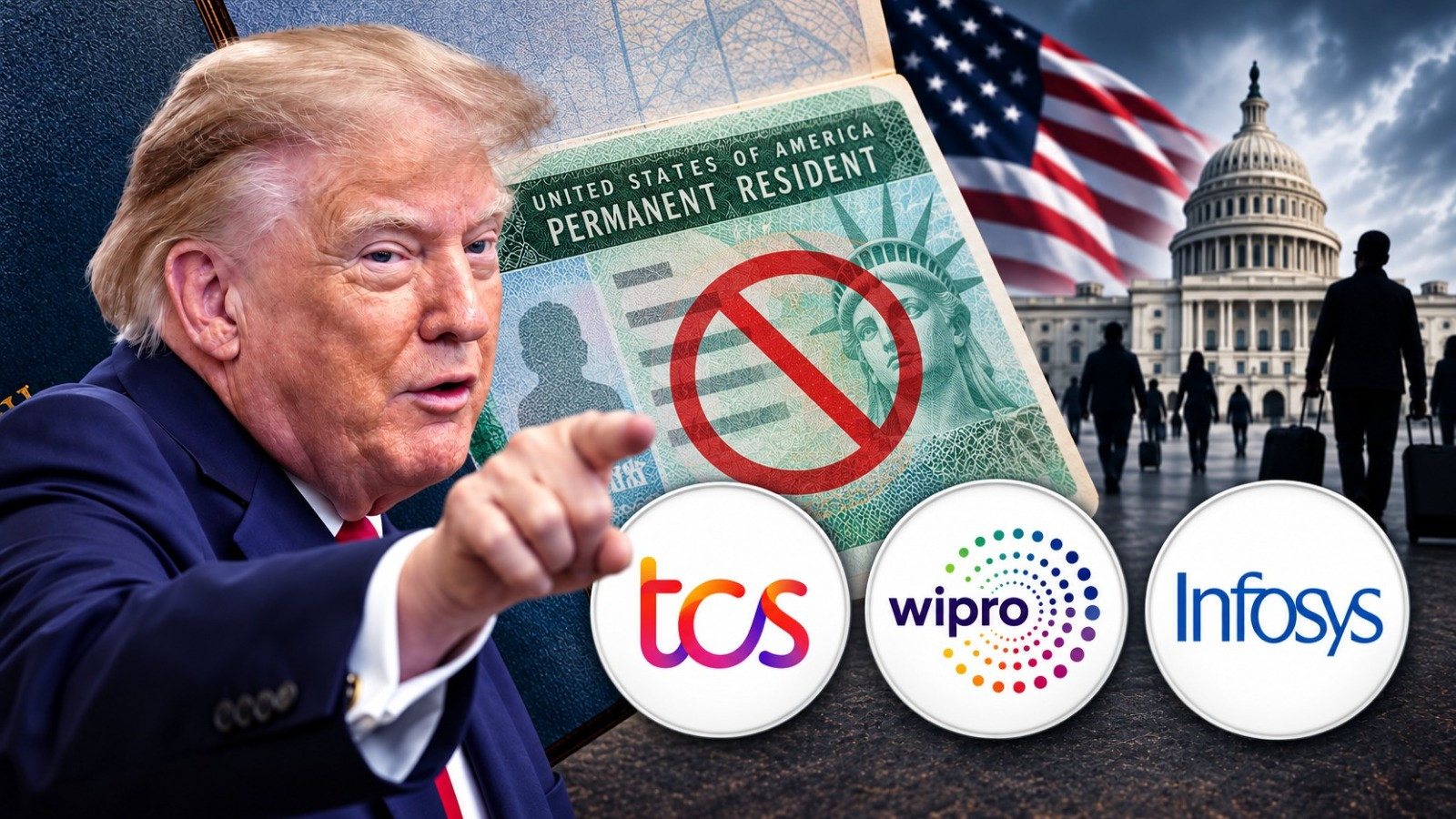
AI Image
Suspension of a company's PERM does not automatically cancel all its employees' existing H-1B visas.
A new challenge has emerged for Indian IT professionals dreaming of settling permanently in the U.S. with a job. The Trump administration has announced the suspension of several major technology and IT outsourcing companies from a government program that facilitates the green card process for foreign employees.
This action includes Tata Consultancy Services (TCS), Infosys, Wipro, HCL, Cognizant, and Capgemini, along with Microsoft and Adobe. The Trump administration cited fraud and the impact on employment opportunities for American workers as reasons. However, these allegations cannot be considered proven facts against the companies. Why was this decision made, what role does this program play in the green card process, and what does it mean for Indian employees?
Let us understand this in detail.
U.S. Secretary of Labor Keith Sonderling announced the suspension of companies from the Permanent Labor Certification Program. This is commonly referred to as PERM, or Program Electronic Review Management.

Sonderling said that,
the administration wants to eliminate fraud that increases dependence on foreign workers. Their argument is that American companies should prioritize American employees when hiring. Previously, a similar action was announced against Cognizant. At that time, specific allegations against the company, the number of affected applications, and the duration of the suspension were not detailed. Now, the scope of action has been expanded to several other major companies.
It reached a point when Sonderling even compared Indian IT professionals to snakes.
Sonderling said that,
the Trump administration knows that American employees are the most qualified and talented in the world. The jobs taken from them should have gone to Americans first, and they will still go to Americans first, not foreigners, especially those foreigners who commit fraud. Today, thanks to President Trump, the Vice President, and the task force, we are cutting off the head of the snake.
The Trump administration alleges that,
some companies have misused immigration programs to recruit foreign employees. Issues under investigation include fraudulent documentation, hiring foreign employees at lower wages, and employing foreign professionals instead of American workers.
Sonderling claimed that,
affected companies have requested permanent residency for about 3 million foreign employees since 2009. He also mentioned over 2.30 lakh approved H-1B visas and more than 1 lakh permanent labor certifications.
These figures and the conclusion that American jobs are being affected are currently only claims made by the Trump administration. The mere hiring of foreign employees or the filing of immigration applications does not automatically prove fraud. Whether a company has violated rules or not will be determined by the relevant investigations and available evidence.
PERM is a crucial initial step in the process of obtaining a green card based on employment. Under this, U.S. employers obtain certification from the labor department for their foreign employees. The aim is to check whether offering a permanent job to a foreign employee will adversely affect the employment opportunities, wages, or working conditions of American workers.
Before filing an application, the employer must obtain an assessment of the prevailing wage for the designated position. They must also complete the recruitment process as per the prescribed rules to determine whether a qualified and available American worker can be found for that job. After this, the employer files the application on behalf of the foreign employee. Upon receiving certification from the labor department, they can proceed to the next stage of the green card process. Therefore, approval of PERM does not equate to automatically receiving a green card.
H-1B is a temporary work visa. Through this, U.S. companies hire foreign professionals with special qualifications. PERM, on the other hand, is related to the process of permanent residency. Therefore, being suspended from PERM does not mean that all existing H-1B visas of its employees are automatically revoked.
Similarly, it would be incorrect to interpret this announcement as a broad restriction on all Indians' green cards. Its impact will primarily be on the employment-based process moving forward through the affected companies. The effect on individual employees will depend on the stage their case is at. For those employees whose green card process has not yet reached the stage of filing aPERM application, the biggest issue will be delays.
The suspension may disrupt the ability of affected companies to initiate new applications, which could halt employees' further processes. This could make their plans to settle permanently in the U.S. uncertain. For Indian employees, this delay is particularly significant, as there is already a long wait in many categories of employment-based green cards. A late start to the process could further extend the wait.
The date on which the labor department accepts the labor certification application generally becomes the employee's priority date. In simpler terms, this can be understood as the date that determines their place in the queue for the green card. The availability of green cards depends on the relevant category, country, and set limits. If the PERM application cannot be filed, the employee cannot obtain their priority date through this stage. Therefore, delays in starting the process are not just bureaucratic hassles; they can also push back the beginning of a long wait.
For some employees holding H-1B visas, the situation may be more serious. This visa typically has a six-year limit, although extensions are possible upon meeting certain conditions.
Timely filing of the labor certification application could provide some employees with a basis for extending beyond six years. In such cases, PERM process delays could increase anxiety for those employees approaching this limit.
However, employees with previously approved immigration petitions and waiting for green cards may have a different situation. Under the prescribed rules, they may be eligible for extensions. It is crucial to have clear answers to questions regarding how long the suspension will last, what will happen to pending cases, and what instructions will apply to applications that have reached different stages. For now, the greatest impact is the uncertainty for employees starting new processes. The future for Indian IT professionals will depend on the official directives received by companies, the outcomes of investigations, and the status of their own applications.