
Thousands of students protest against Macron in France

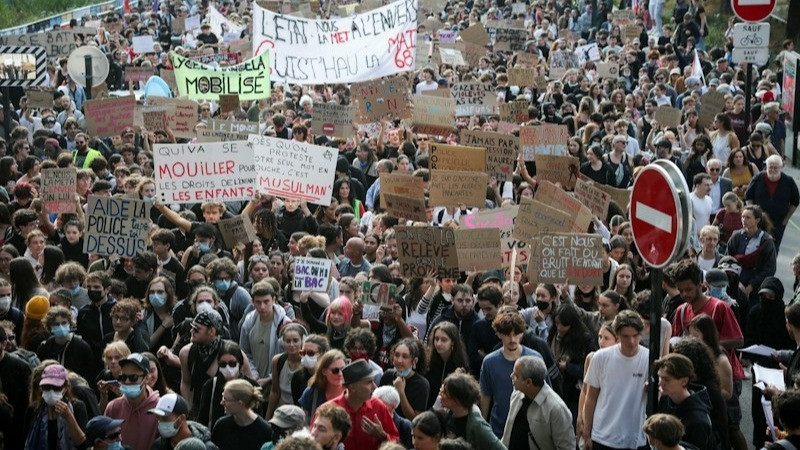
Students are demonstrating against teacher shortages, inadequate budgets, and poor facilities.
The ongoing movement against the shortage of teachers, inadequate budgets, and poor facilities in schools in France has now taken the form of a nationwide protest. Thousands of students have taken to the streets across the country against President Emmanuel Macron's policies. This movement, which began in September, has spread throughout the country. Students are protesting against overcrowded schools, dilapidated buildings, and a lack of teachers.
In the past week, students have shut down more than 1,800 schools. During the protests, clashes occurred between students and police in several locations. In Lens, an explosion near a school resulted in a 15-year-old student's hand being severed. He was hospitalized. Earlier last week, a 14-year-old student named Eden was reported to have been hit in the head by a tear gas canister. He suffered two fractures in his jaw and required major surgery.
At least 190 students have been injured during the protests, while 5,060 protesting students have been arrested. Among them, 87% are minors.
According to a report by France 24, on Tuesday, high school student organizations and trade unions are planning blockades and street protests across the country. Thousands are expected to participate in these protests. The protesters are demanding that President Emmanuel Macron's government take concrete steps to address the issues in the education system.
This movement, which emerged in recent weeks, began in the economically disadvantaged suburban areas of Paris. It has now spread to other parts of the country. Students from affluent areas have also joined the movement in solidarity.
Students say that the shortage of teachers and resources is affecting their education. They want better facilities and a conducive learning environment in schools.
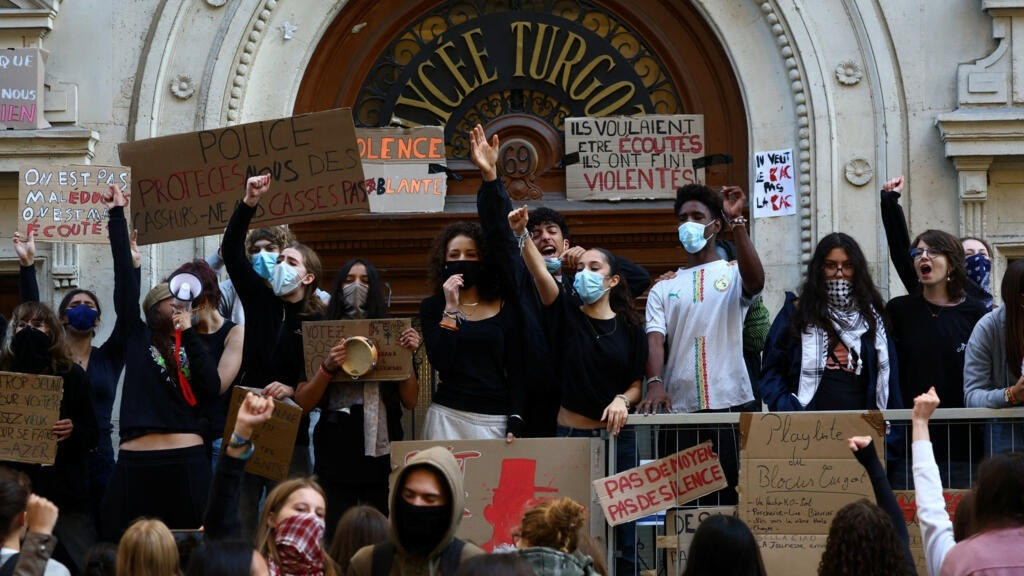
Since the end of September, student protesters have blocked the entrances of hundreds of high schools. Their complaints include the absence of teachers, an extremely busy study schedule, dilapidated classrooms, and a lack of adequate arrangements to protect against heat. Many school buildings are unsuitable for studying in high temperatures. Students demand that the government take these issues seriously and take action to resolve them.
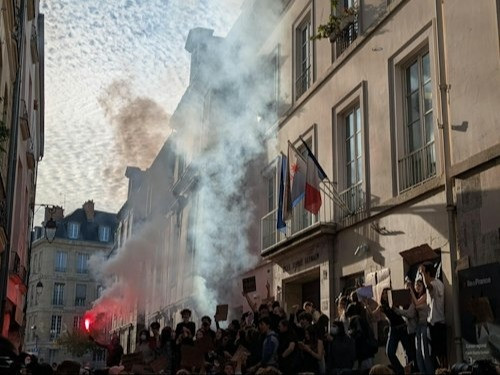
While many protests have remained peaceful, incidents of violence and clashes with police have also been reported in some areas. Some protesters set fire to trash bins and vandalized bus stop shelters. Riot control police responded with batons, tear gas, and special projectiles used for crowd control. Authorities have alleged that the movement has turned violent in some locations.
According to France's Ministry of Justice, since the protests began, 5,060 people have been arrested. About 87 percent of those detained are minors. The ministry reported that charges have been filed against more than 1,800 individuals, including 1,483 minors.
However, the ministry did not clarify what charges have been brought against these individuals. Approximately 790 cases have already been closed.
Trade unions and human rights organizations have raised questions about the large number of minor arrests and police actions. These organizations allege that the police used excessive force against children. Interior Minister Laurent Nunez stated on Monday that 10 internal investigations have been initiated to examine allegations of police brutality since the protests began.
Meanwhile, Prime Minister Sébastien Lecornu has stated that,
he has instructed ministers to study the students' key demands. The government will consider issues such as providing substitute teachers for absent teachers, reviewing the school day duration from 8 AM to 6 PM, and allowing more time for lunch. There is also a promise to look into the repair needs of old school buildings.
The movement began on September 21 at the Saint-Exupéry High School in a suburb of Paris. Teachers were on strike against the shortage of staff and resources, and students joined in support. After additional staff were sent, the local strike ended, but by then the protests had spread to other schools.
According to student leader Manes Nadel,
the movement has spread like wildfire. He said that it is unprecedented for so many schools to join the movement simultaneously, and the Ministry of Education seems completely helpless in dealing with the crisis.
Students in Paris and surrounding areas began blocking school entrances. Within days, such protests spread from Lille in the north to Marseille in the south. Images of setting trash bins on fire, erecting barricades, attacking teachers, and clashes with police have raised questions about the direction of the movement and police actions. So far, over 100 high schools have been damaged.
There have also been allegations of excessive force used by the police. A video surfaced in Alençon showing a police officer grabbing a girl's neck. This method is legally prohibited. Student leaders allege that the government is resorting to repression instead of listening to their demands.
A significant part of the government's initial response focused on the far-left party La France Insoumise (LFI) and its presence at protest sites. Leftist party leader Jean-Luc Mélenchon has supported the students' right to protest and the presence of his party there, anticipating a strong performance in the upcoming presidential elections next spring.
The damage caused by the students' movement in schools in the Greater Paris area alone is estimated at nearly €7 million. An initial concession related to technical high school fees was later removed from the government budget. Nadel described this as irresponsible, stating that students' anger stems from the fact that their voices are not being heard.
Poor public finances are also complicating the government's situation. It aims to bring the deficit in the 2027 budget to about five percent of GDP, which will require significant cuts in spending. Last week, the yield on France's ten-year government bonds briefly rose above five percent, the highest level since 2002.
This unrest has also intensified the political competition for the presidential elections. The student movement of May 1968 in France turned into the country's largest strike. Today, protesters say their demands are not impossible—they simply want an education system that gives them a proper chance to learn.