
UP SIR reveals shocking deletion of 85,854 voter names

Surprisingly, all these applications were submitted after the deadline.
Questions are continuously being raised regarding the process of removing voters' names during the Special Intensive Review (SIR) in Uttar Pradesh. The Reporters Collective investigation revealed that the software of the Election Commission of India (ECI) automatically generated forms for removing the names of 85,854 voters without providing any reasons. Everything was automated, and later, these forms with digital signatures were sent to the officials for approval. In other words, the software deleted the votes of 85,854 voters on its own without any reason. Isn't that a remarkable game!
Interestingly, all these applications were submitted after the deadline set by law.
According to the report,
These requests for name removals emerged in large numbers during the claims and objections phase in Uttar Pradesh. This phase ran from the publication of the draft voter list on January 6, 2026, to the release of the final list on April 10. All applications for name removals, officially referred to as Form 7 objection applications, were displayed on the website of the Chief Electoral Officer of Uttar Pradesh.
A total of over 4.3 lakh Form 7 applications were submitted. The Reporters Collective conducted an investigation by collecting data from the website with a team of data analysts. Approximately 20 percent of the requests were filed by the Commission's own assembly-level officials. However, the officials did not fill these forms themselves.
According to the investigation,
During the hearings of the SIR, the Commission's ERONET software automatically prepared forms for the removal of voters by the officials. The digital signatures of the officials were already present on these forms. They were sent for approval to senior officials. The officials responsible for deciding on the claims for name removals were playing both the roles of applicants and decision-makers in these cases.
According to the rules,
A citizen filing an objection to remove a voter's name must provide clear reasons. It is necessary to choose one of the options provided in Form 7. These include the death of the concerned individual, being underage, being absent, permanently moving elsewhere, being already registered, or not being an Indian citizen.

The investigation found that,
Election Registration Officers (ERO) and Assistant Election Registration Officers (AERO) filed a total of 87,127 applications. Among these, 85,854, or 98.5 percent of the applications, did not provide any reason for name removal. In 62 forms, letters like 'A, N, H, E' were written in place of a reason. The remaining 1,211 applications recorded 'absent/transfer' as the reason.
All 87,127 applications from ERO and AERO were filed in just 19 days between March 15 and April 2, 2026. On the other hand, approximately 3.43 lakh individual objectors provided reasons for name removals following the process. The investigation also revealed that the Commission accepted a total of 1,10,476 applications filed by individuals after the deadline.
The Reporters Collective stated that,
This process is against the Voter Registration Rules, 1960. The rules state that claims or objections not submitted in the prescribed manner should be rejected. This includes providing a clear reason for name removal. The report alleges that changes in the software compelled officials to sign forms that were against the rules.
The investigation found hundreds of applications from individuals with similar names in the Tarabganj and Pilibhit assembly constituencies. Almost entirely, these targeted Muslim voters. According to the report, 90 percent of the name removal requests filed in both areas were against Muslim voters.
In Tarabganj, 188 objections were registered under the name 'Reshma'. Further investigation revealed that all applications were filed on the same date and against voters from the same polling station. The report indicated that such a pattern was also observed in other parts of the state. However, the Commission's data does not include any identification details of those proposing name removals, so citizens cannot freely verify their identity. The Reporters Collective sent detailed questions to the Chief Electoral Officer of Uttar Pradesh, Navdeep Rinhwa, and the Election Commission based in Delhi. No response had been received by the time of publication.
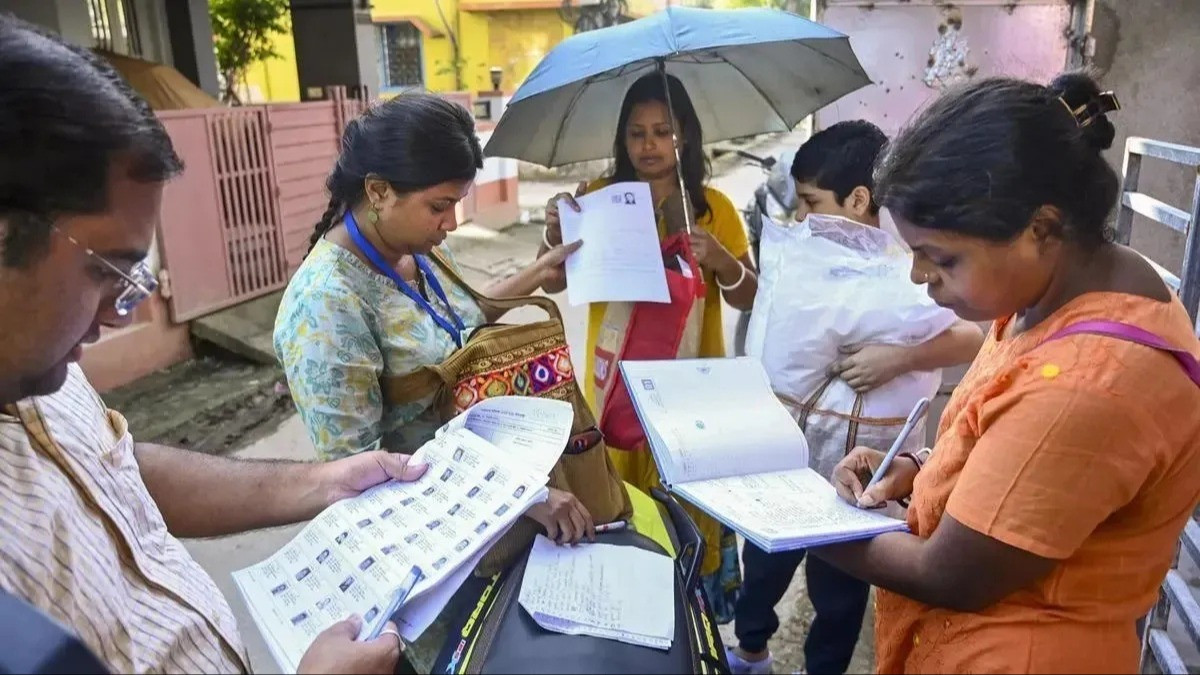
The Reporters Collective spoke with four electoral officers at the assembly level. According to them, during the SIR hearings, Form 7 was automatically generated for the removal of voters. Since digital signatures were already present, the officials had no option but to send them for approval.
The Commission had previously been preparing Form 7 automatically during the enumeration phase as well. At that time, booth-level officers (BLO) recorded cases of absent, transferred, deceased, or double-registered voters. They had to specify one of the six reasons available for name removal. Then ERO and AERO decided whether the concerned name should be kept in the ASDD list or not. However, the investigation claims that after the hearings, the software placed ERO and AERO in both roles of filing and approving name removal applications. These officials are empowered under the Representation of the People Act, 1950. The rules of the SIR hearings state that it is necessary to record the reason for removing a voter.

Uttar Pradesh was among the 12 states and union territories where the second phase of SIR took place. The first phase began on November 4, 2025. BLO was tasked with delivering and retrieving enumeration forms to every voter listed in the October 2025 voter list. Those whose forms were not received were placed in the ASDD list for removal.
For this, ERONET automatically created Form 7, which BLO had to sign with reasons. Out of the state's original 15.44 crore registered voters, 2.89 crore names were placed in the ASDD list.
The draft list was published on January 6. After this, hearings were held for those voters whom the Commission's algorithm had flagged as suspicious but whose names were in the draft list. A total of 3.26 crore voters were marked based on 'logical discrepancies' or being 'unmapped'. ERO and AERO summoned them to prove their identity. If verification did not occur, names were removed from the final list.
The final list released on April 10 included 13.4 crore voters. Navdeep Rinhwa did not disclose in the press conference how many names were removed during the hearings. Four EROs told the Collective that the applications found in the investigation were meant for removing unverified voters.
One ERO stated,
Whenever we did not approve a voter during the hearings, the system automatically prepared Form 7 on our behalf. He explained that the option to approve was only available through their login in the app, so their signatures on the forms were inevitable.
The Collective also reviewed the hearing rules sent to officials but not made public. These rules required recording an explanation for name removal after issuing a notice based on suo motu cognizance. Officials claim that the order was reversed in SIR: hearings were held first, and then notices for name removals were prepared.