
Congress rejects Modi government's claims on UPI tax support

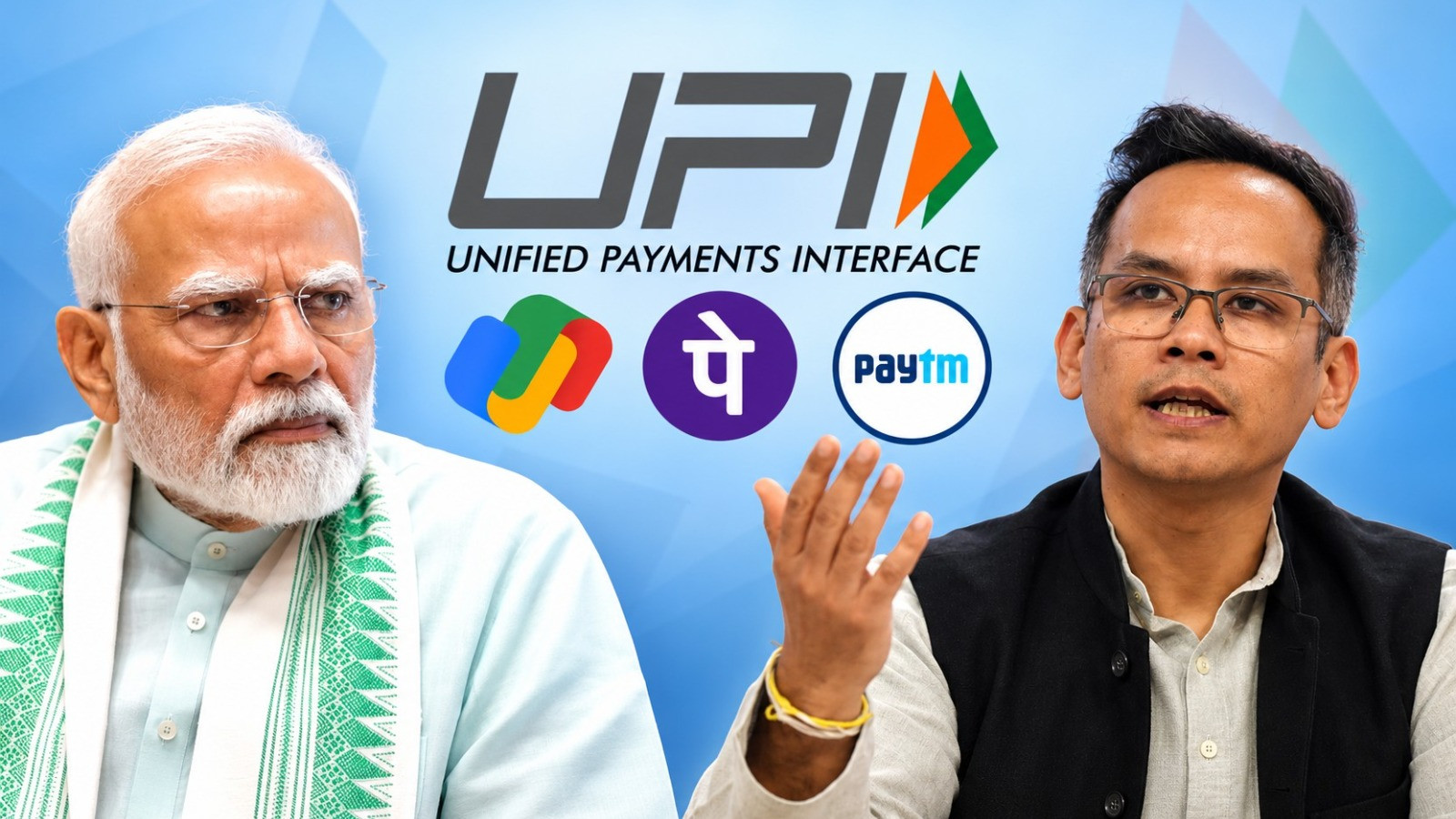
Congress stated that the finance department had no concrete proposal regarding 'UPI tax' during the committee meeting.
The Congress party on Thursday dismissed claims that its MPs, who are part of the parliamentary finance committee, supported the decision to impose charges on UPI payments above ₹2,000. The party alleged that,
the Modi government is making a “very weak” attempt to divert attention from the massive opposition that arose after the decision of the ‘UPI tax’.
This response from Congress came after the government questioned Rahul Gandhi's criticism of the decision to impose charges on UPI payments over ₹2,000. The government stated that the parliamentary committee had supported such a provision and that the Congress MPs involved in the committee had also agreed to it.
According to a senior government official,
the parliamentary finance committee had recommended implementing a phased Merchant Discount Rate (MDR) or revenue arrangement for UPI. The committee stated that its notification should be issued and implemented without delay.
A BJP official claimed that during the acceptance of the report on August 12, five Congress MPs, including P. Chidambaram, Manish Tewari, Gaurav Gogoi, Kishori Lal, and K. Gopinath, were present. There is no mention of any dissent from them in the published proceedings.
However, Congress MP Gaurav Gogoi rejected these claims, stating that there was no discussion on the recently announced ‘UPI tax’ proposal in the parliamentary finance committee.
According to Gogoi,
the finance department did not have any concrete proposal related to the ‘UPI tax’ at the time of the meeting with committee members. Questions were raised regarding the need for MDR, but government representatives did not have any clear or satisfactory answers at that time.
Gogoi wrote on the social media platform ‘X’,
I reiterate that the recent UPI tax policy will harm small Indian traders, shopkeepers, and entrepreneurs, while benefiting large American companies. The UPI tax should be withdrawn. Prime Minister Modi, stop surrendering.”
Sharing a post by Congress leader Manish Tewari, Congress General Secretary Jairam Ramesh said that,
the system of ‘planted news’ that has emerged during the Modi government has been exposed. In another post, he alleged that the government is making such claims to divert attention from the massive public opposition to the UPI tax. Ramesh stated that this decision has been taken to please American companies and ‘Donald Bhai’.
Congress MP Manish Tewari also targeted the government. He stated that the proceedings of parliamentary committees are considered confidential, but the government is now using them for political gain.
Tewari said,
“My colleague Gaurav Gogoi is correct. No specific proposal related to the MDR applicable to UPI transactions from October 15, 2026, was presented before the parliamentary finance committee. Information regarding fee rates, volumes, maximum limits, and categories of discounts was also not presented before the committee. He stated that questions were raised regarding the principles and necessity of MDR in various meetings of the committee. Therefore, it is incorrect and misleading to claim that some members of the committee supported this specific step.”
Earlier, a government official had questioned why Rahul Gandhi was opposing a system that had been supported by his party's MPs—including former Finance Minister P. Chidambaram and former Union Minister Manish Tewari—in the parliamentary committee. Rahul Gandhi had alleged that the government's decision to impose charges on UPI payments over ₹2,000 was a result of Prime Minister Narendra Modi “kneeling” before U.S. President Donald Trump and deciding to pay a large sum to the U.S. He also demanded the withdrawal of this decision.
According to the report of the permanent committee chaired by BJP MP Bhartuhari Mahtab, the committee mentioned its previous recommendation, stating that a practical revenue model for the digital payment system is necessary. For this purpose, legal provisions have been made to implement a phased MDR system. However, the committee expressed deep concern over the significant gap between the ₹2,000 crore allocated by the government and the estimated operational cost of ₹20,700 crore for the digital payment industry.
According to the committee,
despite the legal framework for implementing a balanced MDR on higher-value transactions, delays in its notification and implementation will leave payment service providers dependent on inadequate government subsidies. This could affect necessary investments in cybersecurity, fraud prevention, and network infrastructure.
RuPay debit cards and low-value BHIM-UPI person-to-merchant transactions were promoted by the committee, which stated that,
for the financial year 2026-27, a budget of ₹2,000 crore has been allocated. Its purpose is to compensate for the costs arising from the zero-MDR policy on RuPay and low-value UPI payments.
According to the report,
it is expected that UPI will facilitate transactions worth up to ₹150 billion every month and that 60 million new users will join. Nevertheless, the current government incentive amount covers only 11 percent of the industry's actual costs and about 14 percent of potential MDR collections. This is creating a significant financial gap for long-term infrastructure investments.
The committee recommended that a proposed three-year plan and cashback scheme to promote digital payments in tier-3 to tier-6 cities are necessary. Additionally, the financial services department should also work on the possibilities of a self-sustaining and phased revenue model.