
US threatens sanctions after Modi-Paeshkian meeting

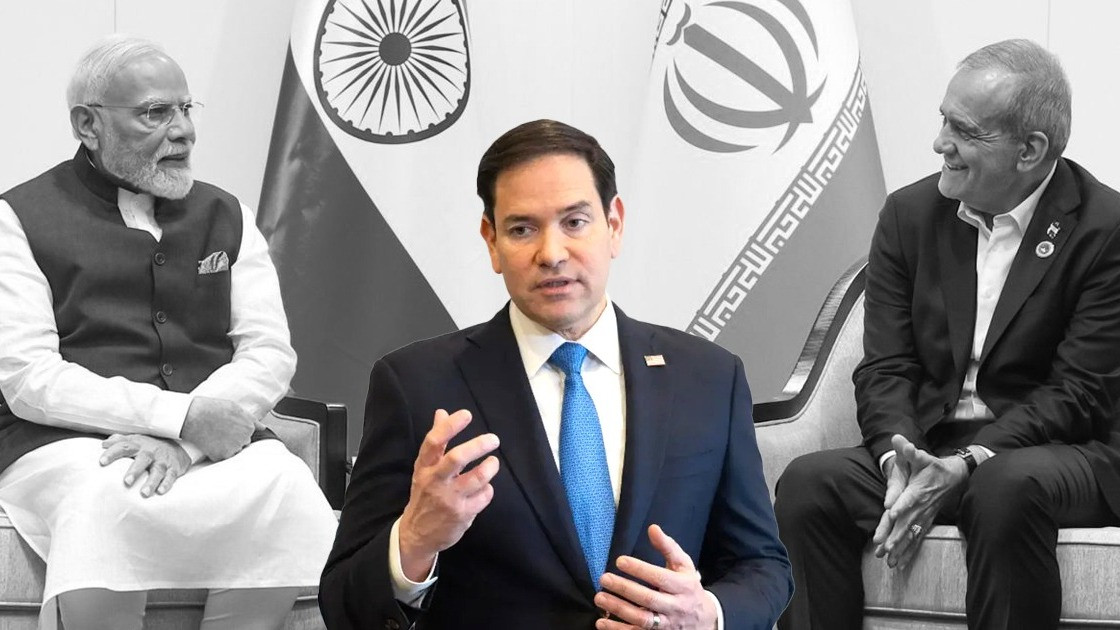
US Secretary of State Marco Rubio warned that India will face sanctions if it strikes a trade deal with Iran.
U.S. Secretary of State Marco Rubio has stated that if India enters into a trade agreement with Iran, it will also face sanctions. In an interview with Fox News’ The Brian Kilmeade Show, Rubio was asked about the Modi-Paijeshkian meeting and news regarding a potential trade agreement between the two countries, during which he issued a warning about U.S. sanctions.
However, Rubio dismissed speculation that India is moving towards a trade agreement with Iran following the meeting between Prime Minister Narendra Modi and Iranian President Masoud Paijeshkian at the 26th Shanghai Cooperation Organization (SCO) summit held in Bishkek, Kyrgyzstan.

Rubio said,
I do not think there is any trade agreement happening between India and Iran. Naturally, all countries make their own independent foreign policies, and many countries in the world engage with the Iranian regime. He noted that the U.S. has also maintained contact with some representatives of the Iranian regime during discussions on various issues. He reiterated U.S. President Donald Trump’s stance that any country wishing to avoid U.S. sanctions should not assist Iran.
It is surprising that the U.S. repeatedly threatens tariff wars and sanctions, while Indian companies have invested $40 billion in the U.S., providing direct employment to over 70,000 Americans. Unemployment is at a peak in the country, and preparations are being made to provide jobs abroad. According to a report by NITI Aayog, over 8.75 crore youth in India remain unemployed despite receiving necessary training.
The U.S. Embassy stated on X that,
U.S. Treasury Secretary Scott Basent met with India’s Finance Minister Nirmala Sitharaman after the G20 Finance Ministers and Central Bank Governors (FMCBG) meeting held in Asheville, North Carolina, on September 1. This meeting took place at a time when Indian companies are continuously expanding their business in the U.S. According to the post, Indian companies have invested $40 billion in the U.S. and are providing direct employment to over 70,000 Americans.
It is noteworthy that PM Modi held a bilateral meeting with Iranian President Masoud Paijeshkian in Bishkek, Kyrgyzstan. This was the first face-to-face meeting between the two leaders since the war with Iran began in February. According to Iran's semi-official news agency Tasnim, both sides reviewed the current status of bilateral relations during the meeting. They also emphasized the need to strengthen cooperation in areas of mutual interest between India and Iran and to expand its scope. Iran's Foreign Minister Mohammad Javad Zarif and several other senior Iranian officials were also present at this meeting.
The meeting between Modi and Paijeshkian occurred at a time when tensions in West Asia are high due to the ongoing war between the U.S. and Iran. India has remained one of Iran's ten largest trading partners, but economic activities between the two countries have been affected due to the closure of the Hormuz Strait and U.S. sanctions imposed on Tehran.
Rubio stated in an interview with Fox News that,
“President Trump is very clear on this issue. No country should assist Iran in evading sanctions. No country should help create a mechanism through which it can generate revenue and then use that revenue to sponsor terrorism and pursue nuclear weapons.”
He added that,
Preventing Iran from acquiring nuclear weapons is a primary objective of the Trump administration. Iran will never be allowed to possess nuclear weapons—at least not while President Trump is in office.
The U.S. Secretary of State stated that Washington's primary means of exerting pressure on Tehran is through economic sanctions. However, the U.S. also reserves the right to take military action if necessary. He said,
As long as Iran continues to pursue or express a desire to acquire nuclear weapons, it will have to pay a price. This price will primarily be economic. But we reserve the right to take military action if necessary—not only for our own security but also to prevent Iran from becoming a threat to other countries.
Rubio's comments come at a time when threats between Iran and the U.S. have intensified following some of the most severe fighting in the Middle East in recent weeks. The confrontation between the two countries appears to be escalating amid a war that has been ongoing for nearly six months.
The U.S. military launched a “devastating attack” on over 60 Iranian targets from Tuesday night to Wednesday morning, and the U.S. is prepared to carry out another attack whenever it chooses.
On the other hand, a senior security official in Tehran stated that Iran has adopted a “new strategy” in the war following the U.S.-Israel attacks that began at the end of February.
Mohsen Rezaei, Secretary of Iran's Supreme National Security Council, wrote on the social media platform X,
You will soon see that Iran's new strategy, prepared to counter the battlefield, diplomacy, and economic blockade, will shake your foundations.