
Tension at parliament march over paper leak, protesters detained
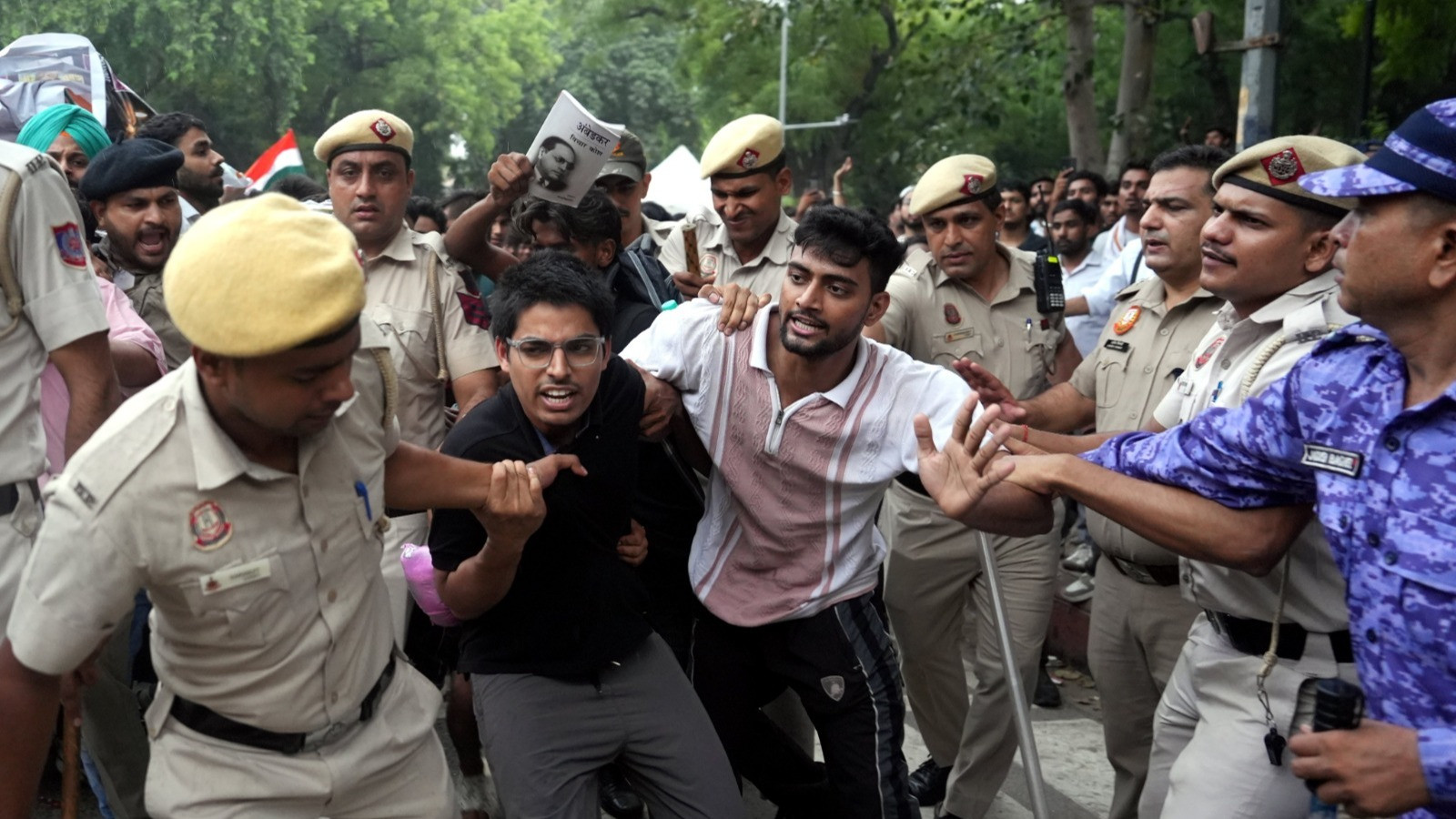
Protesters gathered at Jantar Mantar in New Delhi against paper leaks and unemployment.
New Delhi: The student protest at Delhi's Jantar Mantar, demanding accountability in the education system, unemployment, and paper leaks, turned tense on Monday during the Parliament march. A large number of students and supporters, responding to the call of the Cockroach Janata Party (CJP), began moving towards Parliament, but the police stopped them citing the lack of permission for the march.
The protesters allege that the police used force and conducted a lathi charge near the barricades, injuring many and causing head injuries to some. However, Delhi Police denied the lathi charge, stating that the protesters were only stopped from advancing into the restricted area and some were detained to maintain law and order.
From the morning, a large number of students, youth, and activists from various organizations began gathering at Jantar Mantar. As the crowd grew, several protesters attempted to cross the barricades and move towards Parliament Street. Some reached near the Parliament Street police station, where they were detained by the police.
The protest also impacted the Delhi Metro. For security reasons, the entry and exit gates of Rajiv Chowk, Janpath, Patel Chowk, Central Secretariat, and Seva Teerth metro stations were temporarily closed. As protesters reached metro stations and moved towards Parliament from different routes, security in central Delhi was tightened.
Along with Delhi Police, personnel from the Rapid Action Force (RAF) were also deployed at the site. CJP founder Abhijeet Deepke stated that the Parliament march was to be conducted peacefully and that police action cannot stop the movement. He said the government must respond to issues like the future of students, recurring paper leaks, and youth unemployment.
CJP's main demands include the resignation of Union Education Minister Dharmendra Pradhan, reforms in the examination system, and accountability in cases of paper leaks. Protesters claim that irregularities in exams are affecting the future of lakhs of students, but no major official or minister has been held accountable so far.
Meanwhile, environmentalist and educationist Sonam Wangchuk, who has been on a hunger strike for the past 23 days, has set three conditions to end his fast. First, the government must accept responsibility for the education system and paper leaks. Second, a CJP delegation should be allowed to present their case in Parliament, and MPs should assure to raise these issues in the House. Third, if a meeting with the delegation is not possible due to his health, MPs should visit Safdarjung Hospital to provide assurance.
In the meantime, three student leaders from AISA, who were on a hunger strike with Sonam Wangchuk, ended their fast. Actor Shabana Azmi, Prakash Raj, and Rajya Sabha MP Manoj Jha offered them water to break their fast. However, organizations associated with the movement have clarified that the protest will continue until the demands are met.
Government Invites for Talks
Amidst the protest and police action, the government has initiated talks. CJP spokesperson Saurav Das announced on X at 11:52 AM that the government has contacted the organization for discussions.
He wrote that he, along with Ashutosh Ranka, is going to meet JP Nadda on behalf of CJP. Saurav Das said, “Our demands are clear and the youth have gathered in large numbers. We will win.”
The future direction of the movement will largely depend on the outcome of this meeting. It is currently unclear which of CJP's demands the government has agreed to consider and whether any concrete decision was made in the meeting.

Md. Tousif
मोहम्मद तौसिफ़ राष्ट्रीय और अंतर्राष्ट्रीय खबरों पर नजर रखते हैं और ‘द क्रेडिबल हिस्ट्री’ में रिसर्चर के रूप में कार्यरत हैं।