
Norwegian king's message: Unity in diversity
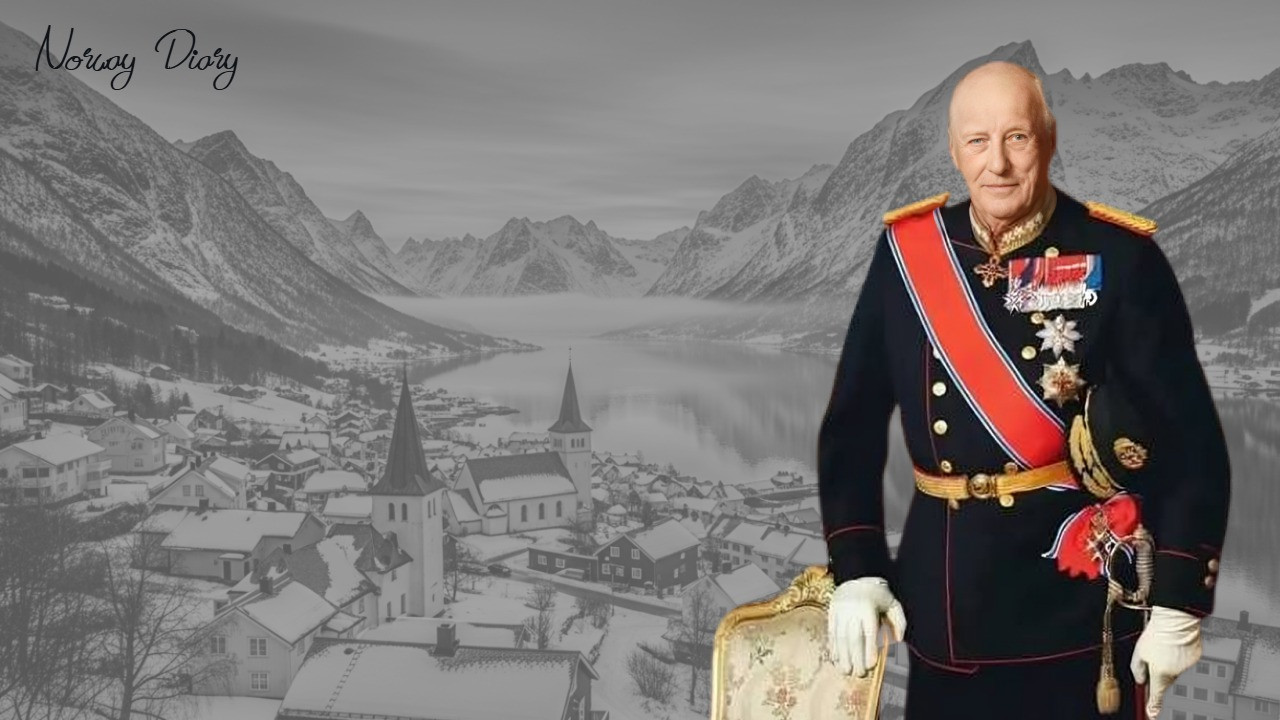
King Harald of Norway advocated for equal rights for all, despite his limited powers.
With the death of King Harald V at the age of 89, an era has ended in Norway. Perhaps his greatest legacy is not the crown, but the 2016 speech in which he called migrants, homosexuals, people of different religions, and those struggling with loneliness, all 'Norway'.
On Friday, 28 August, at 6:35 AM, an unusual silence descended over Norway. King Harald V took his last breath at the age of 89 in Oslo's Royal Hospital. After a brief announcement from the palace, people began gathering with flowers in front of Oslo's Royal Palace. Flags were lowered to half-mast, the government declared national mourning, and memories of a king who, in his 35-year reign, brought the monarchy closer to everyday Norway than the grandeur of palatial buildings, began to return.
Harald became king in 1991 after the death of his father, Olav V. In a constitutional monarchy, the king does not hold real political power, yet the royal family holds a symbolic social position in Norway. Harald's uniqueness lay in his attempt to link this symbol less with 'pure blood', lineage, or tradition, and more with shared citizenship. Perhaps that is why, upon his death, Prime Minister Jonas Gahr Støre remembered him as a person who inspired Norwegians to see the better in themselves and each other.

The famous 2016 speech, when race, religion, and love were united
On 1 September 2016, the royal couple hosted a garden party for about 1,500 people from across the country in Oslo's Palace Park. There, Harald gave a short speech. The speech contained no major political announcement, nor the name of any party or ideology. He asked a simple question, what is Norway?
First came mountains, fjords, seas, long winters, and small towns; then he said that above all, Norway is its people.
He said that Norwegians come from the north, central, and south; they have also come from other parts of the world. Some people have come from Afghanistan, Pakistan, and Poland, some from Sweden, Somalia, and Syria. Some people's parents came from outside, some their grandparents. In other words, there is no single face of being Norwegian.
He addressed religion with the same ease. Norwegians believe in God, believe in Allah, believe in the universe, and some believe in nothing. This sentence was notable even then; today, when identity politics from Europe to India begins to make religion a criterion of citizenship, its meaning becomes even greater. The king was not preaching secularism; he was simply stating that the real picture of a modern nation is already pluralistic.
Then came the part that took the speech beyond gender boundaries. The king said that there are girls who love girls, boys who love boys, and boys and girls who love each other. He also added that some people are struggling with their loneliness, some with illness, some with displacement; some are rich, some poor. That is, the nation is not just a club of successful, healthy, and majority citizens.
The central line of the speech meant: 'Norway is us.' Then he asked if we can care for each other despite differences; can we turn this country into a shared 'us'. It was not a revolutionary manifesto of a king, but the language of civic equality from the mouth of a monarchy. Ten years later, when debates on immigration, race, religion, and gender identity are far more polarized worldwide, this speech sounds almost like a contemporary editorial.
Last meeting with Modi
Harald's last major diplomatic event with India came only three months before his death. On 18 May 2026, Prime Minister Narendra Modi arrived in Oslo on an official visit to Norway and met King Harald at the Royal Palace. Modi conveyed greetings from the Indian people and described India-Norway relations as being linked by shared values like democracy and justice. They discussed the growing role of Indian and Norwegian companies in various sectors, including new technologies. After the meeting, the king hosted a luncheon in honour of the Indian Prime Minister.
After Harald's death, Modi recalled this meeting, saying that the king's warmth and dedication to his country had impressed him. It is also interesting that one of Harald's last international memories included a picture related to India. The relationship between India and Norway is now not limited to maritime trade or energy; its economic dimension is also rapidly expanding with green technology, investment, research, and the EFTA trade agreement.
The king who played in the Olympics
Harald was a sailor and had represented Norway in the Olympics. But the 2026 Football World Cup became one of his last public joys. After Norway's historic performance, he invited the entire national team to the Royal Palace on 13 July. Captain Martin Ødegaard led the way; players including Erling Haaland, coach Ståle Solbakken, and Football Association President Lise Klaveness were also present.
Thousands of supporters outside the palace were singing 'Alt for Norge' (Everything for Norway). A few weeks earlier, after a 3-2 victory over Senegal, Norwegian fans celebrated all night, reaching the palace and jokingly chanting that they had come to wake the king. Upon Harald's death, Haaland wrote that meeting him was an honour. That meeting of an elderly king and the new generation of superstar footballers is now recorded in his final public chapters.
Now Haakon VIII and Queen Mette-Marit
Norway's throne does not remain vacant. At the moment of Harald's death, his 53-year-old son Haakon became the new king, "Haakon VIII". His wife Mette-Marit is now the queen, and 22-year-old Ingrid Alexandra is the Crown Princess and next in line. Haakon has been fulfilling responsibilities as regent during his father's illness for years.
However, this has come more as a test than a succession celebration. The new Queen Mette-Marit has been embroiled in serious controversy due to documents linked to Jeffrey Epstein. Publicly released email records show regular contact between the two from 2011 to 2014. By that time, Epstein had already been convicted in 2008 for a sexual offense involving a minor. Documents revealed in 2026 also showed that the contact lasted longer than previously reported. Mette-Marit stated that she did not sufficiently investigate Epstein's background and later felt 'manipulated and deceived' by him and accepted responsibility for it.
It is important to distinguish between facts and allegations here. The documents confirm Mette-Marit's contact, meetings, and correspondence with Epstein; they do not in themselves prove any involvement of Mette-Marit in Epstein's crimes. Yet, the prolonged contact of a future queen with a convicted sex offender has raised significant questions of public trust. Thus, the new King Haakon faces not only the task of upholding his father's legacy but also the challenge of restoring the royal family's credibility.
 (Norway's new King Haakon and Queen Mette-Marit)
 (Princess Ingrid)
An African-American Son-in-law
The Norwegian royal family stands out among modern European royal houses for another reason. King Harald's daughter, Princess Märtha Louise, married American Durek Verrett in 2024. Verrett is African-American, and several international publications have described him as the first African-American man to marry into a modern European royal family. Thus, it is more accurate to say that Norway is the European royal family where an African-American man entered the family by marrying the king's daughter.
King Harald and Queen Sonja themselves attended the wedding and had already publicly extended their best wishes to the couple. Harald also condemned the racist reactions against Verrett. Ironically, Verrett later claimed in a Netflix documentary that the royal family initially did not understand his experiences with racism. This allegation sparked intense debate in Norway, with many defending the king. This episode adds another layer to Harald's legacy: a family that publicly speaks the language of inclusivity but continues to learn and grapple with new social realities in private life.
 (Märtha Louise and Durek Verrett)
More Than a King, a 'Shared Symbol'
Harald's life was a story of breaking traditions. He waited years to marry Sonja Haraldsen because she was not from a royal family. They eventually married in 1968. In the next generation, his son Haakon married Mette-Marit, who was already a mother. His daughter Märtha Louise chose an African-American spiritual guru as her life partner. Each of these events distanced the Norwegian monarchy further from the old European aristocratic framework.
The monarchy is not a democratic institution in itself. The heir is determined by birth, not election. In Norway, demands for a republic have arisen from time to time. Therefore, it would not be correct to equate Harald's popularity with the monarchy's undisputed acceptance. His personal popularity perhaps remained because he did not attempt to convert the undemocratic origin of his position into political power; instead, he became a symbol providing solace in times of crisis, partnership in times of celebration, and a minimal shared language in times of disagreement.
Whether it was addressing a grieving nation after the 2011 terrorist attacks, integrating immigrants into Norwegian identity, or inviting the World Cup-returned football team to the palace, Harald's role often appeared where the logic of politics required a shared sentiment. His real power as a king was perhaps that he had very little political power.
Now, Haakon VIII faces a challenging legacy. He must preserve the language of 'we' that his father created at a time when the royal family itself is amid controversies and European politics is grappling with identity, immigration, and polarization. Perhaps this is why the question from 2016 returns: Who are we? Harald's answer was very simple: a country is not just a map, but the people living in it. Different people. And if they can take care of each other, that is the nation. These lines remind one of the Hindi poet Sarveshwar Dayal Saxena, whose poem goes,
A country is not a map on paper
That remains intact even if one part is torn
Praveen Kumar Jha
प्रवीण कुमार झा नार्वे में रहते हैं। पेशे से डॉक्टर हैं, मन से लेखक। कई चर्चित किताबें प्रकाशित