
Nepal floods caused by glacier collapse, not earthquake

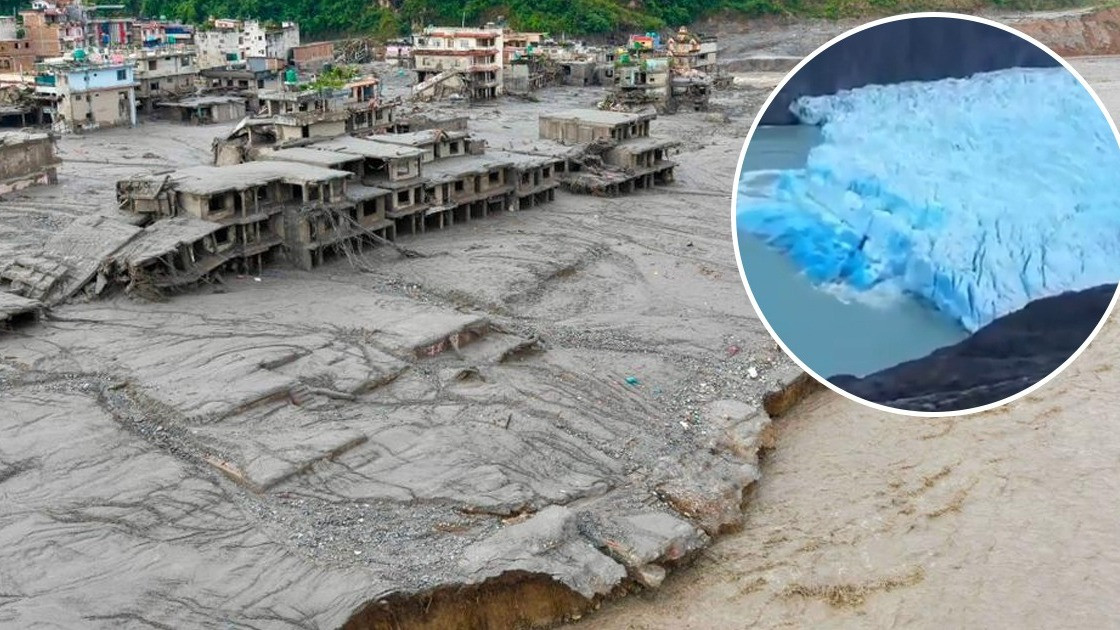
The devastating floods in Nepal were triggered by a glacier collapse, not a 4.4 magnitude earthquake.
The devastating flood in Nepal was not caused by a 4.4 magnitude earthquake, but by the collapse of a large section of a glacier. According to scientists, this disaster was similar to the catastrophic flood in Chamoli district, Uttarakhand in February 2021.
The United States Geological Survey (USGS) reported that a detailed study of long-period seismic waves revealed that the recorded tremors were not due to an earthquake, but were generated by the glacier collapse and the subsequent rapid flow of debris. This sudden flood, which began in Tibet on Wednesday, caused massive destruction in Nepal's Rasuwa and Dhading districts. Hundreds of people have died in this disaster, while a large number of people are still reported missing.
USGS stated in its update related to the incident,
"Initially, this event was considered a 4.4 magnitude earthquake. However, after further analysis of nearby seismic centers, long-period waves, and satellite images, it was concluded that it was an event of glacier collapse and debris flow. No earthquake occurred at that time."
USGS has also revised the estimated magnitude of this seismic event from 4.4 to 5.2. According to the agency,
"The glacier collapse caused a massive debris flow, which had a devastating impact on the areas below. Daniel Shugar, an associate professor of geomorphology at the University of Calgary in Canada, stated that a large section of the glacier, located at an altitude of about 5,200 meters or approximately 17,000 feet, broke off from the rock. This ice and debris rapidly moved thousands of feet down towards the valley."
According to 'The New York Times', the glacier collapse occurred about 64 kilometers north of Kathmandu. Following this, the ice flow moved northwest from the valley towards the Bhote Koshi River, located on the Nepal-Tibet border.
Daniel Shugar compared satellite images taken a day before and after the disaster. He noted a significant reduction in the ice on the surrounding glaciers within just 24 hours. He speculated that a large amount of water from melting ice and glaciers might have entered the glacier, making its base slippery, which led to the collapse of a large section.
Simon Cook, a glacier expert from the University of Dundee in Scotland, said that a large section of ice accumulated at such a high altitude in the mountains has immense potential energy. When this section breaks off and falls, the intense collision causes the ice to rapidly transform into a dangerous mixture of water and debris.
According to Cook,
"A similar event occurred in Chamoli, Uttarakhand in February 2021. At that time, a large section of glacier and rocks broke off, resulting in a devastating flood that claimed the lives of over 100 people."
However, scientists have not completely ruled out the possibility that other natural factors may have contributed to the severity of this disaster in Nepal.
It is to be noted that the sudden flood in the Bhote Koshi River on Wednesday morning caused massive destruction in three districts. At least 162 people have died, and many, including security personnel and foreign tourists, are missing. Nepal affairs expert and columnist Pushparanjan stated that a flash flood occurred after an avalanche. The sudden breaking of a natural dam led to a massive surge downstream, which is believed to have been triggered by an earthquake or high temperatures.
This was one of the worst disasters in the country in recent years. The death toll is expected to rise unexpectedly. Rasuwa, Nuwakot, Chitwan, Dhading, and other districts have been affected by the sudden flood. Bihar and UP will also be impacted by this devastation.
"The flood occurred when an avalanche blocked the flow of the Bhote Koshi's tributary 'Lhendey', and the wave of water first engulfed Timure, located near the Nepal-China border at Rasuwagadhi. Hundreds of homes and a large part of the settlement were swept away before the flood advanced. Due to the absence of rain in the area, residents received no warning of the disaster, and when the flood struck, they were engaged in their daily activities."
Approximately 114 injured people have been airlifted from the flood-affected areas in Rasuwa district. Nepali army helicopters rescued 85 people, while private sector helicopters airlifted 29 people. Rasuwa is a hilly district in Nepal's Bagmati Province, bordering Tibet.
Rasuwa's Chief Customs Officer Rajendra Dhungana stated,
"On Wednesday morning, when he felt the ground shaking, he thought it was an earthquake. As he ran outside, he saw a massive wall of water with something resembling a cloud of smoke behind it; this water was rapidly moving downwards towards Timure Bazaar. Dhungana said, 'It was a flood, rising like a wave about 100 meters high and engulfing the market.' 'In moments, the market was gone.'
As the magnitude of the disaster became apparent, Dhungana and dozens of others fled towards the nearby forest. Over 300 vehicles and trucks parked at the customs checkpoint were swept away. The flood moved towards Syafrubesi and the lower areas of the river, engulfing almost everything in its path—people, animals, buildings, and public infrastructure. According to a statement from the Prime Minister's Office, hundreds of people are missing, including 391 foreigners and 44 security personnel. Among the missing are at least 133 Indians.
Last year, the same river experienced flooding, and the devastated areas have not yet returned to normalcy. The flood in the Lhendey River on July 8 last year resulted in the deaths of at least 11 people, and several sections of the road on this route were washed away. It also swept away the Mitri Bridge connecting Nepal and China. Officials say that the lack of accurate information about the sudden flood led to significant loss of life and property. Officials at the Rasuwa District Administration Office stated that they had no information about the flood that began in Tibet.
"This incident has raised a fundamental question. Should people living in lower areas be warned only after major floods occur in Nepal's rivers, or should there be a system to receive information as soon as an event occurs in the sensitive Himalayan region? The problem is not limited to information sharing between Nepal and China. It seems that the equipment Nepal had installed in its area before the flood also failed to send warnings."
The most missing tourists are Indians. So far, 133 are from India, 47 from the US, 34 from Australia, 33 from the UK, 24 from Canada, 19 from Malaysia, seven from Ukraine, six each from Singapore and South Africa, and five each from New Zealand and Japan. Additionally, according to the Nepal Tourism Board, citizens from Germany, France, Russia, Spain, Ireland, the Netherlands, and over 25 other countries are missing in the flood. The flood has caused significant damage to settlements, police posts, and the customs office in the Timure and Syafrubesi areas. Roads and bridges connecting the Rasuwagadhi border crossing have also been damaged.
The Nepal Tourism Board has advised contacting the toll-free number 1234, hotline number 1144, and Tourism Police at 9851289445 for any information or assistance.