
Escape from Carbon County Jail: A tale of struggle and survival
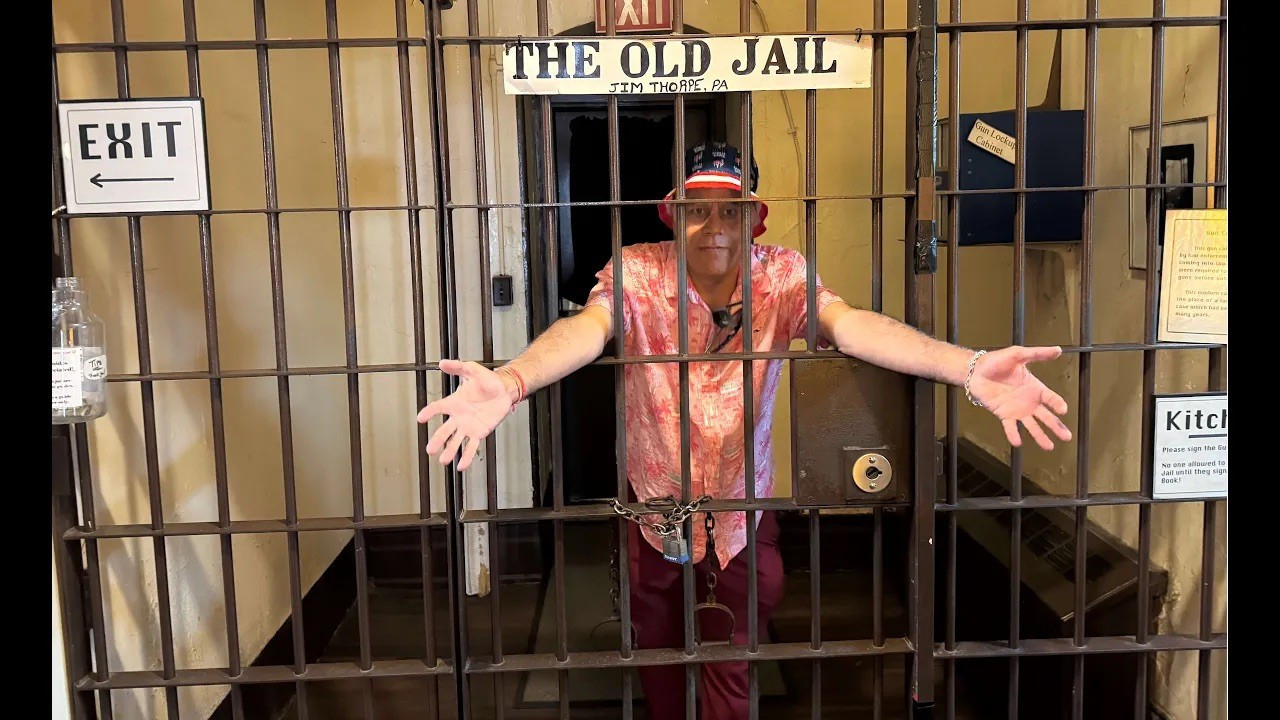
The Old Carbon County Jail stands as a witness to America's dark industrial and labor history.
Pennsylvania's picturesque town of Jim Thorpe, nestled among scenic mountains, is known for its beautiful landscapes and white-water rafting. Due to its beauty, it is often called the Switzerland of America. However, the stone Victorian-style building here—
Old Carbon County Jail (Old Carbon County Jail)—bears witness to some of the darkest, bloodiest, and most brutal chapters of America's early industrial and labor history.
From the outside, it appears to be just an old jail, but inside, it holds the entire saga of 19th-century class struggle, inhumane exploitation, the collusion of power and industrialists, and an astonishing prison escape.
Background: 'Great Irish Potato Famine' and the Tragedy of Displacement
Between 1845 and 1852, the severe 'Potato Famine' (Irish Potato Famine) in Ireland was one of the most painful tragedies in history. Nearly one-third of Ireland's population was entirely dependent on potatoes for their livelihood and food. When the crops were destroyed by the 'blight' (Phytophthora infestans) fungus, nearly 10 lakh people died of starvation and disease, and over 15 lakh were forced to leave the country.
Millions of destitute refugees fled Ireland and reached America. A large number of them settled in Pennsylvania's anthracite (hard coal) mining regions, such as Carbon, Schuylkill, and Luzerne County. However, little did these famine survivors know that they were escaping starvation only to enter a modern hell.
The Hell of Mines, 'Breaker Boys' and the Scourge of Child Labor
The lives of these miners, who fueled America's industrialization, were surrounded by unimaginable cruelties:
- Bloody Mines and Black Lung: Workers had to toil 10 to 16 hours daily, hundreds of feet underground in dense darkness. Due to poor ventilation, the incurable lung disease 'Black Lung' (Anthracosilicosis) became the fate of every worker. Lack of ventilation and exit routes led to frequent gas explosions, roof collapses, and toxic smoke, claiming hundreds of lives.
- Inhumane Exploitation of 'Breaker Boys' (Breaker Boys): The greed of mine owners was not limited to adults. Children of miners, aged 6 to 10, were employed as 'Breaker Boys'. Their job was to sort slate and stones from coal with bare hands. Working 10-12 hours continuously among sharp stones, children's fingers would get cut, nails would be torn off, and many children would be crushed in moving machinery. It was said that finding a 10-year-old child with all ten fingers intact was rare in those days.
- 'Company Towns' and Economic Bondage: Workers were paid not in American dollars but in the company's private currency (Scrip), which could only be redeemed at expensive company-run stores. Miners lived in company-owned rental houses. If a miner died in a mine accident, his widow and orphaned children were evicted and thrown onto the streets within just three days.
Irish Resilience and 'Molly Maguires' (Molly Maguires)
In Ireland, there was a tradition of waging a covert war against oppressive British landlords for centuries—known as 'Whiteboys' or 'Molly Maguires'. When exploitation in Pennsylvania's mines became unbearable, Irish-American miners revived that fighting spirit.
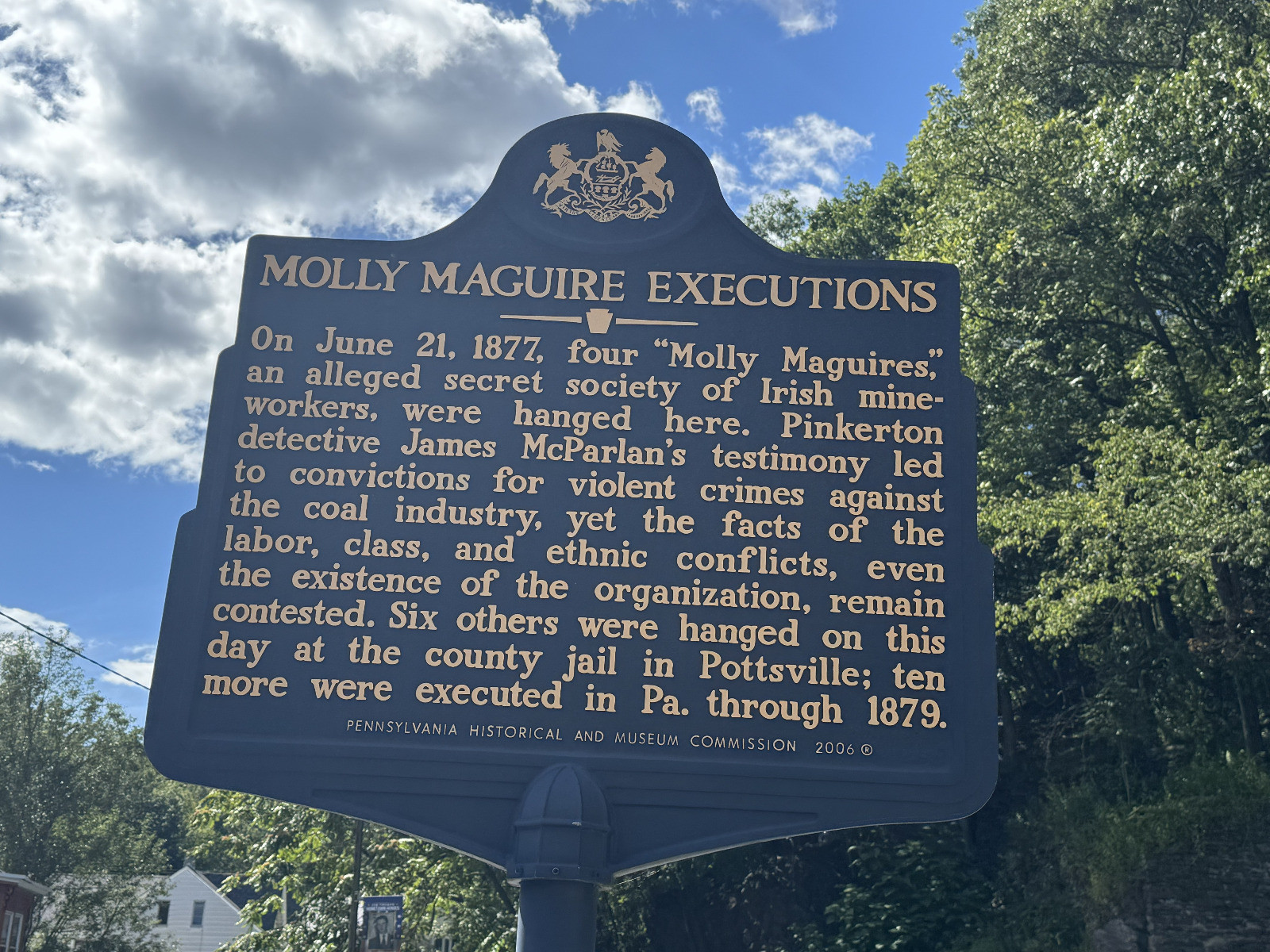
Irish immigrants formed an underground resistance network within organizations like the Ancient Order of Hibernians (AOH), which became known in history as the Molly Maguires.
- When peaceful strikes and early labor unions (such as the Workingmen's Benevolent Association) were crushed by companies, workers' anger turned into violent resistance.
- Brutal mine supervisors, middlemen, and company henchmen began receiving 'Coffin Notices' (threatening letters with coffin drawings). If they did not comply, there were beatings, arson, and even murders of mine officials.
Corporate Dictatorship, Biased Trials, and Collusion of Power
To completely eliminate this labor resistance, the powerful and ruthless president of the Philadelphia and Reading Railroad, Franklin B. Gowen (Franklin B. Gowen), devised a terrifying plan:
- Infiltration by Pinkerton Detective: Gowen hired America's largest detective agency, the 'Pinkerton Detective Agency'. Detective James McParland (James McParlan) infiltrated the organization as an Irish miner under the alias 'Jim McKenna' and gathered information and evidence from within for two years.
- Terror of Private Police: The state government handed over law and order responsibilities to the armed forces of private coal companies, the 'Coal and Iron Police' (Coal and Iron Police), which conducted brutal raids in Irish settlements.
- Kangaroo Courts and Sham Trials: Pennsylvania's local government and judiciary turned a blind eye. The most shocking aspect was that instead of a government lawyer, the railroad company's owner, Franklin Gowen, appeared in court as the main prosecutor (Special Prosecutor). The jury was deliberately composed only of Germans and non-Irish who did not even understand English properly, while Irish Catholic witnesses were not allowed to speak in court.
'Day of Hanging' and the Mystery of Cell Number 17
Between 1877 and 1879, nearly 20 Irish miners were sentenced to death.
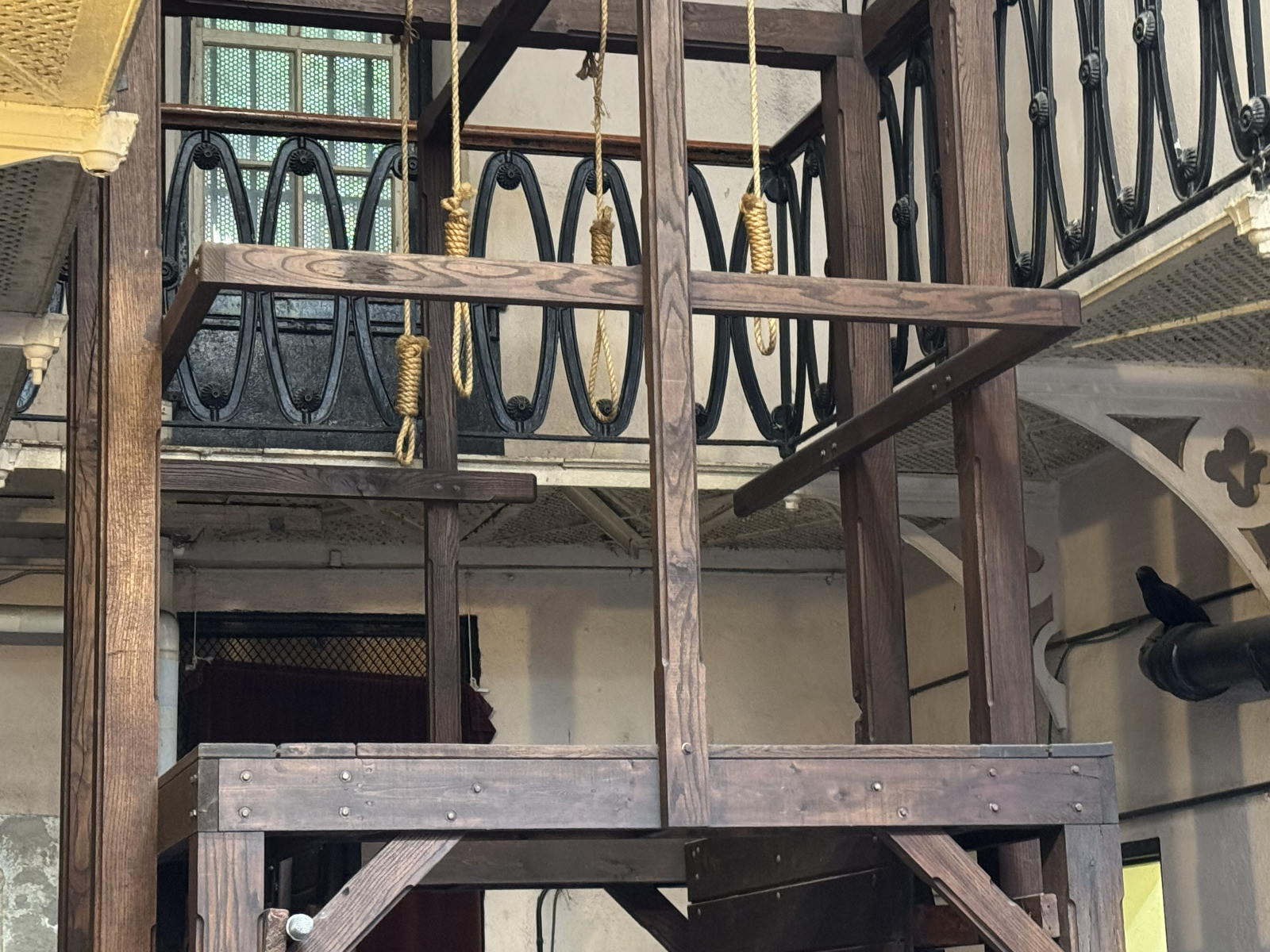
- 21 June 1877 (Black Thursday / Day of the Hanging): That dark day in history when four prominent miners (Alexander Campbell, John Donahue, Michael Doyle, and Edward Kelly) were hanged together at Carbon County Jail (Mauch Chunk), and six others at Pottsville Jail.
- The Immortal Handprint on the Wall: Just before going to the gallows, Alexander Campbell (Alexander Campbell), confined in Cell Number 17, left his final testimony of innocence by imprinting his coal/clay-stained hand on the dungeon wall. He challenged:
"This mark will forever bear witness to my innocence. No one will be able to erase it." Over the centuries, the jail administration scraped that wall, applied thick plaster and paint dozens of times, but even today, the mysterious handprint is clearly visible on the wall of Cell Number 17 in Carbon County Jail.
When a Prisoner Wrote the Tale of Escape with a Bar of Soap
While the bloody and serious chapter of the Molly Maguires is recorded in the history of Carbon County Jail, there is also an astonishing and intriguing story in the jail's records that shook the security arrangements of the jail. This is the story of Frank 'Slippery Ollie' O'Malley (Frank "Slippery Ollie" O'Malley).
Frank O'Malley was caught on charges of petty theft and sentenced by the court to one year (365 days) in Carbon County Jail.
The atmosphere in Carbon County Jail was extremely suffocating and oppressive. The air in the cells always carried the smell of three things—stale tobacco smoke, the stench of unwashed prisoners' sweat for months, and the steam of thick, tasteless soup served at night. For Frank, enduring more than 180 days in this monotonous and foul-smelling jail life was becoming an unbearable mental burden. He needed to breathe in the open air at any cost.
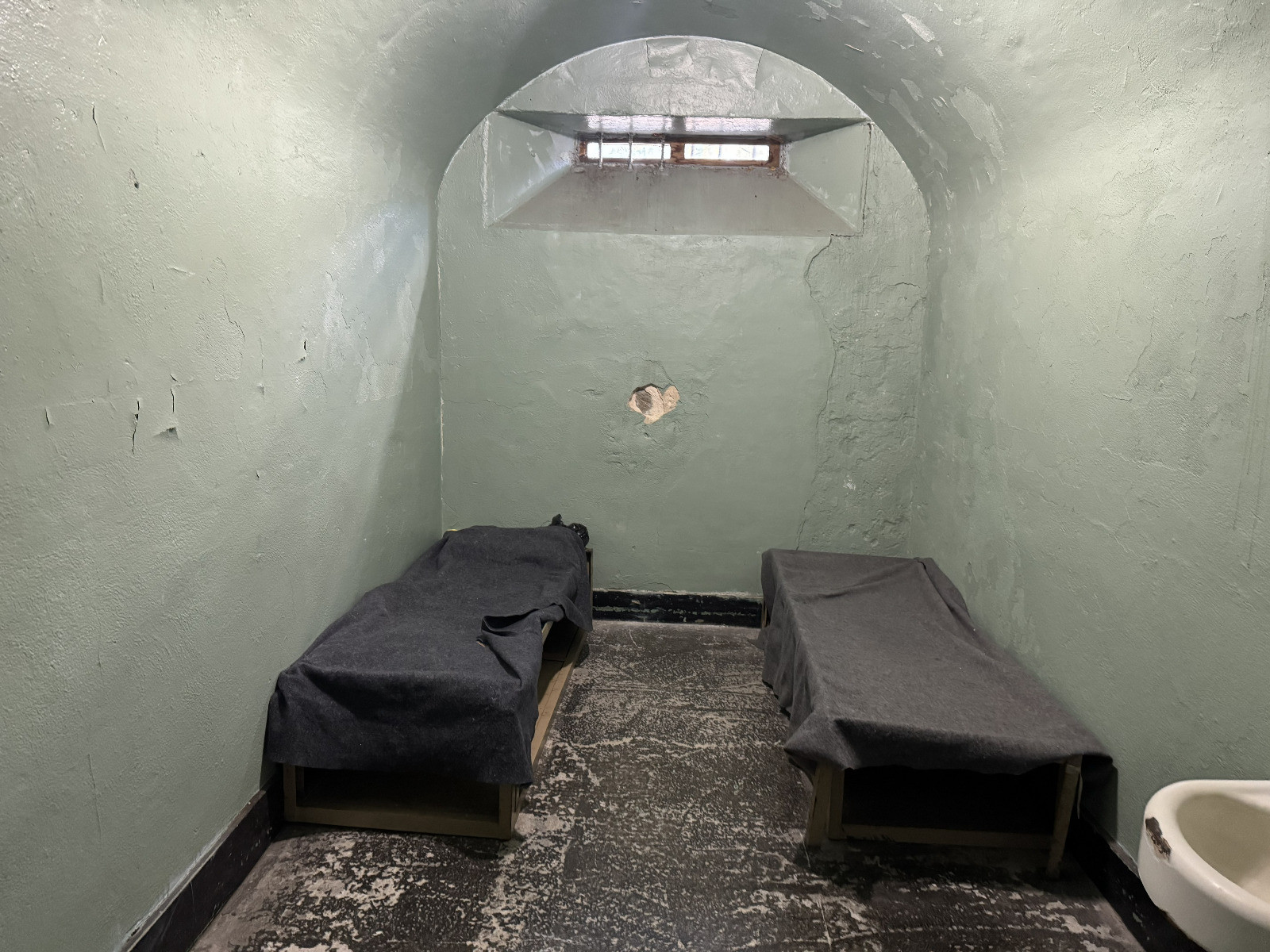
In Frank's cell, there was only a very narrow window, 7 inches wide, at the top of the wall for light and air. The window was so thin that at night, only a faint streak of moonlight could enter through it. For any ordinary person, thinking of escaping through that window was madness.
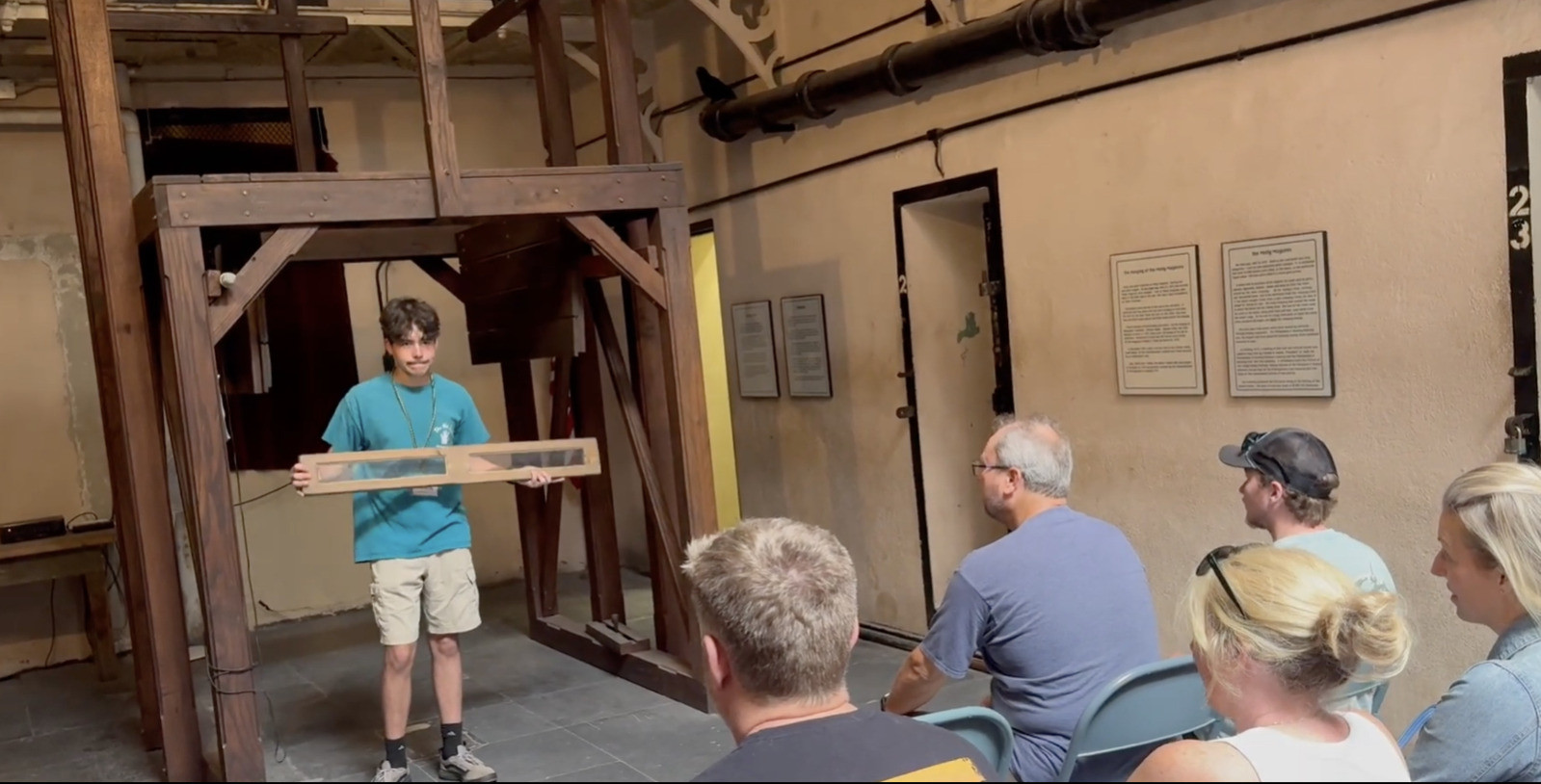
But Frank observed that window very closely:
- The iron bars in the middle of the window were embedded in a metal frame.
- Due to years of dampness and neglect, the old mortar around the edges of the bars had decayed and was crumbling.
The problem was that a strong and sharp tool was needed to scrape that mortar, which was impossible to find in a strict jail. Then Frank noticed the cheap, hard, and sharp 'lye' soap bar provided by the jail administration for bathing.
Frank turned the sharp corner of that hard soap bar into his secret 'chisel-hammer'.
- Every night, when the other prisoners and guards fell asleep, he would quietly climb to the window and spend hours slowly scraping the mortar around the bars with the sharp corner of the hard soap.
- Weeks of this scraping left his fingers' skin peeled, deep blisters formed, and unbearable pain ensued.
- Day by day, his patience was thinning like the ray of light coming from the window, but the passion for freedom was so deep that he did not stop.
Finally, one night, the grip of the iron bar loosened. Frank used all his strength to shake the bar and pulled it out of the frame.
Naked Body, Soap's Slipperiness, and the Impossible Escape
The iron bar was removed, but the path was still only 7 inches wide. An adult's ribs and shoulders could not pass straight through that narrow hole.
Here, Frank lived up to his nickname 'Slippery Ollie':
- He took off all his prisoner clothes.
- He wet the remaining soap with water and rubbed it all over his naked body—shoulders, chest, thighs, and arms—as a thick layer of slipperiness.
- Completely naked and with a soap-slick body, he climbed onto the window sill.
- Inching forward, twisting himself, and squeezing his ribs, he slipped out of the 7-inch narrow slit just like a wet soap slips out of hand.
In the dead of night, Frank O'Malley crossed the high walls of the jail and was free.
3 Days of Freedom and Handcuffs on the Plate
After escaping from jail, Frank first hid in a freight train's compartment and got away from the city. But luck did not favor him for long:
- On the third night of his escape, starving Frank was sitting in a local eatery in a small town nearby, having a meal.
- Someone recognized his suspicious condition and appearance and informed the police.
- Before Frank could remove his hand from the plate or attempt to escape, the police caught him from behind and handcuffed him.
When the police brought Frank back to Carbon County Jail, the warden saw that his entire body was covered with three-day-old, dried white soap crust, emitting a strange smell. Seeing the 7-inch window and this 'soap-covered' prisoner standing in front, the jail warden hit his head in amazement and annoyance.
A Reformed Life, Carpentry, and Two Promises
After this escape, Frank was put back in solitary confinement. However, after that, he fully adhered to the jail rules and served the rest of his sentence as an 'ideal prisoner'.
After being released from jail, he made a fresh start:
- He never looked back at the world of crime.
- He learned the skill of carpentry, started his own business, got married, and began living a respectable and peaceful life with his family.
- Upon release from jail, he made two promises to himself:
- First: He would never do anything in life that would land him in jail again.
- Second: If, God forbid, he ever had to go to jail again, he would never try to escape through a window again!
Climax After Fifty Years: When the Ticket Money Was Waived
Almost 50 years passed. One day, the now elderly Frank O'Malley read in his local newspaper that the old Carbon County Jail had been permanently closed and opened as a historical museum for tourists.
Driven by old memories and curiosity, Frank, holding a cane, stood in line like a regular tourist and bought a ticket from his pocket to enter the jail.
- He slowly moved forward with the tour group and reached outside his old cell.
- The cell was preserved exactly as it was 50 years ago—the same narrow window and the same iron cot.
- The tour guide was dramatically and proudly telling the tourists:
"Ladies and gentlemen! This is the very cell where a very foolish and notorious thief made a foolish plan to escape with the help of just an ordinary soap bar. He loosened the window bar but was caught just a few miles away. What a ridiculous and foolish trick it was!"
The elderly Frank standing in the crowd smiled gently. He leaned against the cold stone wall, placed his cane on the ground, cleared his throat slightly, and spoke in a calm voice:
"Madam, please wait... it was not a foolish plan. At that time, there was no other tool in my cell except that soap... and the person who escaped through the window you are talking about is me—my name is Frank O'Malley!"
The entire tourist group and guide were stunned. When Frank recounted the whole truth of that night, the museum administration respectfully refunded his ticket money and recorded this historical tale as a rare chapter in the official museum records and books of the jail.
There are striking similarities between the historical and current struggles of Pennsylvania's coal miners and Indian mine workers (especially in Jharkhand's Jharia, Dhanbad, Raniganj, Odisha, and Meghalaya). Whether it is 19th-century America or 20th-21st century India, the exploitation of the working class in industrial capitalism appears the same.
1. Geography of Displacement and Compulsion
- Pennsylvania: Irish labourers fled their country to escape the 'Potato Famine' and starvation, becoming a source of cheap labour in Pennsylvania's mines.
- India: Most workers in the coal mines of Jharkhand and Bengal were local Santhal, Ho, Munda tribals, and poor landless Dalits from Bihar and eastern Uttar Pradesh, who came to these mines trapped by famine and debt. In both cases, the mines ran on the sweat and blood of those displaced from their original places and on the brink of starvation.
2. Breaker Boys vs Meghalaya's 'Rat-hole Mining' and Child Labour
- Pennsylvania: 'Breaker Boys' aged 8-10 lost their fingers and childhood sorting coal among sharp stones.
- India:
- From the colonial era to several decades post-independence, children were employed to transport coal in Indian mines.
- In Meghalaya's 'Rat-hole Mining' (Rat-hole mining), small children were preferred to descend into 3-4 feet narrow tunnels as adults could not fit into those tight pits. In both places, the physical size of children was exploited for their brutal exploitation.
3. 'Black Lung' and Health Disaster
- Pennsylvania: Lung disease 'Black Lung' (Anthracosilicosis) due to poor ventilation and toxic methane gas explosions were common.
- India: Miners in Jharia and Raniganj have been victims of silicosis, pneumoconiosis, and TB for decades. The 1965 Dhori mine accident or the 1975 Chasnala mine disaster (where over 375 miners were drowned alive due to flooding) are evidence of the same neglect of safety standards and the zero value of workers' lives as seen in Pennsylvania.
4. Company Currency vs 'Dadan' and the Usury Maze
- Pennsylvania: Miners were paid in company currency (Scrip) instead of US dollars, which could only be spent at the company store. Miners remained perpetually indebted to the company.
- India: Before and after independence, the 'Dadan system' (bonding through advance loans) and the rule of local contractors/moneylenders prevailed in Indian mines. A large portion of workers' wages went back to the exploitative system through ration debts and liquor shops.
5. 'Coal and Iron Police' vs 'Coal Mafia' and Police Repression
- Pennsylvania: Mine owners employed private armed forces like 'Coal and Iron Police' and 'Pinkerton', which spread terror in workers' settlements while the state government remained a mute spectator.
- India: The entire history of Dhanbad and Jharia is filled with the triangle of 'Coal Mafia', dominant contractors (lathaits), and police-administration. Whenever workers tried to form unions or demand rights, the movement was crushed through private goons and police lathi-charge (as seen during the labour movements led by B.P. Sinha or Comrade A.K. Roy in the 1970s).
6. 'Molly Maguires' vs 'Red Flag' and Underground Resistance
- Pennsylvania: When legal avenues were closed, Irish miners formed a secret and sometimes violent organisation like 'Molly Maguires'.
- India: In India's mining areas, when exploitation reached its peak, workers in some regions chose the path of Naxalite/underground movements. In both places, the roots of violent or militant resistance lay in the extreme cruelty of the system and the apathy of the judiciary.

Atul Arora
अमेरिका में बसे अतुल अरोड़ा ट्रैवल ब्लॉगर हैं। रोजनामचा नाम का इनका एक यू-ट्यूब चैनल है जिसमें वो खालिस कनपुरिया अंदाज में Humour शो करते हैं।