
DCP ordered pellet gun use, reveals police diary

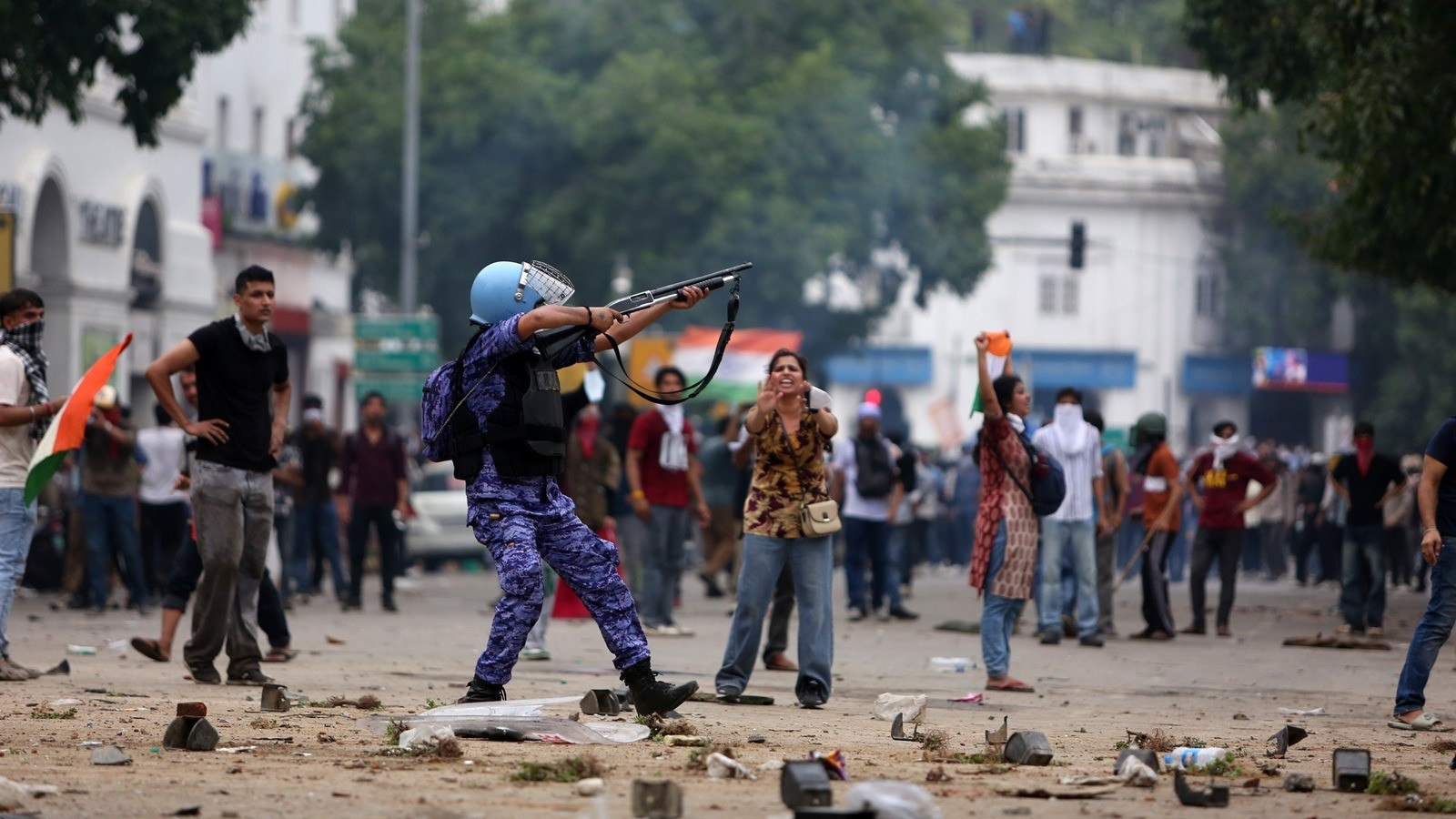
A diary entry reveals that on July 20, a DCP ordered the use of pellet guns on protesting students.
In a diary entry filed by the Rapid Action Force (RAF) at the Parliament Street Police Station in New Delhi, it has been revealed that on 20th July, two rounds of pellet gun firing were ordered by a Deputy Commissioner of Police (DCP) rank officer on protesters.
According to a report by The Hindu, an entry was made in the general diary at 1:24 PM on 20th July regarding this incident. The diary entry disclosed that during the protest by the 'Cockroach Janata Party', to control the crowd, on the orders of the DCP, the RAF's Deputy Commandant fired 55 rounds of non-electrical shells, 15 rounds of electrical shells, five tear smoke grenades, and two rounds of ballistic cartridges with plastic pellets from an anti-riot gun.
During the protest on 20th July, three people were injured by pellets. According to their families, one of the injured, a 19-year-old youth, risks losing sight in his right eye due to a pellet injury. The Central Reserve Police Force (CRPF)'s anti-riot unit, RAF, was deployed alongside Delhi Police at Jantar Mantar and surrounding areas on 20th July. The 'Cockroach Janata Party' had called for a march to Parliament demanding the resignation of Union Education Minister Dharmendra Pradhan.
Delhi Police has officially stated that the claims of pellet use against "peaceful protesters" are completely "false and misleading." According to a PTI report, neither the CRPF nor the RAF has commented on the matter so far.
Notably, in a virtual meeting chaired by RAF Inspector General (IG) Seema Dhundia on Wednesday, it was directed that pump action guns (PAG), anti-riot guns (ARG), electric shock weapons, and electric shields will neither be used nor issued in Delhi until further orders. The IG also told RAF personnel and officers that the "excessive use of force" during the protest at Jantar Mantar was "inappropriate" and emphasized that the use of force should always be phased and as per need, following the set protocol and RAF training. An internal investigation into the entire incident has already begun within the RAF.
Anti-riot guns are considered less lethal weapons for crowd control. They differ from traditional pellet guns but fall into the same category. Instead of metal pellets fired by traditional pellet guns, cartridges with plastic pellets are used. When fired, a cartridge breaks into multiple pieces and can hit several people simultaneously. The aim is to disperse the crowd, not to target any individual.
Opposition, particularly Rahul Gandhi, the Leader of the Opposition in the Lok Sabha, is targeting the central government over the use of pellet guns on protesters and is demanding a statement from Home Minister Amit Shah in Parliament.
Meanwhile, the matter has also reached the Supreme Court. On Monday, a former IPS officer and two individuals who claim to have been injured by pellet guns during protests filed a petition. The petition, filed by Yashvardhan Azad, Prashant Kumar, and Sheikh Irshad Mansuri through advocate Vrinda Grover, seeks directions to stop or restrict the use of fully or partially metal pellets fired from pump action rifles or projectile action guns (PAG) by law enforcement agencies to disperse crowds of citizens.
After the protest on 20th July in Delhi, several civilians sustained serious injuries from pellet guns, including a 19-year-old Delhi University student who may lose vision in one eye due to the injury.
Irshad Sheikh, a 25-year-old MBA graduate, still shudders at the memory of that day while recovering in a bed at Lady Hardinge Hospital in Delhi after surgery. Irshad says,
During the Parliament march on 20th July, a Rapid Action Force (RAF) personnel fired a pellet gun at him, causing multiple pellets to hit his face. The CRPF's RAF was deployed alongside Delhi Police to control the crowd during the Parliament march. When the situation escalated during the protest, the police used lathi charge, tear gas, and pellet guns.
It is noteworthy that after the protests in Jammu and Kashmir in 2010, central forces began using pellet guns for crowd control. Reports of pellet gun use also emerged later in Jammu and Kashmir in 2016, Manipur in 2023, the farmers' movement in 2024, and the Leh movement in 2025.