
Controversy erupts over Maulana Abubakar Ahmad's statement in Kerala

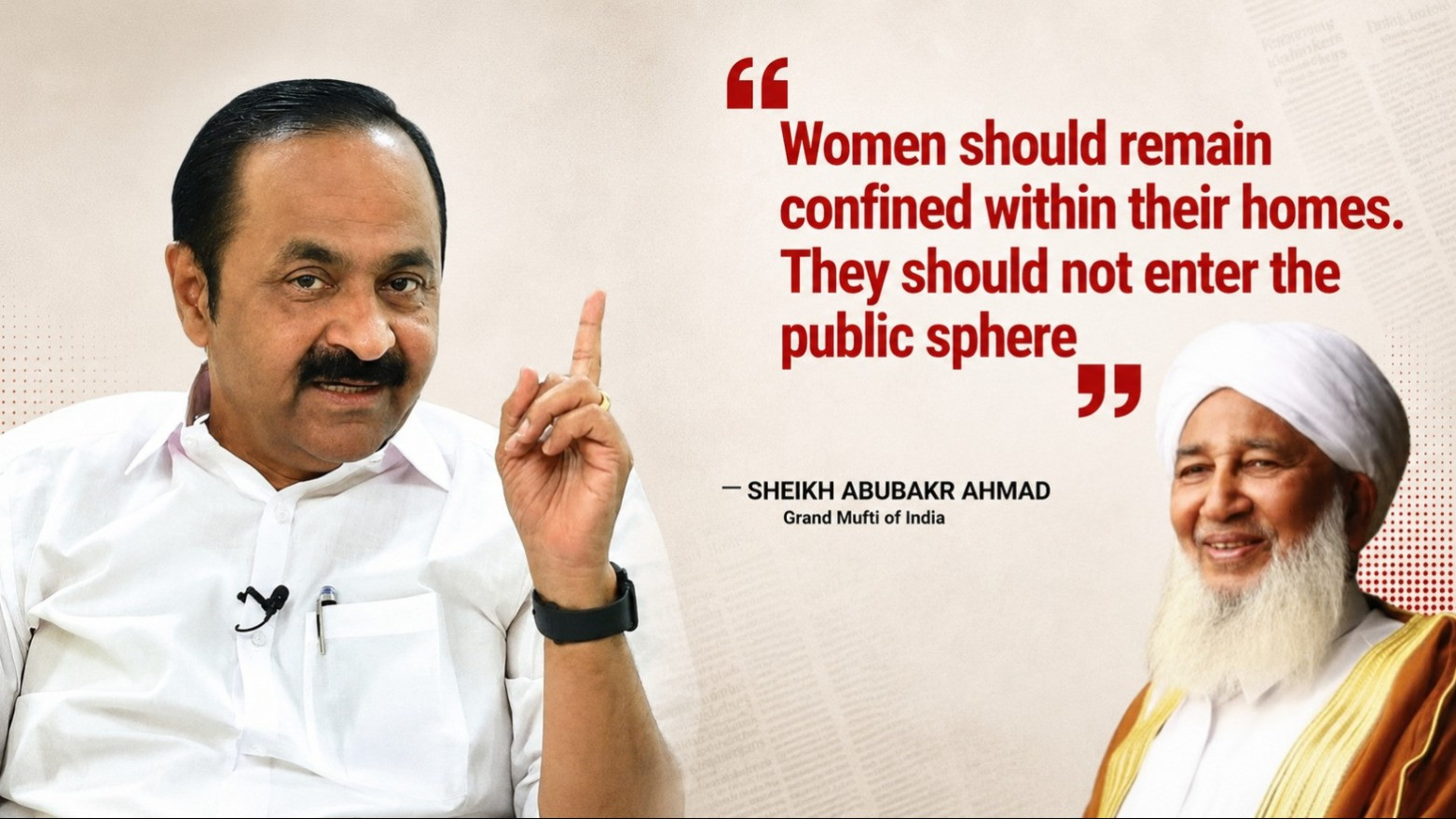
Widespread outrage is being witnessed in Kerala following Islamic scholar Sheikh Abubakar Ahmad's remarks.
Kerala Chief Minister V. D. Satheesan strongly opposed the statement made by Islamic scholar Sheikh Abubakar Ahmed, in which he stated that women should be confined to their homes. Satheesan described it as a “misinterpretation” of Islamic history.
Sheikh Abubakar Ahmed, who holds the title of ‘Grand Mufti of India’, had said that,
“Women should not be allowed to come into public life, as it can lead to a situation of destruction.”
Following his statement, widespread outrage was observed in Kerala. According to news agency PTI, the Chief Minister dismissed the cleric's remarks, stating that this view is not in line with the “progressive” tradition of the southern state of Kerala.
In a press conference held after a state cabinet meeting, Satheesan said,
“We completely disagree with this statement. It is not a view that aligns with progressive Kerala. We cannot accept it in any form.”
Many writers and public intellectuals have also objected to Kanthapuram A. P. Abubakar's statement. Renowned Hindi writer and Chief Editor of The Credible News, Ashok Kumar Pandey, posted on X stating that,
“Such clerics should be confined to the mosque only. They should not be allowed to interfere in the lives of others from anywhere.”
It is noteworthy that Kanthapuram A. P. Abubakar, also known as Musaliyar, cited the Quran in support of his views. He stated that women should remain confined to their homes and should not come into public platforms. Opposing this view, Chief Minister Satheesan said that,
“Women cannot be confined to the four walls of the house. They have every right to participate in and play a central role in every sphere of life and society. ‘Without any doubt, this is our progressive outlook.’”
Kanthapuram had stated during an Islamic conference held in Kochi on Sunday that,
“If women come to public places, it will lead to a ‘great destruction’. His remarks came after a controversial circular was recently issued stating that ‘women should not be present on public platforms.’ Kanthapuram compared women to gold ornaments, saying they should be kept in a safe place. He said, ‘If the beauty of the necklace is to be maintained, it must be safely kept inside a box.’”
He claimed that this is why there is a provision for veiling women in Islam.
Chief Minister V. D. Satheesan termed the cleric's views as a “misinterpretation” of Islamic history. In support of his argument, he presented examples of women who played roles of power and leadership in Islamic history.
Satheesan said that,
“Prophet Muhammad's first wife Khadija was a successful businesswoman. Another wife, Aisha, participated in the ‘Battle of Jamal’ and played a leadership role. He also mentioned Queen Bilqis, who is described as a ruler in Islamic history.”
Satheesan added,
“In Islamic history, one woman engaged in trade, another woman took on military leadership, and one woman became a queen. All these examples exist in Islamic history.”
He also referred to an incident during the caliphate when a woman raised a question regarding ‘Mehr’. The ruler accepted her argument and changed his decision. The Chief Minister said,
“These examples show that women had a place even in royal courts during that era. Therefore, we cannot accept such views that confine women to their homes in any form.”
It is noteworthy that Sheikh Abubakar Ahmed is referred to as the ‘Grand Mufti of India’. He is a prominent religious scholar among Sunni Muslims in India and South Asia. It is reported that he is the tenth person to hold this title. There are other grand muftis in India and the Islamic world, and several prominent mosques serve as their headquarters. The term ‘Mufti’ originally refers to an expert in Islamic law, or Sharia.