
Car companies' emails reveal E20 petrol harms engines

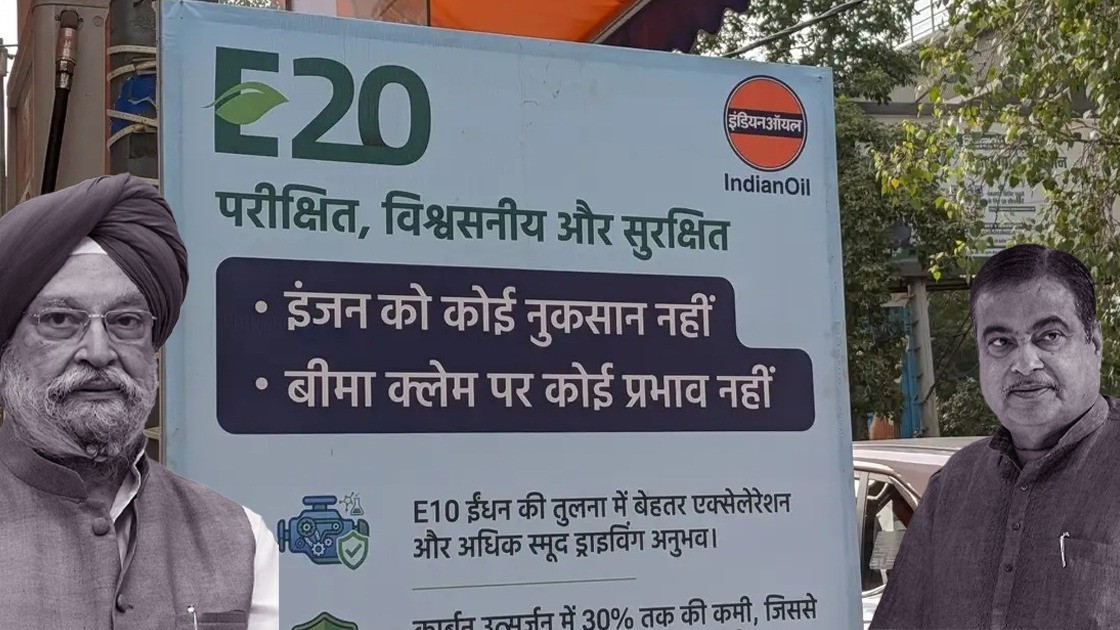
Maruti Suzuki, Tata Motors, and Mahindra knew E20 petrol contains chloride.
The country's leading automobile manufacturers had warned the central government that E20 petrol could damage vehicle engines and that E20 petrol contains the contaminant chloride. According to Reuters, this was revealed through internal emails from Maruti Suzuki, Tata Motors, and Mahindra. Through emails, top officials of Maruti Suzuki, Tata Motors, and Mahindra discussed their concerns about the contaminant chloride in 20% ethanol petrol, i.e., E20, and had also warned the central government about it.
In a group email shared between Maruti, Tata, Mahindra, and SIAM,
Maruti's senior official Anoop Bhatt expressed concern over the high levels of chloride in E20 petrol. He mentioned that there was a private discussion on this issue with the Petroleum Ministry on July 26.
However, it is noteworthy that the automobile industry body, the Society of Indian Automobile Manufacturers (SIAM), withdrew its complaint regarding contamination in E20 petrol a week after it was sent to the government, just hours after the Indian government publicly assured that ethanol-blended petrol is safe. The organization stated that further investigation of some data was needed.
According to a report by Reuters, communications among officials of Maruti Suzuki, Tata Motors, and Mahindra indicate that E20 petrol, which contains 20% ethanol, has contaminants that can damage vehicle fuel. Moreover, these companies conducted extensive fuel testing, the data of which has now emerged. This testing was conducted after the Modi government implemented E20 nationwide last year. The car companies' emails reveal for the first time that despite publicly supporting the government's E20 campaign, the companies are privately concerned about contaminants like chloride and moisture. They claim these elements are damaging vehicles. It should be noted that the government has promoted E20 to reduce pollution and oil imports.
Industry data and emails, not previously made public, seen by Reuters show that
many vehicle companies had already conducted large-scale testing. They collected over 250 fuel samples from petrol pumps in 21 out of 36 states and union territories in India over a year. In these tests, many samples from 18 states showed high levels of chloride. Additionally, moisture levels were also found to be high.
When asked about the private emails, SIAM told Reuters that these data were shared internally only for discussion and verification and were collected by very few vehicle companies. The internal emails from SIAM seen by Reuters include Maruti, Tata, and Mahindra, which together hold about 67% of India's car market share.
SIAM stated that "the basis of the testing and the number of samples were not sufficient to reach any conclusive findings, hence the letter was withdrawn." According to the organization, the letter was sent inadvertently. SIAM also mentioned that it intends to conduct a proper scientific study on the issue. The Ministry of Petroleum and Natural Gas did not respond to requests for comment. However, Petroleum Minister Hardeep Singh Puri said on Friday that,
two weeks before receiving SIAM's letter, India's oil marketing companies had already started stringent testing for contaminants in fuel at petrol pumps. According to Puri, only four cases of contaminated fuel were found.
Government fuel companies also stated last week that extensive, random, and scientific tests showed that "there is no reason for concern regarding fuel contamination." Mahindra said that conclusions drawn from its official's email are "completely baseless and incorrect." According to the company, industry data is limited and preliminary, and it does not see any problem with E20. Maruti and Tata did not respond to requests for comment.
There has also been discontent among vehicle owners regarding E20. Hundreds have alleged that it has reduced their vehicles' mileage and damaged parts. SIAM has previously stated that
high levels of chloride can cause corrosion in vehicle parts, while high moisture in fuel can cause the vehicle to stall immediately after refueling.
According to state-wise data shared in group emails by the industry, the levels of chloride were recorded as follows:
Rajasthan: 6 to 570 parts per million (ppm), New Delhi: 1.4 to 420 ppm, and Maharashtra: 10 to 357 ppm. According to the Government of India, the acceptable limit for chloride is 3 ppm.
The data also showed significantly high moisture levels. In Andhra Pradesh, it reached 13,000 ppm and in Uttar Pradesh 12,500 ppm, while the government-set acceptable standard is 3,000 ppm.
The actual cause of the contaminants is not yet clear. However, SIAM had stated in its now-withdrawn letter that it observed an increase in chloride levels since the implementation of E20. The organization had requested the government to direct oil marketing companies to identify the root cause. Regarding moisture, SIAM's letter mentioned that it could be due to inadequate maintenance of underground storage tanks and pipelines at petrol pumps.
Mahindra's Senior Principal Engineer of Fluid Technology, R. Ramprabhu, stated in an email that,
organic chloride is the contaminant responsible for the rapid deterioration of vehicles observed in the industry and can damage the engine "within 200 kilometers."
He wrote,
most cases that arise immediately after refueling are due to organic chloride." He also mentioned that Mahindra has strong evidence in the form of data from fuel samples taken from petrol pumps.
Mahindra's Ramprabhu and Maruti's Anoop Bhatt did not respond to Reuters' questions.