
Why does BJP have issues with Mughals but not the British?
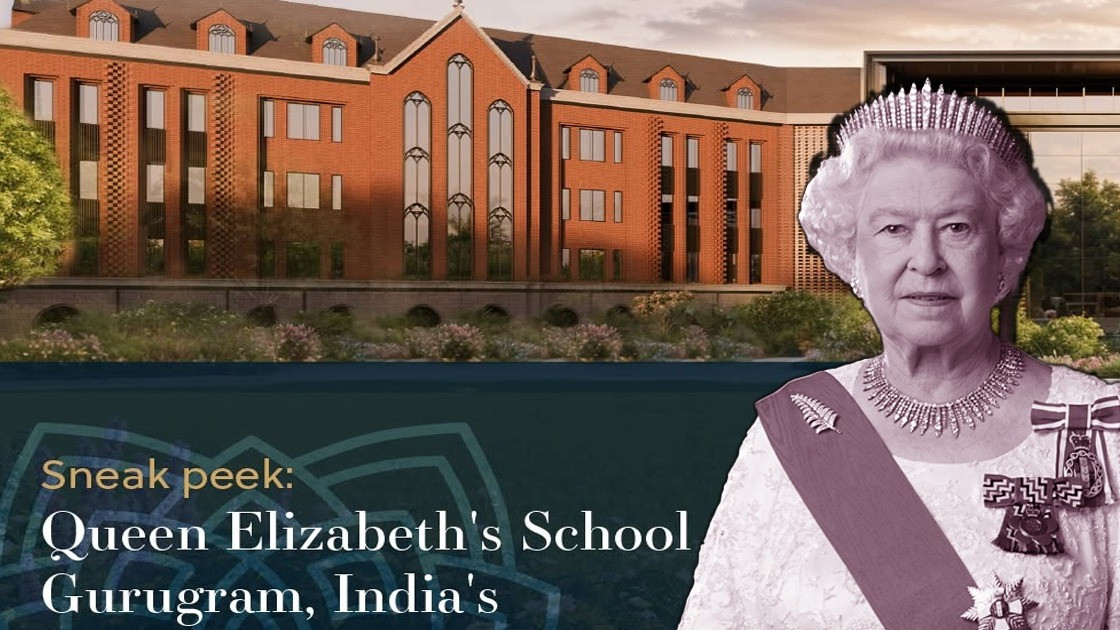
The government shutting down madrasas remains silent on British schools.
For the past 12 years, the BJP and RSS, who have been enjoying power, have a dislike for Muslim names but a strong affinity for English ones. In the last 12 years, many cities, streets, and localities have been renamed simply because the RSS and BJP wanted to 'Hinduise' them. Efforts to close madrasas are ongoing, yet there remains a reverence and faith towards the colonial British Empire, evident in the welcome of British schools.
The political descendants of those who once apologised to the British now seem to prefer seeing the country once again under British subjugation, as evidenced by the opening of a school named after Queen Elizabeth in Gurugram.
The threat of British colonialism is once again entering India through the doors of school education. In the 16th century, the East India Company came to India, and now in the 21st century, a school named after Queen Elizabeth is set to open in Gurugram. According to a report by The Times Of India, children in Bengaluru are already studying under the roof of the renowned Harrow School of London. Admissions have begun in British schools operating in partnership with Whitgift in Pune's Wellington, Bhopal's Shrewsbury, and Hyderabad's Sagebrook. Another British grammar school, established nearly five centuries ago, is planning to open a branch in Bengaluru. Meanwhile, Highgrove Education is turning towards Uttar Pradesh.
Interestingly, this time, Indian education companies, real estate developers, and investment groups are acting as intermediaries between some of Britain's oldest schools and India. Needless to say, all these educational companies, real estate developers, and investment bankers are directly or indirectly benefiting economically from the BJP government.
An expert observing this sector said, "The entire business is being presented in the language of global learning, leadership, heritage, and international experience." However, under this guise, not only is a colonial British Empire curriculum being imported into India, but along with it, their names, associated history, prestige, and social aspirations are also being brought in.
Established in 1573 in Barnet, Queen Elizabeth's School is set to open its campus in Gurugram this month. The notable aspect of its original British institution is that it is a grammar school run with government funds in England. However, in our country, this publicly funded school will lend its centuries-old heritage and prestige to an expensive private institution abroad. This is an interesting reversal of history.
Francis Joseph, India CEO of Dubai-based GEMS Education, which operates schools in more than 10 countries, finds the entry of British school franchises into India interesting, but he says it comes with a responsibility.
He said,
"Every global education brand entering India must remember a fundamental truth—schools are local learning communities, deeply rooted in the culture, traditions, local languages, and aspirations of the society they serve."
InspireNext Learning Foundation director Swati Popat Vats points to the long shadow of colonial education. According to her, one of the most enduring legacies of colonialism has been the notion that knowledge from outside is inherently superior to Indian or indigenous capability. Independent India has taken decades to establish trust in its education system. She said,
"It would be unfortunate if education once again creates a system where being foreign is automatically considered better, and the Indian system needs external validation to prove its worth."
Harrow International School in Bengaluru has brought one of the most prestigious names in British education to Indian soil. Even its uniform carries the weight of old tradition, including a distinctive British hat.
The appeal of Harrow International School lies significantly in its nearly 450-year-old history. Established under a Royal Charter during the reign of Queen Elizabeth I, the school has had many politicians and writers among its alumni. This history is not just decoration but a central part of the school's offering. In a way, this is the main thing being sold.
Caroline Pascoe, head of the Bengaluru institution, said, "For Harrow International School, it was never just about establishing more schools. The aim was to expand a distinctive educational philosophy and find communities that value education that prepares young people not just for university, but for life."
In Pune, Wellington College International works with the identity of England's Wellington College. In Bhopal, Shrewsbury International School has presented a successful model of a British boarding school. The symbolic meaning is almost clear—the educational tradition once created to prepare the ruling class of the British Empire is now being tailored for the children of India's corporate elite.
Royal Grammar School Guildford has partnered with Ryan Group to establish four schools in India. The first RGS Guildford Bengaluru is expected to open in 2028. Hyderabad's Sagebrook International presents a different model. It is not a British school directly brought to India but promotes its partnership with the Whitgift School, established in 1596.
Sagebrook founder Praveen Raju said,
"Our model is collaborative, not prescriptive. We believe there is a market for quality education, especially at a time when a large number of Global Capability Centres, or GCCs, are being established and Indians living around the world are returning to the country."
But a fundamental question is rarely asked—what is the intention behind British schools opening their campuses in India? To enslave or to prepare a corporate elite!
In England, these schools present the British Raj in India as a blessing, with little discussion on anti-colonial movements and the British government's repression. Does the BJP government want to teach the same history to India's children?

Satish Verma
सतीश वर्मा पेशे से पत्रकार हैं। हिंदी की मुख्यधारा की पत्रकारिता में इन्हें 20 साल से ज्यादा का अनुभव है।