
BCI retracts controversial order, lifts ban on NALSAR students

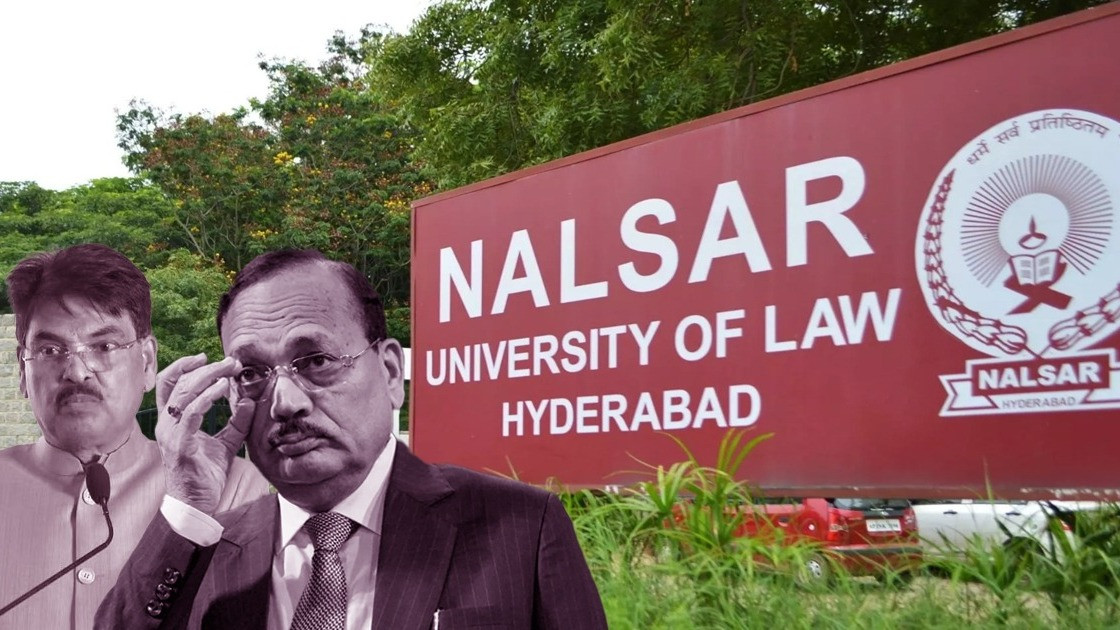
The Bar Council of India faced severe criticism for its decision.
It should never be forgotten that in a democracy, the citizen is supreme. The judiciary understands this maxim well, yet why has a dictatorial decree begun to be issued in a democracy? The Bar Council of India (BCI) and its chairman for nearly a decade and a half, Manan Kumar Mishra, issued a decree in honour of CJI Suryakant that all students graduating from NALSAR University of Law this year will not be able to practice law. But perhaps they underestimated the power of democracy.
On Thursday, there was such opposition to this decree that the Bar Council of India (BCI) had to withdraw its order within a few hours, which had put a halt to the careers of all students graduating from NALSAR University of Law in Hyderabad this year. This order was issued following reports that some students on campus had protested against Chief Justice Suryakant's proposed program at the convocation ceremony.
Bar and Bench reported that the BCI, the apex regulatory body for legal education and practice, had earlier in the day issued an unprecedented order directing all state bar councils not to enroll any student graduating from NALSAR this year as a lawyer. This action was based on media reports of a campus campaign run by some students.
Following this decision, there was a tremendous backlash from politicians and social media users. The Cockroach Janata Party (CJP), which recently forced the Narendra Modi government to bow down on student issues, warned of another protest.
Abhijit Deepke, founder of CJP, wrote on X,
"What if all the legal cockroaches come together?"
This comment recalls his satirical post in May, which came after the Chief Justice of India compared some youths to "cockroaches." That incident laid the groundwork for the Gen Z movement against exam paper leaks. Following CJI Suryakant's comment, widespread protests across the country pushed the Narendra Modi government on the back foot, marking the first time in 12 years of BJP rule that a minister had to resign.
According to the rules, after completing a law degree and passing the All India Bar Examination (AIBE), held twice a year, a person can be enrolled for legal practice. In the initial order sent by BCI Chairman and BJP Rajya Sabha MP Manan Kumar Mishra to all state bar councils, it was stated that,
Until further orders, no student from NALSAR University of Law, who has obtained a law degree in 2026, will be enrolled as an advocate in any state bar council.
The order also stated that at this stage, BCI does not consider that merely participating in the relevant representation or campaign renders a person ineligible for enrollment under Section 24A. However, the order mentioned that BCI is investigating "regulatory aspects controlling entry into the profession" in the case of some applicants. If graduate students are enrolled while such an investigation is pending, it could create a situation that would be difficult to reverse later, rendering the statutory inquiry ineffective.
But after the uproar over this action against dissent on campus, Mishra issued a new order "amending" the initial order.
The second order stated that
all students will be entitled to enroll in the state bar council of their choice."
It stated that after discussion within BCI on the initial order, members unanimously concluded that according to the latest reports, most students of NALSAR's 2026 batch are innocent and were not willing to participate in the "insulting" activity.
However, many who criticized the initial order questioned how protesting the proposed participation of the Chief Justice of India in a campus event could itself be punishable in a democracy.
In the second order, BCI stated that
the council amends the chairman's order regarding the ban on enrollment of NALSAR students in state bar councils. No student will suffer without fault.
The order further stated that information from some reliable sources indicated that some teachers and outsiders played a role in inciting innocent students. The council said it would await the investigation report from NALSAR's Vice-Chancellor and further action would be taken upon receiving the report.
According to media reports, some students of the law university campaigned to persuade the Vice-Chancellor and other officials not to invite Justice Suryakant to the convocation ceremony. It was reported that these students argued that Justice Suryakant's stance on petitions demanding action on alleged excesses by security forces against Jantar Mantar protesters was not in line with established legal jurisprudence.
In the first order by BCI Chairman Mishra, it was stated that,
A law student who does not have respect for the highest judicial position in the country cannot be expected to become a responsible or sensible lawyer, teacher, or judge. Such people will always prove to be a burden on the profession.
In May, a comment attributed to Justice Suryakant surfaced, in which he compared some youths to "cockroaches" and "parasites," who, according to him, enter professions with dubious qualifications and later become social media or RTI activists. He later clarified that his comment was only for those involved in cases like fake degrees.
Recently, the Tata Institute of Social Sciences (TISS) postponed its convocation ceremony, in which Justice Suryakant was to participate. There were reports that the campus administration was advised to postpone the event in view of potential student protests against his presence. However, the institute denied receiving any such advice.