
BCI chairman once called Modi 'my lord'

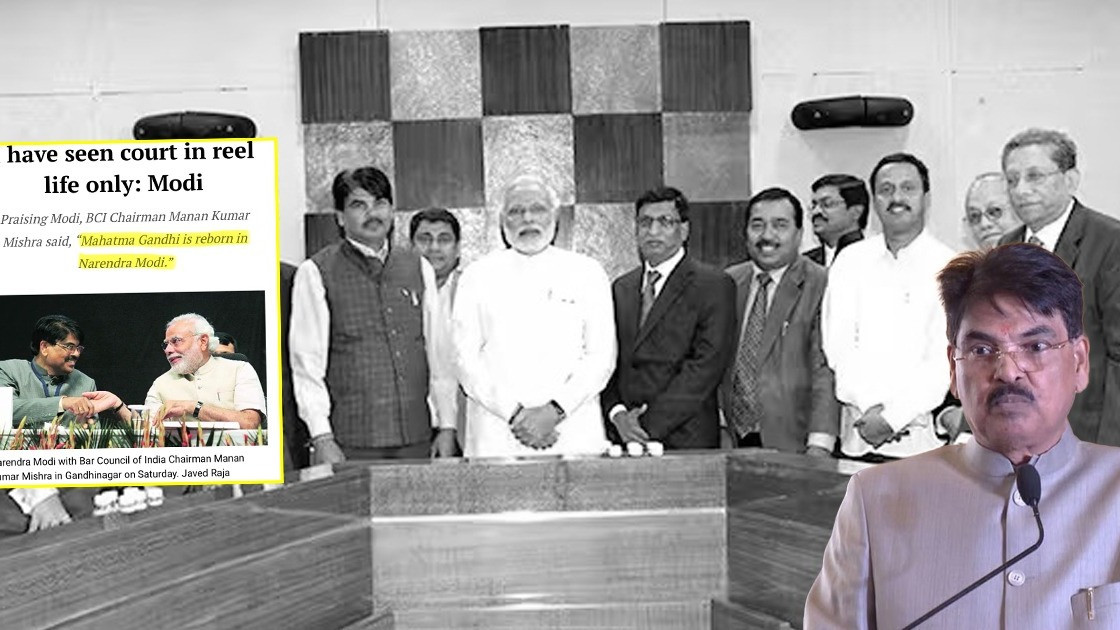
In 2014, BCI Chairman Manan Kumar Mishra openly campaigned for Narendra Modi in Varanasi.
Manan Kumar Mishra has not become the Chairman of the Bar Council of India (BCI) for seven terms without reason. His story does not begin at 12:37 AM on the night between August 13 and 14. It starts in 2014 when, as BCI Chairman, Manan Kumar Mishra openly campaigned for Narendra Modi in Varanasi. He praised Modi so highly that even the most eloquent bards would seem lesser in comparison. Over the past 12 years, there have been numerous instances where he has demonstrated his exceptional devotion to Modi.
On social media platform X, Hyderabad entrepreneur Nayani Anurag Reddy shared a timeline from 2014 to 2026, detailing several occasions where Mishra not only praised Modi but also labelled protesters as ignorant and traitorous.
[]In 2014, at a BCI event in Gandhinagar, he compared PM Narendra Modi to Mahatma Gandhi, even stating that Mahatma Gandhi had been reincarnated in Narendra Modi's form. He claimed he was doing this as a representative of 17 lakh lawyers, not as a personal political opinion.
Such was the extent of his devotion that Manan Mishra made this statement as the Chairman of the Bar Council of India. He was speaking on behalf of the entire legal fraternity while campaigning for a political leader.
Later, in 2016, Mishra wrote a direct letter to PM Modi. The language used by the Chairman of an institution that should protect its independence was extraordinary. Addressing PM Modi, he wrote in a manner such as:
“My Lord.”
“Our Protector.”
“Our Guide.”
“The most skilled and capable leader in the world.”
But the most attention-grabbing line was: “The Bar Council of India is your institution. Read it once again.”
While writing this letter, Mishraji was so carried away by his devotion to Modi that he forgot that an institution representing the legal profession cannot be a personal or political entity of any individual.
Then in 2018, while serving as BCI Chairman, Mishra publicly urged then CJI Dipak Misra not to accept any position from the government post-retirement. BCI stated that it was necessary to protect the independence and integrity of the judiciary. However, when former CJI Ranjan Gogoi was nominated to the Rajya Sabha, BCI welcomed it, calling it a “bridge between the legislature and the judiciary” and termed the criticism of this appointment as “unwarranted and premature.” The institution was the same, the question of judicial independence was the same, but the response was entirely different.
In 2019, during the anti-CAA protests, Mishra used the BCI platform to describe the protesters as a “misled illiterate and ignorant crowd.” However, his devotion to Modi did not work this time. His statement backfired, with about 1,000 lawyers distancing themselves from it, stating that it did not represent the views of the Bar.
The issue is not whether someone supported or opposed the CAA. The question is whether the Chairman of a statutory body representing the legal profession should use the authority and influence of that institution to speak in such a manner about citizens exercising their right to dissent.
In 2021, BCI amended its rules to make public criticism of BCI or state bar councils' decisions punishable. This could result in actions like suspension or disqualification. Think about the principle behind this. An institution controlling lawyers was trying to prevent lawyers from publicly criticizing the same institution. There was tremendous opposition to this. Eventually, the controversial provisions were suspended. This incident is significant as it shows how BCI, under Mishra's leadership, viewed criticism.
Then came 2026. The youth of the country took to the streets to protest. Mishra's response was that,
“Anti-social and anti-national forces” have infiltrated student movements. He also appealed to the legal fraternity and intellectuals to counter them.
Imagine how dangerous such language can be. If the first reaction towards protesting youth is to label them “anti-national,” what are we teaching the next generation of lawyers about dissent? Is questioning authority a threat? The position of BCI Chairman is one of the most important in India's legal profession. The person holding that position should be someone under whom lawyers feel free to speak. Not fearful. Free to question the government. Free to question judges. Free to dissent. Because the Bar exists to stand between power and the citizen, not to stand with power against the citizen. BCI does not belong to its Chairman. It is the institution of the Bar. And the independence of the Bar begins with a very simple principle. Dissent is not treason or betrayal of the country.
It is noteworthy that Manan Kumar Mishra is a senior advocate and a Rajya Sabha MP from Bihar. He was nominated to the Rajya Sabha by the Bharatiya Janata Party (BJP). He is also the Chairman of the Bar Council of India (BCI), the top regulatory body for lawyers and legal education in the country. His role in the current controversy is central. Hailing from Gopalganj district in Bihar, Mishra completed his B.Sc. (Honours) from Rajendra College in Chapra. He then obtained an LLB degree from Patna Law College. He began his career as a lawyer at Gopalganj Civil Court. In 1982, he started practicing at the Patna High Court and later became a senior advocate at the Supreme Court.
Mishra has been leading BCI since November 2014. In 2025, he was elected as BCI Chairman for a record seventh consecutive time. The term of the Chairman is two years. Besides the legal field, Mishra has also been active in politics. Before joining the BJP, he contested the 2010 Bihar Assembly election on a Congress ticket. In 2024, the BJP nominated him for the Rajya Sabha from Bihar, where he was elected unopposed.