
Assam floods blamed on government and coal mafia

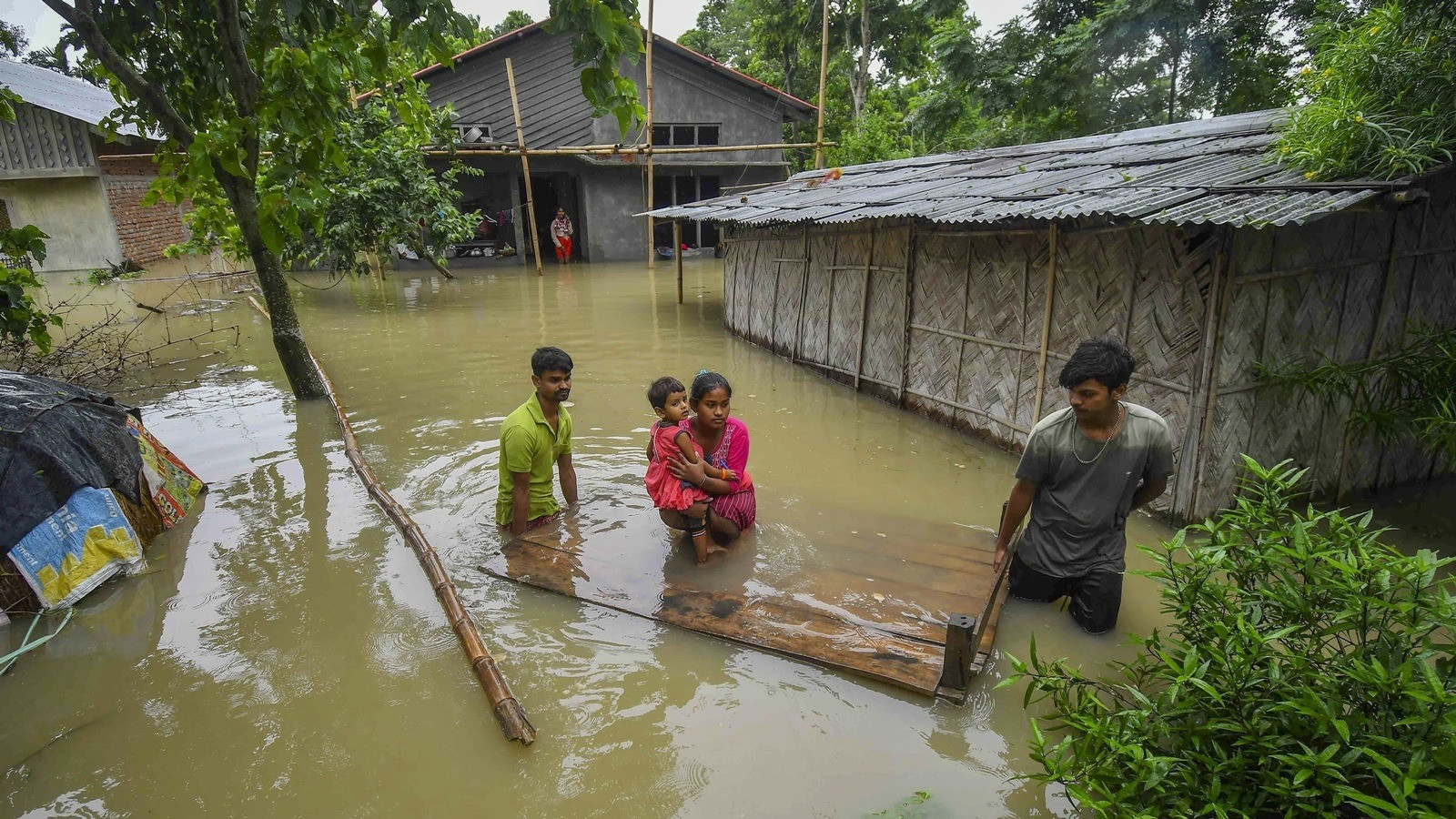
Former opposition leader Debabrata Saikia calls Assam floods a man-made disaster.
In Assam, former Leader of the Opposition Debabrata Saikia has termed the devastating floods in the state as a man-made disaster. He has directly blamed the Himanta Biswa Sarma government for this. Saikia alleged that the rampant activities of sand, stone, and coal mafias have led to the destructive floods. As evidence, he cited satellite images of the affected areas from 2010 to 2024. However, the Assam government has attributed the unprecedented floods in four districts of Upper Assam to Nagaland and the extraordinary heavy rainfall in the flood-affected districts.
The Telegraph reports that Saikia targeted the Himanta government, stating that these floods are the result of large-scale illegal mining. In a post on X on Thursday, Saikia mentioned the severe floods in the Nazira constituency, stating that this area falls under the most affected Sivasagar district. He said that if one compares satellite images of this area between 2010 and 2024, it becomes evident that "the once lush banks and natural flow paths of the Dikhow river have been ruthlessly excavated and turned into barren land with pits." It is noteworthy that the Dikhow river flows from Nagaland into Assam.
Former Congress MLA (who was a three-time MLA from Nazira) Saikia said,
"The rampant and uncontrolled plunder of our natural resources is the main reason for the current devastation in Nazira, Sivasagar, Charaideo, Jorhat, etc. I have continuously warned the BJP government and fought against this impending disaster for years, but they chose to protect the mafias instead of our citizens."
He further stated, "I approached the Guwahati High Court and filed a Public Interest Litigation against the large-scale illegal mining on the banks of the Dikhow river. On 21 October 2019, the High Court directed the government to form a 'Mines and Minerals Task Force Battalion' within three months to curb this problem. Despite the clear instructions of the court, the Assam government admitted in the Assembly on 22 December 2021 that the formation of this 200-member task force is still 'in process.' I raised this issue again in the March 2022 Assembly session and sought to know what concrete steps were taken to prevent illegal mining and trade of forests and minerals as per the High Court's directives."
It is noteworthy that following Saikia's persistent complaints, on 12 January 2022, the Assistant Executive Engineer (Water Resources, Nazira Sub-Division) inspected the illegal mining sites near Bamunpukhuri Tea Estate and Santak and issued a written warning that continuous excavation could change the river's course and cause massive destruction.
Saikia claims that the BJP-led Assam government "suppressed this report to protect the mafia."
Tagging Prime Minister Narendra Modi and Union Home Minister Amit Shah, Saikia said that he had formally warned the Union Minister of Environment and Forests on 15 June 2024, stating that "the continuous illegal mining poses a threat of changing the course of the Dikhow river, which could lead to massive destruction."
Saikia said,
"The warnings were deliberately ignored," and the people of Nazira "are now paying a heavy price, losing their homes, livelihoods, and loved ones due to the collusion between the Himanta government and the mining mafia."
Besides Saikia, Assam Public Works Secretary Dhrubajyoti Talukdar also showed Google Earth satellite images during a TV show on Thursday evening, highlighting the impact of coal mining in the lower areas of Nagaland's Naganimora region. The Sivasagar unit of the Asomiya Yuva Samaj has also raised concerns about large-scale mining and hill cutting in the upper regions of Nagaland, which is being considered a cause of flooding in the districts of Upper Assam.
Senior journalist from Guwahati, Sushanta Talukdar, said, "Natural disasters cannot be prevented, but lives can be saved, property damage minimized, and standing crops protected by strengthening structural and non-structural measures. When disasters like floods and erosion become more severe due to human causes, such as large-scale deforestation, indiscriminate excavation of sand and stones from riverbeds, and other activities that destroy the river ecosystem and watershed, it becomes crucial to address these causes to reduce the scale of devastation."
He further stated,
"If the Assam government had taken stringent measures in 2019 to stop the indiscriminate excavation of coal, sand, and stones by the mining mafia along the banks of the Dikhow river and its basin, the damage would have been much less."
It is noteworthy that officially, 40 percent of Assam is prone to flooding. Floods are an annual problem, but this time they have caused massive destruction in four districts that usually remain unaffected. According to locals and the administration, these districts have never witnessed such a situation before. Even 11 days after the unusually heavy rainfall on 19 and 20 July, many areas in the most affected districts - Charaideo and Sivasagar - remain submerged. The government's handling of the floods is facing criticism.