
Arundhati Roy claims Modi's image shattered in two weeks

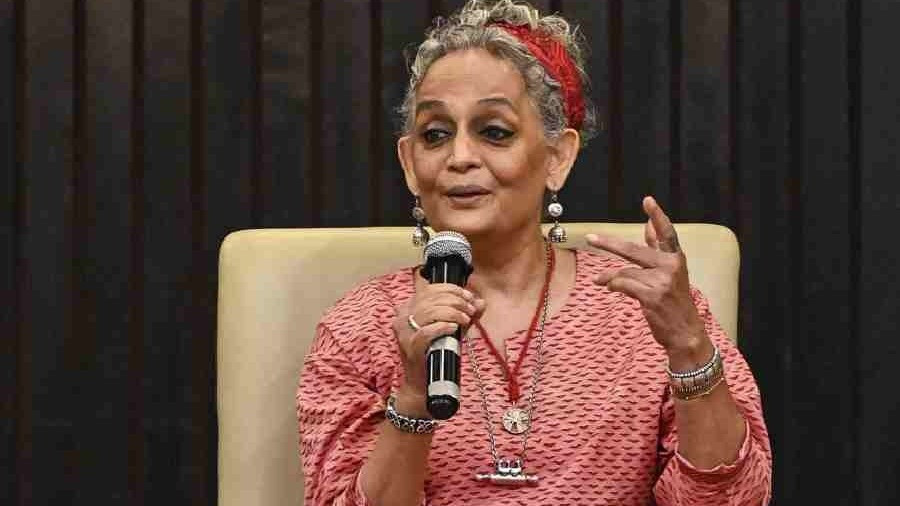
Arundhati Roy urges opposition parties to learn from Jantar Mantar protesters.
The protest by Gen Z and the youth at Jantar Mantar has destroyed the public image that Prime Minister Narendra Modi built over more than two decades in just two weeks. This movement has delivered a political blow to the BJP that is "greater than any electoral victory." Renowned author Arundhati Roy made this statement on Monday during the launch of the Hindi translation of her book "Mother Mary Comes to Me", titled "Meri Maa, Meri Gangster".
The Telegraph reports that Arundhati Roy said that winning and losing elections is just one aspect of politics. The recent mass mobilisation has shown that narratives built over decades can be shaken in just a few weeks. "What I find most interesting is that no one knows what is going to happen next with us, with this country. The script is still being written, and everyone has a role to play in it. People often assumed they would have to live in these circumstances for a thousand years, but it has been shaken to its roots in two weeks."
In a packed hall at the India International Centre (IIC), Roy said,
"The image of Prime Minister Modi built over 24 years, on which crores of rupees were spent, without even holding a press conference, where some people call him an avatar of Vishnu, has been destroyed by Gen Z and the youth in two weeks."
Booker Prize-winning Roy, for "The God of Small Things", however, cautioned that the challenge is not over if the government maintains its control over institutions and the levers of power. She said, "If this government maintains control over institutions or the levers of power, it will be very difficult for us."
She appealed to opposition parties and civil society to work together to protect democratic institutions. Roy also urged opposition parties to learn from the protesters at Jantar Mantar. According to her, the youth involved showed "maturity," even if they did not agree with each other on every issue. She said, "They played their roles very responsibly."
The 64-year-old Roy compared the cooperation among the protesters to a musical band. She said,
In a musical band, everyone has their own distinct role, but they all work together for a common purpose. "The bass guitarist cannot be the singer, the singer cannot be the drummer, and the drummer cannot be the guitarist. Everyone has played their role in different ways. Now the elders must also show their maturity."
Over the past two decades, Roy has written several non-fiction books, including "The Ministry of Utmost Happiness". She has also penned numerous essays on diverse subjects such as Kashmir, big dams, globalisation, Dalit thinker Dr. B.R. Ambedkar, meetings with Maoist rebels, and conversations with whistleblower Edward Snowden and Hollywood actor John Cusack.
Roy is as revered by her admirers as she is sharply criticised by her detractors. The 2024 PEN Pinter Prize winner's work has often provoked strong reactions, and she has faced legal controversies. Her effigies have been burned, events disrupted, and she has been called 'anti-national', told to 'go to Pakistan', and faced charges of sedition and contempt of court.
Translated by Prabhat Singh and published by Rajkamal Prakashan, "Meri Maa, Meri Gangster" is primarily based on the complex relationship between Arundhati Roy and her mother, Mary Roy.
Mary Roy was a renowned educator and women's rights activist. She fought a historic legal battle to secure equal rights for Syrian Christian women in Kerala to their father's property. According to Roy, this book is "neither her autobiography nor her mother's biography," but rather "a biography of a relationship"—the story of a relationship between two women who happened to be mother and daughter. Roy also explained why she called her mother a "gangster" in the book.
She said, "Some people, perhaps in the Hindi-speaking world, get upset that I called my mother a 'gangster'. But both the critics and those defending me are missing the point. Critics say, 'How can you call your mother a gangster?' On the other hand, those defending me say, 'She was just very protective.' Both are wrong. She was a gangster." Roy further said, "To be honest, whenever I am attacked—as happens to everyone these days—I tell myself, 'Do you know who my mother is? Do you know whose daughter I am? What can you do to me?'"
Referring to a chapter titled "Collateral" in her book "Mother Mary Comes to Me", Roy recounted an incident from her childhood.
She narrated that one night she pretended to sleep while her mother woke her brother at midnight and beat him with a wooden scale because his report card described him as an "average student." The next morning, Roy was lovingly embraced by her mother for achieving good marks. Roy said that this incident left a deep and lasting impression on her perspective on success and privilege.
In the book, she writes, "Since then, every personal achievement for me is accompanied by a sense of foreboding. Whenever toasts are raised in my honour or applause is given, I always feel that somewhere in another room, a quiet person is being beaten." She said,
"People think I am a successful writer. I am not. People respect me, give me awards, give me the Booker... but someone is being beaten in another room. My entire writing is about that." Extending this metaphor, Roy said that "someone is being beaten" everywhere—"in Gaza, at a bus stand, in a village, at Jantar Mantar."