
Allahabad High Court quashes NSA against Noida protester

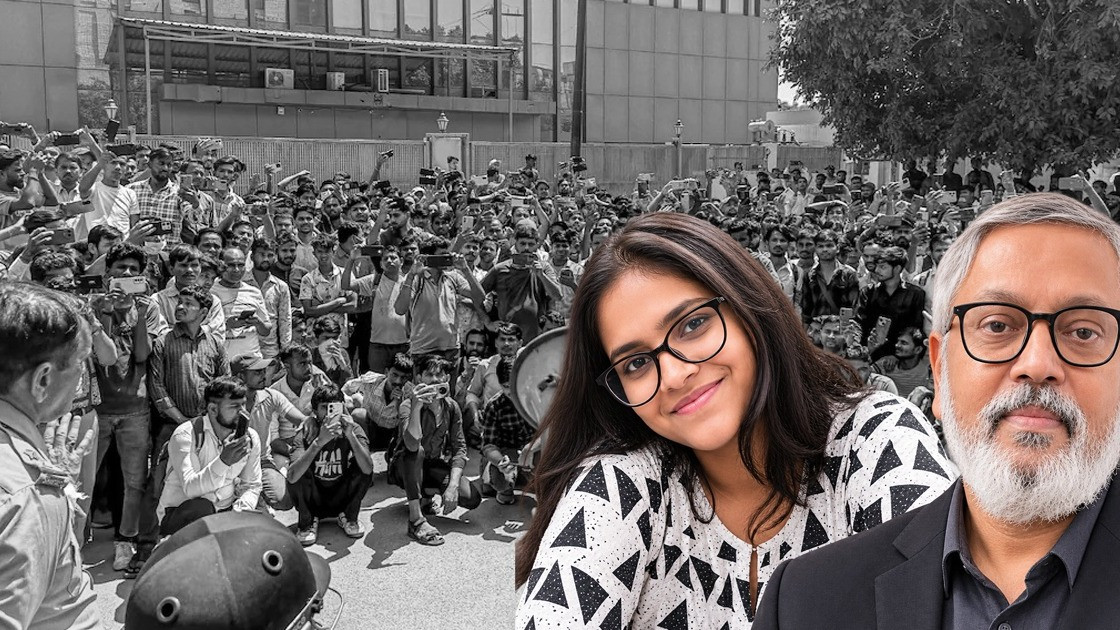
The Allahabad High Court has annulled the detention order issued under NSA against Akriti.
The Allahabad High Court has quashed the detention of 25-year-old Akriti Chaudhary, a graduate from Delhi University, under the National Security Act (NSA). Akriti has been in jail for nearly five months in connection with a case related to workers' protests that took place in Noida in April. The court has annulled the detention order issued against Akriti under the NSA and has also ordered the payment of ₹5 lakh to her.
It is noteworthy that under the National Security Act, a person can be detained without trial for a maximum of one year.

According to Bar and Bench, on Tuesday, a bench comprising Justice Atul Srivastava and Justice Achal Sachdeva stated that Akriti Chaudhary was detained based on a fabricated story by the Uttar Pradesh government. ‘Bar and Bench reported, citing advocate Charlie Prakash, that the court has also directed the Noida administration to pay ₹5 lakh as compensation to Akriti Chaudhary. However, Akriti will not be released from jail yet, as she is still awaiting bail in other cases related to the protests.
On April 13, around 40,000 to 45,000 workers from various industrial units in the city gathered to demand long-pending wage increases. The protests occurred amid rising gas prices due to supply disruptions caused by ongoing wars in West Asia. The protests later turned violent. Videos widely shared on social media showed some protesters throwing stones and vandalizing property. Over 350 people were arrested in connection with the violence on April 14.
About a month later, the Uttar Pradesh police registered a case against Akriti Chaudhary and 60-year-old Satyam Verma under the National Security Act. Satyam Verma, a former journalist, resides in Lucknow, while Akriti Chaudhary, a history graduate, hails from Durgapur in West Bengal. Both are members of the workers' organization 'Mazdoor Bigul Dasta.'
The police alleged that both played a "significant" role in inciting violence, arson, and creating chaos during the protests. The police also claimed that Verma and Akriti incited people in different areas to "disturb public order." Akriti's family claimed that the police detained her on April 11 from a metro station in Noida. Her father, Arun Chaudhary, questioned how someone detained on April 11 could be accused of violence that occurred on April 13.
Eyewitnesses alleged that,
1On April 13, police officers deployed to control the violence assaulted the protesters. A video surfaced on April 16 showing police officers beating women. Many social media users, including Uttar Pradesh Congress, shared this video, claiming it showed Noida police lathi charging and mistreating women workers protesting for wage increases.
The Gautam Buddh Nagar police commissionerate denied these allegations. The police stated,
At first glance, this video appears to be morphed or AI-generated. It does not seem to be from Noida but from another location.
However, eyewitnesses, who chose not to reveal their identities for fear of administrative backlash, told 'Scroll' that the video captured the same scenes they witnessed.
Scroll conducted geolocation analysis and matched the video with a press photograph to establish that,
the incident actually took place at Block A and Block B in Sector 6 of Noida. The 'Scroll' team also visited the site and spoke to several individuals who witnessed the police assault. There was no response to the questions sent to Police Commissioner Lakshmi Singh at that time.
After the NSA was imposed, a hearing was scheduled at the Allahabad High Court on Tuesday, September 1, where the court quashed Akriti Chaudhary's detention under the National Security Act.
Three bail applications for Akriti had been rejected, and she had approached the Supreme Court for relief. The Supreme Court advised her to seek relief from the High Court instead, and during the hearing at the Allahabad High Court on Tuesday, her detention was challenged. Accepting her petition, the bench of Justices Atul Srivastava and Achal Sachdeva termed her detention a “fabricated story” by the state and directed that if her arrest in any other case is not justified, she should be released immediately.
This incident came to light when the bench examined the process of issuing notices under the Indian Citizen Security Act (BNSA) during her arrest. In this process, detailed scrutiny and procedural flaws were found. A detailed order is currently awaited in this matter. During the court hearing, the state informed the court that Akriti Chaudhary was arrested on April 12, 2026, at 10:56 AM and that a notice was issued under Section 130 of the BNSA. The state's special case is that she incited the crowd to commit arson and stone-pelting.
According to reports, Justice Srivastava asked whether the first notice under Section 126 of the BNSA had been served. In response, the state said,
No notice was given under Section 126, and a notice was issued under Section 130.
In this case, Justice Srivastava made the following observation:
According to the notice under the BNSA, if she had been willing to give a statement, she would not have been arrested. Now look at this GD entry, she will be arrested, then the notice will be prepared.
The court raised questions about the state's statement based on the information recorded in the General Diary, finding that the records suggest that Akriti Chaudhary was arrested before the notice was prepared. This comment was made in the context of the bench examining whether the evidence presented by the state could indeed establish Akriti's role in the violence. The court had asked the state to show footage that would reveal that Chaudhary incited the violence; however, the state requested time to present the video, but the court denied the request, stating that Akriti had already spent five months in jail.