Why are students in Bihar protesting?
Students question the language used in exams that decide their future.
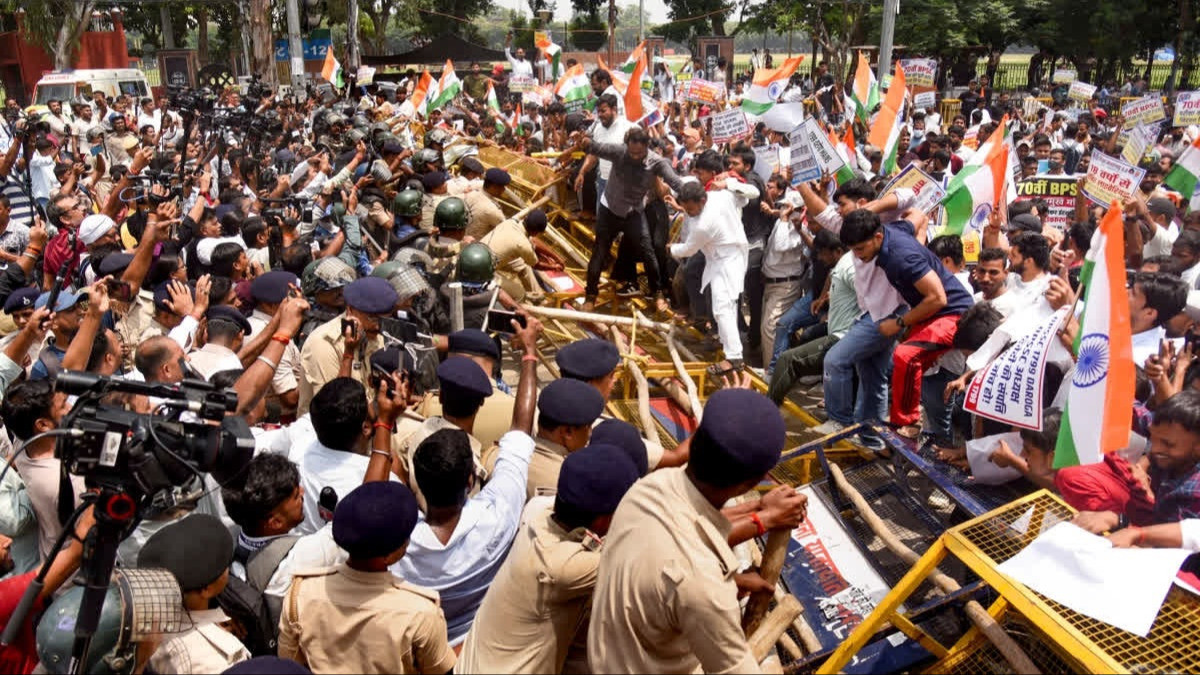
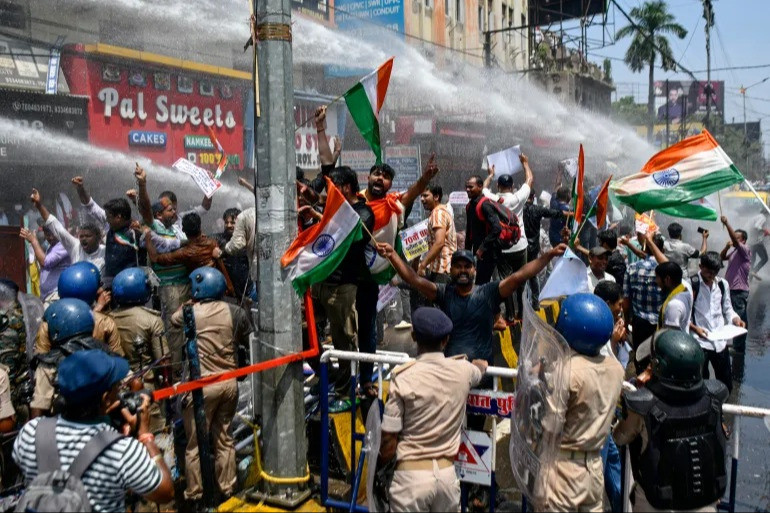
Bihar students had announced their plan to march towards the Chief Minister's residence on August 25 several days in advance. On Tuesday, as they proceeded with their planned march, barricades were set up to stop them. The students crossed the barricades, and the police used water cannons to stop them. A lathi charge was conducted. Several students sustained head injuries and are seriously injured, admitted to the hospital.
However, to consider Tuesday's student protest merely as a protest and police action would be to underestimate the entire issue. Behind this is the anger of students that has been accumulating for months, caused by repeated delays in recruitments, irregularities in examinations, unclear procedures, and the administration's silence.
Meanwhile, a statement by BPSC Examination Controller Rajesh Kumar Singh added fuel to the fire, further inciting the students' anger. When questioned about the protest and examination system, he said,
"An elephant walks through the market, while a thousand dogs bark." The students took this saying as an insult to their movement and their voice. Following the controversy, the state government suspended Rajesh Kumar Singh. Later, the official clarified that he had used a saying and expressed regret if his words hurt anyone.
But the question is why such language was used in response to the questions of the youth whose future depends on an examination? Is questioning the examination system so trivial that it can be dismissed with a saying? The students' anger is not limited to that statement. It is directed at the entire system, where they have to repeatedly take to the streets to make their voices heard.
How the Movement Reached Gardanibagh
This movement did not start suddenly. On May 8, a large number of candidates took to the streets of Patna with demands related to the advertisement of TRE-4 and the recruitment process. During that time, reports of police action and FIRs emerged. Even after that, the students' demands did not end. Then, on August 18, an indefinite hunger strike began at Gardanibagh. Initially, the students' main demand was to issue the advertisement for TRE-4.
Finally, the advertisement and examination schedule for 32,388 teacher posts under TRE-4 was issued. But the movement did not end with the advertisement. Because the students say their problem is not limited to the advertisement. They want,
the TRE-4 examination to be conducted in a single phase, the negative marking system to be abolished, and the interests of local candidates of Bihar to be protected in recruitment. Additionally, demands are being raised to complete pending recruitments, release supplementary results for the remaining posts of TRE-1, TRE-2, and TRE-3, increase seats according to actual vacancies, and complete pending recruitments of BSSC.
Thus, a movement that started with a demand for an advertisement has now raised questions on the entire recruitment system of Bihar. And it is important to understand why students are still on the streets even after the advertisement has been issued. Because for a young person, it is not enough to know that recruitment will be announced. They also need assurance that the examination will be conducted on time, will be fair, results will be announced on time, and they will not have to wait for years for appointments.
A young person preparing for competitive exams in Bihar first waits for the advertisement, then for the examination, then for the results, and then for the appointment. Meanwhile, age passes, and both the family's money and the student's effort are spent. In such a situation, when questions arise about the examination process, it is not unnatural for the dissatisfaction within them to reach the streets.
BPSC and the Eroding Trust
It is important to remember the past controversies of BPSC here. Because the students' dissatisfaction has not arisen from just one incident today. In 2022, the 67th BPSC preliminary examination had to be canceled after allegations of question paper leaks. At that time, the hard work and time of thousands of candidates were directly affected. Later, in 2024, the TRE-3 examination was also canceled following a question paper leak case. Lakhs of candidates participated in that examination, and thousands of teacher posts were to be filled.
Then the 70th BPSC created a new controversy. Candidates alleged question paper leaks and irregularities at examination centers. The matter reached the Patna High Court. During the court proceedings, several allegations of irregularities in the examination were raised by the candidates. Later, the demand to cancel the examination across the state was not accepted, and the commission's decision to conduct a re-examination for one examination center was upheld.
But the legal decision is one thing, and the students' trust is another. If thousands of candidates are continuously raising questions after an examination, dismissing those questions as mere voices of protest is not a solution to the problem.
In this context, the issue of action and debarment against candidates also becomes significant. After the 70th BPSC, some candidates were debarred for three years for allegedly using unfair means. The commission has the authority to maintain discipline and take action against unfair means, but the students' question is who will impartially hear the complaints of candidates who raise issues about the examination system?
For a young person, three years are not just three calendar years. It is the time in their life when their age, preparation, and career opportunities progress. Therefore, an action like a three-year ban on a candidate can affect their entire future. This is why the students' question is not just about jobs. The question is how they can trust the system that holds the decision of their future in its hands.
A young person prepares for many years. The family bears the cost of their education. They spend the most important years of their life among books and notes. They have only one dream: to pass the examination, get a job, and make life a little better. But then there are delays in advertisements, sometimes in examinations. Sometimes questions arise about the examination, sometimes about the results. Sometimes there are reports of paper leaks, and sometimes the recruitment process itself becomes controversial. And when the same student comes to the streets to ask questions, barricades are erected in front of them, water cannons are used, lathi charges occur, detentions happen, and FIRs are filed. Why does the student have to pay the price every time?
The Question is Bigger than Just Jobs
Today, the Education Minister has stated that almost all the problems of the students have been resolved and the government is ready for dialogue. The government has also announced the initiation of student support camps, helplines, and online systems for students' grievances.
On the other hand, BPSC has made it clear that the negative marking system will not be abolished and its examinations will be conducted in at least two phases. Thus, the claim of resolution from the government and the commission stands, but the students' movement continues. And that is the biggest question.
These questions cannot be answered merely by statements. Answers will come when recruitment happens on time. When the impartiality of the examination is not questioned. When strict action is taken against the gangs leaking question papers, deterring anyone from attempting it again. When candidates do not have to remain in doubt regarding the OMR and answer key. When results and appointments are not stuck for years. And when a student approaches the commission with a complaint, they will be heard, and their voice will not be mocked.
Because the students sitting in Gardanibagh are not just fighting for their jobs. They are demanding the value of their time. They are demanding respect for their hard work. They are demanding trust in their future. But the real question is, will the barricades stop the students' questions? Will the water cannons wash away the questions raised on the recruitment system? Will the lathi charge end the restlessness of the youth who have spent several years of their age preparing for a government job? Perhaps not.
Because today, not just a few candidates are sitting in Gardanibagh. The trust of the youth of Bihar is sitting there, who want their hard work to be judged not by negligence, paper leaks, irregularities, or an opaque process, but by a fair system. The government has power, the commission has the system, but the students have their questions. And in a democracy, the real test of any government is whether it suppresses the questions raised against it or answers them. The student movement in Gardanibagh is not just a movement for jobs. It is a test of the credibility of Bihar's recruitment system. And in this test, the questions should now be asked of the system, not the students.