
Threat of lake burst on China-Nepal border averted, over 2,500 still missing

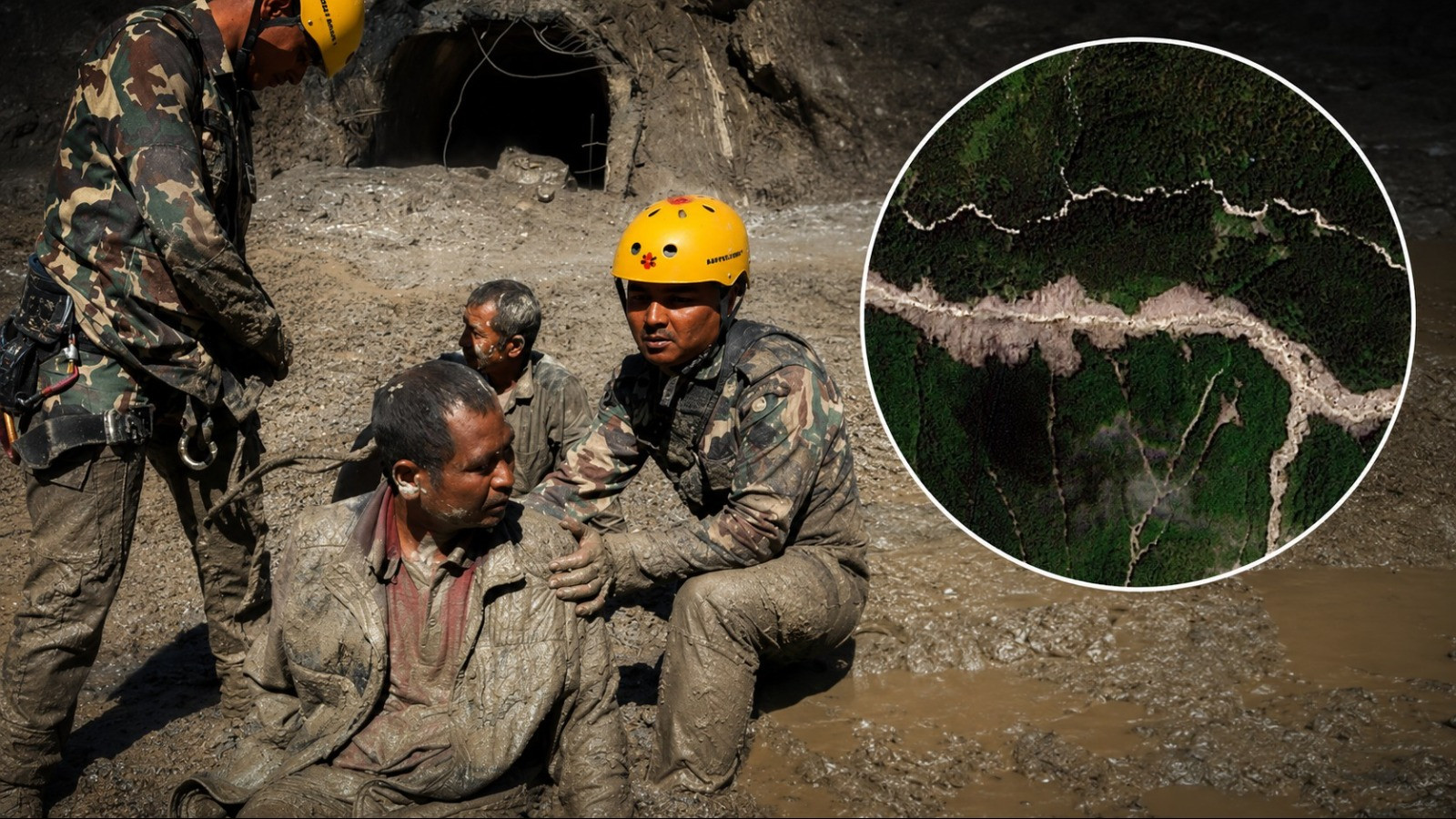
The death toll in Nepal continues to rise due to flooding.
The risk of a lake burst near the China-Nepal border, following the formation of a lake due to a glacier burst, has now decreased. Earlier this week, the region experienced devastating floods. Chinese officials reported on Saturday (29 August, 2026) that the size of the lake appears to be reducing.
The Hindu reported, citing Nepal's Ministry of Water Resources, that satellite images from Thursday (27 August, 2026) to Saturday (29 August, 2026) morning indicate that water from the lake, spread at the confluence of two rivers on the border of China's Tibet region and Nepal, is gradually flowing out. This has resulted in a continuous decrease in the water accumulated in the lake.

It is to be noted that the death toll due to the flood in Nepal's Bhotekoshi River is continuously rising. According to a report by 'The Kathmandu Post', the death toll has increased to 626, and 2,426 people are still missing.
Scientists are investigating how the glacier burst and landslides led to the flood in the Bhotekoshi River. Chinese officials have informed that a massive barrier lake has formed in Nepal, which is already overflowing, and with more water expected in the coming days, it could burst.
The flood in Nepal has caused extensive destruction, with reports of numerous deaths and missing persons, including various tourists. Private and public properties in Nepal have been swept away, causing significant damage. The flood followed a landslide in Nepal, which blocked the flow of the Lende tributary of the Bhotekoshi River and affected Timure, located near the Nepal-China border in Rasuwagadhi. Most of the area was engulfed by the flood, destroying many settlements.
Rasuwa's Chief Customs Officer Rajendra Dhungana stated,
When he felt the ground shaking in the morning, he thought it was an earthquake. When he looked outside, a massive wave of water, with a cloud of dust behind it, was rapidly descending and moving towards Timure Bazaar. As the flood moved towards lower areas, it destroyed everything in its path, including animals, buildings, and people.
Given the flood situation, disaster experts say Wednesday's flood could be one of the deadliest in Nepal's modern history - possibly surpassing every disaster since the 1993 floods in Sarlahi, Rautahat, and Makwanpur, which killed 1,400 people and have long been considered the country's largest disaster.
Rescue teams are searching for people affected by Nepal's disaster, and bodies are still being recovered from the flooded areas. Chinese officials said they would continue to monitor the lake and conduct hydrological analysis, while also preparing for potential emergency rescue and flood control operations.
According to media reports, Nepal's Meteorological Department has issued a warning of more rain in the flood-affected areas, which could hinder relief efforts. Chinese officials have stated that the threat from the lake formed by the glacier burst near the Nepal-Tibet border has decreased. The state broadcaster CCTV reported, citing the Ministry of Water Resources, that satellite images from Thursday to Saturday show that water from the lake located at the confluence of two rivers is gradually flowing out, reducing the reservoir's water level.
A total of 15,224 security personnel are being deployed for search, rescue, and relief operations. Nepal experiences floods almost every year during the monsoon season. Environmental changes are occurring frequently, leading to changes in weather patterns each year. According to reports, as security personnel reach the affected areas for identification, the number of people affected by the flood is expected to increase, and the search for missing persons is ongoing.