
Supreme Court questions protests at Jantar Mantar

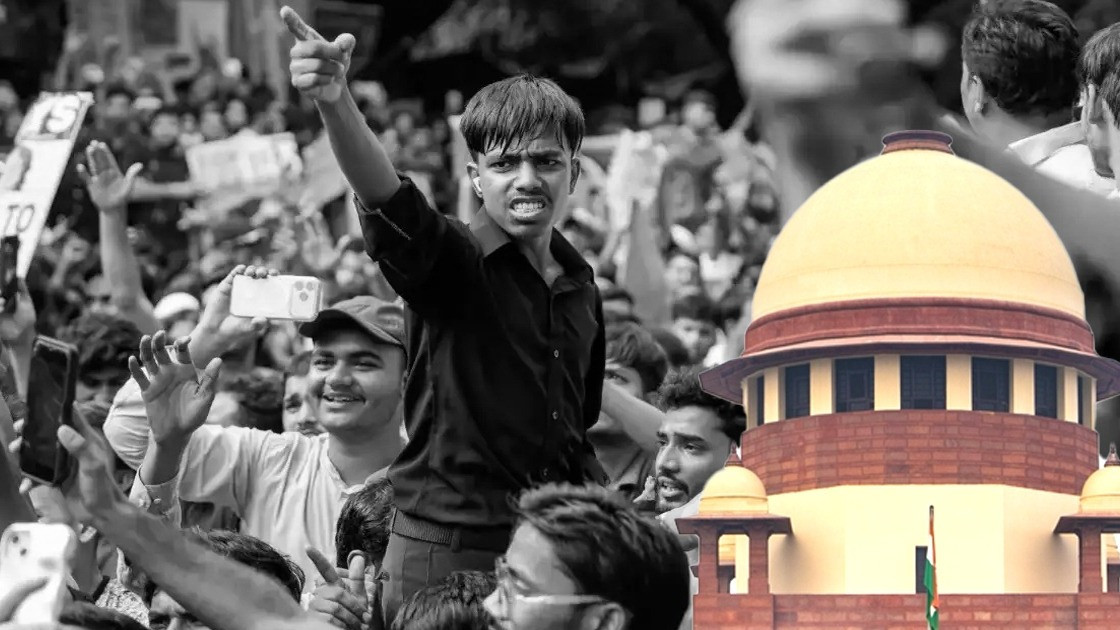
The Supreme Court noted that protests at Jantar Mantar cause inconvenience to local residents.
Jantar Mantar, which has been a witness to protests and freedom of expression for centuries, is now under the scrutiny of the Modi government. The government is taking all measures to suppress protests that make them uncomfortable. A conspiracy is being hatched to ensure that no constitutional protest takes place at Jantar Mantar. For this, the government may even increase pressure on constitutional institutions.
In this context, the Supreme Court on Monday agreed to consider a public interest litigation stating that Jantar Mantar is no longer a suitable place for protests. The court noted that it causes inconvenience to local residents and disrupts essential services.
It goes without saying that the democratic and peaceful movement by students and protesters over the exam paper leak, which lasted for more than a month, has weakened the Modi government internally. This is why, after police repression, the government now wants to silence the voice of protest in the country by increasing pressure on constitutional institutions.
To permanently ban protests at Jantar Mantar, a bench headed by Chief Justice and comprising Justice Joymalya Bagchi and Justice V. Mohana issued notices to the central government and other parties on a petition filed by Satish Chand Kaushik. The court asked Solicitor General Tushar Mehta to seek instructions from the concerned authorities on the issues raised in the petition.
The petition demands alternative arrangements for organizing protests. It states that protests at Jantar Mantar cause difficulties for local residents and affect the supply of essential goods and medical services. During the hearing, the Chief Justice said that the petition raises concerns related to access and movement in the area.
The Chief Justice said,
“The petition states that due to problems related to access, Jantar Mantar is no longer an appropriate place for such protests. There is also the issue of the supply of medical essentials. I think it is important... Mr. Solicitor, please take instructions on this. Notice should be issued and the matter should be listed separately.”
During the proceedings, the petitioner's lawyer also mentioned a proposed political march. He said,
“Arvind Kejriwal called a town hall and decided to march to the Prime Minister's residence, saying that ‘another incident like July 20 should be avoided.’ On this argument, the bench refused to comment on the proposed program.
The Chief Justice said,
“They know how to handle it. If they cannot handle it, come to us in case of mishandling the situation. I am confident they will handle it.” The court has directed that this matter be listed separately for hearing.
It is not known when an alternative location for protests instead of Jantar Mantar will be found, but the promptness with which the Supreme Court has listed this petition for hearing has raised questions in the democratic setup. This also raises the question of whether any future movement on any issue will receive the same support, strength, and sympathy as seen after July 20. It should be noted that this movement against the paper leak started on June 20, 2026, and was withdrawn on July 25, 2026, after the resignation of Union Education Minister Dharmendra Pradhan.
However, several significant developments have occurred since then. The Supreme Court, which initially took a cautious approach to the matter, has now reached a critical stage of judicial intervention. Moving beyond the initial petitions, the ongoing hearings in the Supreme Court have taken on a new dimension. Families of injured police and paramilitary personnel have also joined the legal proceedings. They have opposed any unilateral withdrawal of FIRs against protesters accused of breaking the law or engaging in violence, demanding justice.
How the Supreme Court resolves these questions could set an important framework for the future. It will also clarify how peaceful dissent and lawful governance can coexist without allowing the situation to descend into chaos. In this direction, the Supreme Court is considering several major steps. There is a possibility of forming an independent and high-level team to investigate complaints of alleged police excesses. Additionally, the court is looking at
how crowd control methods can be adopted to ensure the safety of protesters, ordinary citizens, and security personnel alike. The court is also reviewing cases of violence against security personnel to ensure accountability is not limited to one side but applies equally to all.
The purpose of these hearings is to prepare clear and nationwide guidelines that maintain security and law and order in public places while respecting people's democratic voice and right to protest. In this context, it becomes extremely important to understand how the leadership of the movement adopted a dual strategy during these entire proceedings.