
Students respond to allegations against Prof. Faizan Mustafa

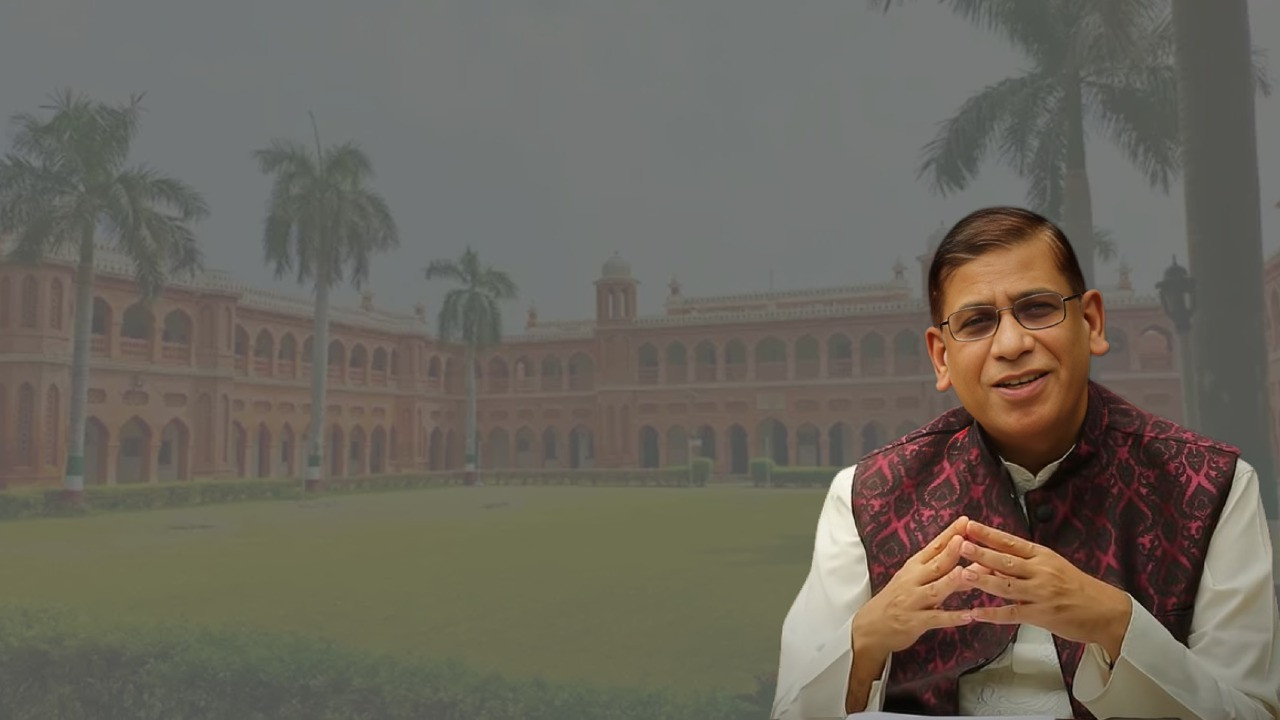
This is a response to the open letter we published a few days ago from members of the Aligarh Muslim University academic community regarding Prof. Faizan Mustafa.
[ This letter has been sent in response to the open letter from Faizan Mustafa. We are publishing the letter as a healthy debate. ]
In every matter, you ask, ‘What are you?’
Prof. Faizan Mustafa: Are they the guardians of Muslim conservatism, Hindutva, or the Constitution?
Anonymous letters are not worthy of a response. Their authors are so afraid of being sued for defamation by Sir or his hundreds of law students that they have decided not to reveal their names. Muslim Mirror, Sabrang, The Credible News, and other websites that published this open letter are also guilty of defamation. They never even asked for Prof. Faizan Mustafa's side before publishing such a sharp open letter.
As students of Prof. Mustafa, we do not want to be part of any motivated and hateful campaign against him, as we cannot legitimize a factually incorrect and malicious open letter.
We would also request Prof. Mustafa not to be disheartened and not to fall into this trap. He has informed us that he is not surprised by the intentions of the writers from Aligarh, but he is saddened that even liberal scholars and esteemed journalists who have known him for years chose to believe this letter without taking the trouble to read his writings and ignoring his lifelong struggle for constitutionalism, minority rights, and the rights of Dalits and OBCs.
However, since what Prof. Mustafa has written and said is entirely available in the public domain, we conducted some research ourselves and read his articles and the book ‘Strict Liability’ once again. We challenge the authors to prove the allegation of plagiarism. The article from which the book is alleged to have been plagiarized is ten times larger in terms of pages. This book is based on his LLM thesis and was considered so outstanding that he received the Commonwealth Fellowship; it was evaluated by a leading expert in criminal law. The authors may have been confused by the title of the research paper. They seem unaware that ‘Strict Liability’ also exists in tort law, and therefore, when someone works on strict liability in criminal law, it must be explicitly stated.
If Prof. Faizan Mustafa is indeed such an uneducated person, then how have editors of almost all newspapers published his articles? Was he not the first law professor in India to take law out of classrooms and generate much-needed legal awareness among the general public? How does he have over 5 crore views and 7.3 lakh subscribers on his channel? The facts speak for themselves, and the malicious propaganda of vested interest groups and enemies of Aligarh Muslim University cannot tarnish his image.
Our investigation results in us being astonished that the motivated writers who have used the name of Aligarh Muslim University have selectively lifted sentences or distorted statements to create a false narrative. Even impartial AI has reached conclusions similar to our investigation regarding the blatant lies in this mischievous so-called open letter. Before presenting our conclusions, let us clear doubts on the subjects for which Prof. Faizan Mustafa cannot be personally blamed, as he cannot invite himself to TV channels. This decision is not made solely by the anchor, but by the editorial team and senior officials of TV channels. At least the following points are noteworthy:
Was Prof. Mustafa's TV presence merely due to Ravish Kumar's grace?
- The allegation is that Ravish Kumar never invited him to any panel discussion. If the authors of the open letter want to say that Prof. Mustafa is so uneducated that he cannot argue in a panel, we request them to search on YouTube and see how many panel discussions Sir has participated in, many of which are with Ravish Kumar. India’s toughest anchor Karan Thapar has interviewed Prof. Mustafa five times. Prof. Mustafa regularly faces joint parliamentary committees where up to 30 members interrogate him for hours. He was questioned for more than 5 hours on the Waqf Bill. We challenge the authors to publicly debate the issues raised in this open letter with him or with us.
- If the authors of the open letter want to say that Prof. Mustafa is an insignificant person and does not know his subject, we are helpless as we have no remedy for mental illnesses. Anyway, the open letter itself admits that he is a giant personality. Even after Ravish Kumar left NDTV, Prof. Mustafa continued to be invited to NDTV programs. He regularly participates in NDTV programs on legal issues. A search on Google will reveal how many programs he has appeared in over the past three years.
- The allegation that Ravish Kumar no longer invites him is also baseless, as Ravish Kumar no longer has the facilities that he had during NDTV's good old days, and all his programs on his YouTube channel are now solo. He does not invite anyone else either.
- Our YouTube search found numerous interviews and panel discussions of Prof. Mustafa with Rajdeep Sardesai, Ashutosh, Barkha Dutt, Sanket, Nidhi Kulpati, Nidhi Razdan, Nagma, Akhilesh Sharma, Karan Thapar, Srinivasan Jain, Saurabh Shukla, Ajit Anjum, and many others. These names are beacons of journalism. No one doubts their integrity, knowledge, and impartiality. Are all of them ignorant and wrong in considering Prof. Faizan Mustafa a distinguished scholar of law?
- Even senior advocates of the stature of Kapil Sibal have interviewed Prof. Mustafa several times, and each time he has praised Sir's profound scholarship in his introduction. Do the authors of the open letter have the monopoly to decide who is a scholar and who is not? Who gave them this authority?
- In the long history of the Faculty of Law at Aligarh Muslim University, which faculty member's writings have been cited by the Supreme Court in its judgments? Can these self-proclaimed evaluators of others' scholarship name anyone other than Prof. Faizan Mustafa? Can any anonymous writer pronounce judgment on Prof. Mustafa's scholarship, whose selection has been made several times by selection committees that included judges of the Supreme Court and former Chief Justices of India as members and chairpersons? Many different Chief Justices of India have nominated him as their nominee in various national law universities.
- Similarly, which working teacher of the AMU Faculty of Law has been repeatedly invited by joint parliamentary committees for expert opinions on important constitutional amendment bills and other laws? Additionally, can the authors of the open letter tell us which working member of the Faculty of Law has drafted parliamentary and state laws? Have the authors of this mischievous campaign investigated what arguments Prof. Mustafa presented in the JPC? Did he simply agree with the government? Do a little research, and you will find that he presented both the positive and negative features of various bills fearlessly, incurring the displeasure of both the government and the opposition.
- As a law teacher, Prof. Mustafa has taught us the art of constructing arguments. Whether it is a Supreme Court decision, laws enacted by Parliament, statements by the RSS chief, or anyone else's — his style is to first highlight the positive aspects and then respectfully present his critical analysis. All his writings follow this style. The authors of the open letter have chosen one sentence without reading what was written before and after that sentence.
Deputation in National Law Universities:
- It appears that the authors of the defamatory open letter have no understanding of the rules of deputation. Did Prof. Mustafa give himself deputation?
- The demand for deputation is made by the borrowing institution. In the case of national law universities, the Chief Justice writes to the Vice-Chancellor requesting deputation. This request itself indicates how successive Chief Justices view Prof. Faizan Mustafa as a legal scholar and capable academic administrator. The opinion of these judges regarding a law teacher is what should be respected, not that of the anonymous authors of the open letter who write more op-eds than Prof. Mustafa himself.
- The decision on deputation is taken by the Executive Council, which includes the President, the Governor, and nominated university teachers. Why was there no objection? In any case, granting deputation is a matter between the Chief Justice and Aligarh Muslim University. Is it not a matter of pride for Aligarh Muslim University that an esteemed faculty member is valued so highly by outsiders? The authors of the open letter should also show that they have received such requests from the President, the Governor, or the Chief Justice and that they too have received deputation.
- The Executive Council has the authority to grant deputation for a long duration. Prof. Ved Prakash, who served as Secretary, Vice-Chairman, and Chairman of the UGC, similarly was on deputation for nearly two decades. Prof. Ranbir Singh was on deputation for over 21 years. There are also several examples of IAS officers who have been on deputation for more than five years.
- If the authors of the open letter truly care for Prof. Mustafa and want him back at Aligarh Muslim University, they should request the Executive Council to cancel his deputation and direct him to contribute to AMU. Aligarh Muslim University has never asked Prof. Mustafa to return. We are confident that Prof. Mustafa will never refuse to serve Aligarh Muslim University.
Did Prof. Faizan Mustafa stop teaching in 2004?
- The authors of the open letter, despite claiming to research Prof. Mustafa, are incorrect on the level of facts/history. It seems they spend more time studying others than their own subjects. As former students of AMU, we know how many classes these authors themselves take. Prof. Mustafa was teaching in Ethiopia in 2004.
- Even after taking charge as Registrar, he continued to take the first semester at the Faculty of Law at Aligarh Muslim University. These critics are not familiar with the national law university system. As institutions of excellence, Vice-Chancellors of national law universities never stop teaching. Many of us have studied under him in these NLUs. He has taught Legal Methods, Constitutional Law, Family Law, and sometimes Criminal Law. He has initiated several new subjects that he taught himself, such as Minority Rights; Strict Liability; Education Law, etc.
- As students of Prof. Mustafa, let us also teach his critics some basic principles of law — can we say that ministers like Rajnath Ji are not members of Parliament because they are ministers? Similarly, even after becoming Vice-Chancellor, a professor remains a professor.
Prof. Mustafa's Opportunism or Consistent Academic Stance on RSS Chief, Legal Pluralism, Muslim Law, Reservation, etc.
The authors of the open letter have attempted to confuse the public, especially the Alig community, by claiming that Prof. Mustafa has allegedly adopted an opportunistic stance in favor of RSS Chief Mohan Bhagwat. These authors appear to be extremely weak in matters of history, as a Google search of Indian Express, The Hindu, and the Legal Awareness web series will clearly show that during the period when Prof. Mustafa's name was being considered for the Vice-Chancellorship of Aligarh Muslim University, he continued to raise Muslim and legal issues fearlessly with his usual critical analysis. Did he change his stance on the minority character of AMU to obtain the VC position? Has he written a single word against Muslims in all these months?
We challenge the authors of the open letter to show any article by Prof. Mustafa from the period between October 2023 and April 2024, when he was being considered for the Vice-Chancellorship of AMU, that contradicts his consistent line of reasoning over the decades.
We conducted a Google search of Prof. Mustafa's articles on the RSS Chief and found that this mischievous letter not only ignored his arguments but also clearly lacked the ability to read between the lines. They deliberately overlooked the clear sentences of those articles. However, let us take each allegation made in the open letter sequentially:
Praise for Israel during Netanyahu's Visit:
Source: tribuneindia.com/news/comment/learn-from-israel-s-legal-pluralism/530205.html
These motivated authors repeatedly quote selectively from this article, even in WhatsApp groups. The title of Prof. Mustafa's article destroys their thesis, namely “Learn from Israel’s Legal Pluralism,” published in The Tribune (2018). Muslims are a minority in Israel. In this article, Prof. Mustafa is critiquing those who advocate for ‘one nation, one law.’
The following statements by Prof. Mustafa in this article demolish their motivated criticism regarding undermining Muslim issues and siding with Netanyahu:
- **“During the long Congress rule, India’s relations with Israel were not very cordial, as Nehru and Indira were fully committed to an independent Palestinian nation.** Under the right-wing BJP, Prime Minister Modi has taken this relationship to new heights. Modi was the first Prime Minister to visit Israel last year, and now Israeli Prime Minister Benjamin Netanyahu is in India. This is only the second visit. The first PM to visit was Sharon during the first NDA government led by Vajpayee.”
- “Now India has close ties with Israel, and we are learning from Israel in counter-terrorism measures, intelligence gathering, and border surveillance. However, for the past two years, the issue of personal law reforms has overshadowed our public discourse. Since the BJP supports a uniform civil code, India should deeply study the splendid model of legal pluralism in Israel. Those who advocate for ‘one nation, one law’ and consider Israel an ideal should see how Israel manages its legal diversity.” Prof. Mustafa is praising not Israel, but the Ottoman legal pluralism that it still follows.
- **“Israel has retained some fundamental features of the traditional Ottoman Empire’s ‘millet’ system, which guarantees substantial cultural autonomy in personal matters. The state law does regulate the election/appointment of central and local rabbinical bodies and other administrative and judicial religious institutions. The state finances these religious bodies.** Those who want India to become a Hindu nation should understand that the price of this integration of Judaism with the Israeli state has been quite high in terms of the freedom of Judaism before the Israeli state.”
Here, Prof. Mustafa is indicating that in a theocracy, the state religion is controlled by the state, and in a Hindu nation, Hinduism may lose the autonomy it enjoys in a secular framework. The foolish cannot understand such matters.
- “Hindu right-wing is dissatisfied with the term ‘secularism’ and considers it a dirty word. A BJP legislator recently claimed that India will become a Hindu nation by 2024. However, extremist right-wing should understand that whether secularism is good for the country or not, it is certainly the best option for religion. In a theocratic state, religion loses its autonomy and freedom, as the state, with its vast powers, takes control of religion. This has been the experience of both Christian and Islamic states. Secularism essentially protects religion from the dominance of the state.” Is this a defense of secularism or an advocacy for Hindu theocracy?
- The Palestine Order-in-Council, 1922, which is still law today, stipulates that in matters related to personal status, the religious law of the relevant communities will apply. Thus, the law provides for the jurisdiction of Sharia courts, Christian courts, and Druze courts. Section 53 related to Rabbinical courts was replaced by the Rabbinical Court Jurisdiction (Marriage and Divorce) Law, 1953, which limited the jurisdiction of Jewish religious courts to just two subjects: marriage and divorce.”
- **“Many of us cannot believe this, but among all religious courts, Sharia courts have the most extensive jurisdiction. The jurisdiction of these courts extends to all Muslims and all matters related to personal status.”** Rabbinical courts have exclusive jurisdiction only over the marriage and divorce cases of those Jews who are Israeli citizens or permanent residents.”
- “Thus, Sharia courts have supreme autonomy, and no civil court can hear matters of personal law for Muslims. However, in Israel, no one has called it appeasement of that Muslim minority whose external loyalties are well known. If we become a Hindu nation, will the Hindu right-wing agree to grant such powers to Sharia courts in India? The Supreme Court had refused to declare Sharia courts unconstitutional because in India these courts are merely mediation councils and their decisions have no legal value. In contrast, in Israel, the decisions of religious courts are binding and executed like those of regular civil courts.”
- “The Law Commission should study the model of Israeli legal pluralism before presenting its report. The goal should not be uniformity of law, but rather justice in law. We need a Just Code.” Prof. Mustafa's suggestion was ultimately accepted by the Law Commission, which rejected the uniform civil code as ‘neither viable nor desirable’ and supported reforms in personal laws. The author of the letter cannot digest Prof. Mustafa's profound influence on the legal development of the country out of jealousy.
- On the comparison of the Babri Masjid and Temple Mount, Prof. Mustafa made an accurate point when he concluded his article with these words — “In Ayodhya, we demolished a historical mosque and have not allowed Muslims to pray for 69 years, while the worship of Lord Ram continues unabated. Let’s see what the situation is in Israel. The Temple Mount is the holiest site for Jews and the location of their first and second temples, yet Jews cannot pray anywhere at that holy site except at the Wailing Wall. The Israeli Supreme Court upheld the local police order that prohibited public prayer by Jews in the Temple Mount compound. It is hoped that the Indian Supreme Court will demonstrate complete impartiality while deciding the ownership dispute of the Babri Masjid.”
- Only a fake writer would ask a cardiologist why he does not treat eyes. The above article is about legal pluralism, not the Palestine issue. For Prof. Mustafa's views on Palestine, we request the writers to watch his Legal Awareness web series video — Palestine’s Right to Self Defence (2021)
Prof. Faizan Mustafa has never opposed reservation
- General article on reservation
The anonymous letter writers have expressed their complete ignorance regarding the debate on reservation. Prof. Mustafa has been consistently writing the same points on reservation for the past three decades. The issues he raised are still debated in the context of reservation, as they are the most relevant legal questions related to it. Many decisions of the Supreme Court and High Courts are on these very issues, but we can understand that the anonymous writers do not have the time or patience to read so many pages. The problem with such writers is that they want to portray Prof. Mustafa as anti-Dalit, anti-OBC, and anti-Muslim, especially anti-Pasmanda. We have reviewed most of his articles and videos on reservation once again, and the following statements clearly prove that Prof. Faizan Mustafa is not against reservation. He supports reservation solely due to his belief in substantive equality rather than formal equality.
Anyone can read the following articles and tell us which sentence in them or any other article is against reservation.
The Hindu, 11 March 2019
Indian Express, 8 November 2022
Indian Express, 21 May 2019,
Indian Express, 1 July 2019,
Indian Express, 25 May 2018,
Muslim OBC Reservation , 28 May 2024
The following statements in this article clearly show that Prof. Mustafa is a true advocate for OBC Muslims. The so-called Pasmanda supporters at AMU have said nothing about this decision and the recent denial of reservation to OBC Muslims by the new government of West Bengal, as their only objective is to gain power in the name of Pasmanda:
- **“The Indian Constitution promises social justice and allows the state to make special provisions for the disadvantaged to achieve substantive equality.** Mainly due to electoral compulsions rather than constitutional promises, successive governments of various political parties have been bringing reservation policies. However, the label of "appeasement" has only been applied in cases of reservation for Muslim backward classes or Pasmanda Muslims, not when reservations were announced for Patidars, Gujjars, Jats, Marathas, and EWS. Are the authors of the open letter blind that they cannot see that Prof. Mustafa is mocking the Muslim appeasement lobby?” Are they undermining Muslim interests or OBC Muslim interests here?”
- “It is strange for the High Court to reject the Sachar Committee's findings on the grounds that the 2006 data cannot be trusted in 2010, because in such cases we do not get data every year. The census occurs every 10 years. Based on the 1980 report of the Mandal Commission in 1991, the data from the 1931 census was used to provide 27 percent reservation to OBCs. How can the High Court ignore the less than four-year-old Sachar Committee report?”
- “The High Court's criticism of the Backward Classes Commission for surveying only 5 percent of the population is equally surprising, because the Mandal Commission surveyed only two villages and one block in 405 out of 406 districts. The High Court's interpretation that the Sachar Committee recommended the Equal Opportunities Commission “only for Muslims” (para 106) is also erroneous.”
- “Since the High Court delved into the workings of the Backward Classes Commission, it should have conducted a similar analysis of its recommendations concerning non-Muslim castes and examined whether public hearings were held, whether the inadequacy of representation was investigated, or whether a survey of all castes was conducted based on the 11 criteria set by the Mandal Commission.”
- **“Similarly, ignoring the fact that many of these Muslim backward castes were already included in the backward class category by the central government on the recommendation of the National Backward Classes Commission,** makes this decision controversial.”
- Reservation after caste survey in Bihar — “Patna High Court reservation ruling: An overemphasis on merit” (June 22, 2024, Indian Express)
- This decision was made by their then direct senior and Chief Justice of Patna High Court, Justice Vinod Chandran, who is now a sitting judge of the Supreme Court. From which sentence of this decision can it be said that Prof. Faizan Mustafa is against reservations? We challenge the authors of the open letter to come forward if they have the courage and show one line against reservations. In this fearless article by Prof. Mustafa, we found the following sentence in favor of reservations:
- “The Indian Constitution promises social justice and allows the state to make special provisions for the disadvantaged. Governments of all political parties, including the BJP, have attempted to extend reservations — more due to electoral compulsion than constitutional principles. However, if we closely observe the judicial responses to these reservation policies, it becomes clear that our judiciary has swiftly struck down such policies related to Jats, Gujjars, Marathas, Patidars, and Muslims through the principle of 'strict scrutiny'. The judiciary has appeared more concerned about 'merit' and 'efficiency in administration'. Isn't this a criticism of the same judiciary under which Prof. Mustafa works? Which Vice-Chancellor has such courage? Which Vice-Chancellor has adopted such a stance against the Visitor/Chancellor?
- “The High Court rightly relied on Indra Sawhney (1992), in which the Supreme Court stated that 'adequate representation cannot be read as proportional representation'. However, inadequacy is indeed related to the low ratio of representation of any backward class, and the contentious reservations were not truly proportional, as Scheduled Castes, Scheduled Tribes, and Other Backward Classes constitute 84.46 percent of Bihar's population. The Supreme Court itself acknowledged in Indra Sawhney that 'the ratio of backward classes in the total population will certainly be relevant'. Isn't it a fact that before granting EWS reservations on the eve of the 2019 general elections, no survey was conducted to check the inadequacy of representation of the EWS category? It is true that this policy was brought in through a constitutional amendment, which limited its judicial review only to the 'basic structure'. However, the Janhit Abhiyan (2022) is a unique declaration by the Supreme Court that relaxed the consistent judicial approach of strict scrutiny.”
- “The High Court refused to accept that Bihar is not part of the national mainstream. Bihar has indeed been the focal point of national politics. However, the government did not inform the court that Bihar's per capita income is the lowest in the country (less than $800) — 30 percent of the average Indian's earnings — and its fertility rate is the highest. Only 12 percent of its population lives in urban areas, while the national average is 35 percent. The state's college density is the lowest in the country, and one in three people lives below the poverty line. These are compelling reasons. In fact, the Supreme Court's decision in the EWS case (2023) was surprising, which applied the sacred 50 percent upper limit of reservations only to Scheduled Castes, Tribes, and OBCs, not to the EWS category. In what sense does Prof. Mustafa appear to be against reservations? Fraudulent authors owe us an apology for making such mischievous allegations.
- “The High Court rightly stated that the recommendations of the National Backward Classes Commission or the State Backward Classes Commission were not necessary, but its insistence on the so-called 'analysis' of the caste survey and consultation with experts will impose additional constraints on the government's affirmative action policies in the future. The mention of consultation with experts led by sociologist M. N. Srinivas in Indra Sawhney (1992) was certainly there (who had distanced himself from the report along with two other experts, Yogendra Singh and B. K. Barman). However, since the Supreme Court had approved the 11 criteria for backwardness of the Mandal Commission, there was no need for expert opinion after the vast exercise of surveying a population of 11 crore. The government was within its rights to act on the report, and then the Assembly unanimously passed the amendment to increase reservations. Even the BJP, which opposed the caste survey, supported the reservation amendment.” Is this statement against reservations?
- The 50 percent rule is justified in the name of efficiency and merit. The Patna High Court also stated that “merit... cannot be sacrificed entirely.” No scientific or empirical research has proven that SC/ST/OBC employees are less efficient in performing their duties than employees recruited from the general category. Justice Chinnappa Reddy had debunked the argument of efficiency in Vasant Kumar (1985) when he said, “Whenever reservations are mentioned, efficiency comes to the lips of the privileged. It seems that efficiency will diminish when reservations exceed 50 percent; it seems that efficiency will be hurt when the carry-forward rule is adopted; it seems that efficiency will be injured when the rule of reservations is extended to promotion posts.” He further stated that “the underlying assumption that those from higher castes and classes who are appointed to unreserved posts due to their 'presumed merit' naturally perform better than those appointed to reserved posts, and that the pure stream of efficiency will be polluted by the intrusion of the latter into the sacred precincts — is a contaminated notion, which is a hallmark of the elitist superiority complex.” Here, Prof. Mustafa is opposing the rule of the 50% upper limit on reservations. Then in what sense is he against reservations? We would request the authors of the open letter to attend his classes on reservations. It will open their eyes.
- “RSS chief’s support for caste-based reservations”, The Indian Express, September 9, 2023
- In this article, Prof. Mustafa once again justified reservations when he said — “Similarly, in some states, if the number of SC/ST and OBC exceeds 75 percent, then insisting on a 50 percent upper limit for reservations becomes problematic. SCs and STs receive 22.5 percent reservation in proportion to their population. The Mandal Commission itself found based on the 1931 census that 52 percent of India is OBC. However, due to the 50 percent upper limit, only 27 percent reservation was provided.”
- “If we believe that reservations promote equality, then the question of abolishing this policy becomes meaningless. Even Western countries promote diversity. Reservations have contributed to bringing more diversity into government jobs. It is unfortunate that due to electoral mathematics, there is no objective discussion and testing on such important issues. Accordingly, all reservation bills have been passed almost unanimously. Political parties have found a shortcut to demonstrate their commitment to constitutional egalitarianism through reservations.”
- Prof. Mustafa raised questions on the denial of SC status to Dalit Muslims and Christians when he said — “The special session of Parliament starting from September 18 should debate every aspect of reservations, including the big question mark on the constitutionality of that presidential order of 1951 which arbitrarily excludes Dalit Christians and Pasmanda Muslims from Scheduled Castes.”
- The Hindu Rashtra article: What did Prof. Faizan Mustafa actually write? (Indian Express, March 21, 2020)
The authors of the inspired open letter have once again been extremely selective and have picked only one sentence out of context. We have read this article again today and would like to highlight the following statements from the same article:
- The title of the article “Minorities too are fed up with this façade of Secularism” clearly reflects Prof. Mustafa's state of frustration. Salman Khurshid wrote several pages about this article in his book on the Babri Masjid and stated that this article reflects Prof. Mustafa's frustration.
- This article's very first paragraph shows what Prof. Mustafa is highlighting — “The so-called high and impenetrable walls between the state and religion are now crumbling in India.” Slogans like “Shoot…” and “Hindus are in danger” are overshadowing people's imagination. So let’s be clear, we are losing patience with Nehruvian secularism.” In his victory speech after the Lok Sabha elections, Prime Minister Narendra Modi mocked his opponents, saying that no political party had the courage to even mention the word secularism during the campaign.”
- “The systematic targeting of religious minorities, the rise in lynching cases, the biased attitude of the police during communal riots, the use of religious symbols in public discourse, and the slogans of “Jai Shri Ram” and “Allahu Akbar” in Parliament have now led us to add a religious criterion to the process of granting citizenship for the first time.” We want to ask — do these words reflect Prof. Mustafa's submission to the RSS? If not, then the authors of the open letter and the portal publishing it owe an apology to Prof. Mustafa.
- “Secularism is a hallmark of modernity and remains the best option for any progressive nation. Isn’t it a fact that it has made us a global power and turned Pakistan into a failed state? Nepal has seen the virtue in this and has become a secular state. However, if Hindus genuinely feel threatened by Muslims and Christians, then we should address their concerns and not shy away from discussing the possibility of a Hindu nation. Minorities too are now fed up with this façade of secularism, where all state institutions are leaning towards one religion. Perhaps some form of a Hindu nation could help us achieve peace and save the country from the path of self-destruction.” It seems that the authors of the open letter are unable to understand these statements. Prof. Mustafa is clearly stating that secularism is a hallmark of modernity and the best option for progressive nations. He then says that if some form of a Hindu nation can bring peace and save the country from self-destruction, then let’s discuss the options. He is talking about alternatives to a Hindu nation, as he wants Hindu nationalist groups to elaborate on this subject so that an informed public debate can take place.
- “A Hindu nation would certainly be the death knell of the idea of India that celebrated diversity, and would lower our international standing,** but minorities need not worry about it. Like many other modern theocracies, a Hindu nation could also guarantee sufficient rights to religious minorities. It would not be based on Manusmriti and would uphold modern ideas of human rights, especially the right to equality and non-discrimination.” This statement comes from an expert in constitutional law. The rights to equality, non-discrimination, voting rights, and religious freedom cannot be taken away from citizens in a Hindu nation either.**
- Prof. Faizan Mustafa then bluntly stated who would be most disappointed by a Hindu nation — “Hindu nationalist extremists will be extremely disappointed to learn that a Hindu nation will not be fundamentally different from the current secular state. It will neither take away the voting rights of religious minorities, nor seize their religious places, nor deprive them of property rights, nor send Muslims to Pakistan.”
The authors of the open letter have clearly misled people, because Prof. Mustafa has established the Hindu nation within the framework of secularism when he stated in the same article — “There are two models of secularism — the non-establishment or the separation of church and state model (America, France) which India has adopted, and the jurisdiction model of England, Ireland, and Greece.” The essence of Nehruvian secularism was to adopt the first model. “In the separation model, the state and church are expected to be in opposition to each other, but in the jurisdiction model, both can coexist — hence a Hindu nation is possible even under the secular model.”
- “Since we are dissatisfied with the separation model, if we want to become a Hindu nation, then the European jurisdiction model could be our first option. The Anglican Church is the official church of England and the Queen is the protector of faith. We too could declare Hinduism as the official religion of the state and, like England, provide equal rights to all citizens, ensuring religious freedom and prohibiting discrimination on the basis of religion.”
The decisive words are “since we are dissatisfied” and then the demand for equal rights, religious freedom, and non-discrimination on the basis of religion. The authors of the open letter have deliberately ignored these important statements and misled those who do not recall Prof. Mustafa's entire article.
“If we are truly fed up with the separation model of secularism and want to adopt the jurisdiction model, which would declare India a Hindu nation or grant Hinduism the status of the principal spiritual heritage, then we must ensure that this comes with real liberalism, substantive equality, modernity, and above all, a guarantee of freedom and cultural autonomy for religious minorities.” Isn’t it a fact that Hinduism is the principal spiritual heritage of India? This suggestion is historically, socially, and culturally correct. Is Prof. Mustafa not subordinating this nominal declaration to liberalism, substantive equality, modernity, cultural autonomy, and the religious freedom of minorities? No other meaning can be derived from this statement.
This is Prof. Mustafa's conclusion — “If even this cannot end the project of hatred and polarization, then we have no option but to work towards strengthening our original concept of secularism and freeing the state from religion.” Here, Prof. Mustafa is clearly suggesting that if hatred and polarization cannot be controlled, then secularism should be strengthened.
Article on RSS chief Mohan Bhagwat — Appreciation of positive statements, criticism of others
Yes. Prof. Faizan Mustafa has written several articles on the RSS chief. Yes, he has appreciated and welcomed many of his extremely positive statements regarding unity, diversity, Hindu-Muslim relations, lynching, not searching for a Shivling in every mosque, and the impossibility of Hindutva without Muslims. We believe he stands firm on these statements, as we have seen over the years that he never hesitates to speak the truth. No one can deny that such statements were indeed made and are worthy of appreciation. The RSS chief has certainly made very positive statements regarding Muslims.
If the authors of the open letter do not agree with his appreciation of such positive statements, then we have no objection. We respect their freedom of expression. However, freedom of expression does not grant a license to engage in hate speech and defamatory speech. They have no right to distort facts and mislead innocent people.
We have reread many articles written by Prof. Mustafa on RSS chief Mohan Bhagwat. We confidently state that in each of these articles, he not only welcomed the positive statements of the RSS chief but also powerfully presented Muslim concerns and a liberal perspective. Here are his statements from those articles:
Let us begin with Prof. Mustafa's latest article (“Mohan Bhagwat’s Hindutva is not narrow. Are his words in New York heard in India?”, The Indian Express, September 1, 2026)
As always, he raised several important points that the authors of the open letter deliberately ignored —
- “Undoubtedly, unlike today’s proponents, Savarkar was completely clear that Hindutva has no relation to Hinduism and that the two are distinct philosophies.” This is not a small statement, as it has a significant impact on the argument that Hindutva and Hinduism are the same. They are clearly stating that today’s Hindutva leaders hold views that differ from those of V. D. Savarkar. In another article, he wrote about Savarkar’s views on cow worship.
- Prof. Mustafa himself wrote in the same article that the RSS chief is inconsistent, and that is why liberals do not trust his words — “He has contradicted himself several times — for example, his statement that Hindus have been at war with Muslims for a thousand years, or that Muslims deliberately increase their population. Such statements have provided liberals with material to claim that the RSS has not changed and that the positive statements made by Bhagwat about diversity and Muslims are mere pretenses. Some Muslim intellectuals who met him criticized this very class, which is not ready to trust the RSS’s commitment to inequality and inclusivity.”
- Prof. Mustafa also wrote in the same article — “Some Hindu right-wing groups and political leaders reach the level of hate speech with extremely polarizing statements, which reinforces the thesis that there is no visible Hindutva ‘perestroika’ under Bhagwat’s leadership.” They are completely clear and vocal that their hope for perestroika under the RSS chief is not reflected on the ground.
- Clarifying the reasons for distrust, Prof. Mustafa criticized the judgments regarding hate speech when he said — “The judicial decisions that clearly did not consider inciting and threatening slogans problematic and did not violate hate speech provisions increase this distrust.” He is referring to the recent hate speech judgments regarding Goli maro, saalon ko.
- The article that was unnecessarily criticized concluded with this powerful statement — “In today’s atmosphere of hate and otherness, it is hoped that the RSS chief will use his influence to restore reason, tolerance, and inclusivity, which have been essential qualities of Hinduism. Only they can rein in the aggressive Hindutva forces and assure them of the value of diversity and the remarkable contributions of Muslims to Indian civilization.”
We challenge the authors of the motivated open letter to specify which line of this article they object to and why. Their final line is completely clear that the RSS chief should not only inform his workers about the remarkable contributions of Muslims but also assure them. We want to tell the former authors of the open letter what else Prof. Mustafa could have written to satisfy these self-appointed controllers-auditors of others' academic qualifications. What will the child know?
- “Mohan Bhagwat’s exaggeration: Ram Temple consecration was not Independence Day”, January 6, 2025, Indian Express
In this powerful article refuting the RSS chief's comparison of the consecration of the Ram Temple in Ayodhya to Independence Day, Prof. Mustafa expressed his strong objections. The following statements are noteworthy —
- He wrote in this article — “However, recently in Indore, the RSS chief attempted to downplay the significance of Independence Day, saying that on this day we only received ‘political freedom’ and that ‘real freedom’ came on the day of the consecration of the Ayodhya Ram Temple.” His words suggested that the consecration day is far more important than Independence Day. A few years ago, Kangana Ranaut also said that India did not gain independence on August 15, 1947. Does this not diminish the significance of our most important day in history?”
- Prof. Mustafa concluded the article in clear terms — “The construction of the Ram Temple in Ayodhya was indeed historic, but to call it the moment of the country’s real independence may be an exaggeration. During the consecration ceremony, the RSS chief spoke like a politician. The temple’s construction primarily occurred after a judicial determination of ownership under laws provided by the British, not following any argument based on cultural or spiritual heritage or national sentiment. It is also not accurate to say that the country’s bread-and-butter issues were closely linked to the Ram Temple movement of the 1980s. The 2024 Lok Sabha results related to Ayodhya and other places associated with Lord Ram tell a different story.”
- **He further stated — “In fact, the central narrative of the temple movement, that a Ram temple was demolished, has not been proven. The Supreme Court itself referred to the installation of idols in 1949** and the demolition of the Babri Masjid in 1992 as “egregious wrongs.”
- “Why liberals and minorities need to value Mohan Bhagwat’s words”
The Indian Express, Date: December 27, 2024.
In this article, Prof. Faizan Mustafa also made some points that the imaginary authors deliberately ignored:
For instance, appreciating the RSS chief’s statement, he quoted Sushma Swaraj on the Ayodhya movement — “We have been living in harmony for a long time. If we want to give this harmony to the world, we must create an ideal of it. After the construction of the Ram Temple, some people think they can become leaders of Hindus by raising similar issues in new places. This is not acceptable.” Although the late Sushma Swaraj acknowledged on April 14, 2000, in Bhopal that “the temple movement was purely political in nature and had no relation to religion,” the RSS chief was clear that the Ayodhya issue was a matter of faith, and he denied any political intent. Many have indeed gained significant political capital from temple politics.”
“Referring to recent controversies, Bhagwat expressed his displeasure when he said that “a new issue (controversy) is being raised every day. How can this be allowed? This cannot go on.” The soothing effect of his words will only be realized when the local civil court gives more importance to the decision of the five-judge bench in the Babri Masjid case (2019) rather than some oral remarks by Justice D. Y. Chandrachud — and Chandrachud himself has clarified that such remarks have no legal validity.” These last two sentences were extremely important, as they criticized the civil courts of Mathura and Shambhal. After his statement, Justice Chandrachud himself clarified that his remarks in the Kashi case were merely oral comments and not part of the order. His critics do not understand how seriously the legal fraternity takes his views.
Whenever the RSS chief makes a controversial statement, Prof. Mustafa never hesitates to say it. In this article, he stated — “The RSS chief is indeed walking a tightrope and is being criticized from both sides. Hardline Hindutva supporters are quickly distancing themselves from him, and Muslims and liberals have yet to develop trust in his words despite the consistency of his statements.”
Prof. Mustafa clearly stated — “Many times they repeat the assertions of classical Hindutva: On August 31, 2023, at an event of Dainik Tarun Bharat, he said: ‘India is a Hindu nation and that is a fact, and all Indians are Hindus’; on January 10, 2023, he said that Hindus have been at war for a thousand years, and on October 7 of this year, he urged Hindu society to unite for their protection.” Prof. Mustafa had written an entire article on the statement of ‘war for 1000 years’.
“The message from Mohan Bhagwat’s words on unity”
Faizan Mustafa writes: The message from Mohan Bhagwat’s words on unity | The Indian Express
(June 3, 2023)
In this article, Prof. Mustafa also mentioned the ground reality of Mohan Bhagwat’s commendable message of unity. The authors of the open letter ignored the following fearless and courageous questions raised by Prof. Mustafa in this article:
i. “The RSS chief wants to achieve the commendable goal of fraternity by emphasizing unity. Can there be fraternity among us if the loyalty of Muslims remains under constant suspicion? Can we remain united when a section of our media is serving hatred and the daily conversation in the country is increasingly along the lines of ‘us’ and ‘them’? Can our nation progress if voters are polarized merely to win elections? Can there be unity among us if we are constantly told that Hindus are in danger and Islam is in crisis? Bhagwat has been trying to remove such fears from people’s minds.” Do these questions reflect blind support for the RSS chief? Can a spineless person raise such questions? Can anyone expect any favor from the RSS after these questions?
ii. In the same article, Prof. Mustafa takes a different stance from the classical Hindutva establishment regarding Aryans when he asks the RSS chief not to speak of migration today. He said — “Bhagwat has acknowledged that ‘some communities came from outside to India.’ Historically speaking, like America, India has also welcomed people from all over the world with open arms. Bal Gangadhar Tilak wrote in his works ‘Orion’ and ‘The Arctic Home in the Vedas’ that the Arctic region was the original home of the Aryans. Even V. D. Savarkar believed in Aryan migration. The decisive word is migration, as no Aryan king invaded the Indus Valley. Some historians argue that there is no evidence of horses in the Indus Valley at that time. However, the Rigveda is filled with numerous references to horses. Ideally, we should not engage in the debate on migration — as migration is completely different from invasion. Moreover, we are discussing migration or invasion in the context of a time when rigid borders of nations were not drawn.”
- Prof. Mustafa’s article shows how he engages with the established Hindutva stance and expresses his disagreement with the RSS chief. This is another example — “The RSS chief has said, ‘We fought against those who brought them.’ If we are talking about the migration of communities, then no one can be blamed. After all, migration is an essential aspect of humanity’s civilizational history. If they are talking about ‘invaders,’ can we differentiate between the invasions of ancient India — such as those by Darius I (Iran), Alexander, Kushan, and Huns, etc. — and the medieval Muslim invaders?”
- Prof. Mustafa further presented the correct historical perspective when he said — **“Some Muslim invaders were actually invited by Indian rulers themselves. For example, Rana Sanga invited Babur, the founder of the Mughal dynasty.** We cannot ignore the fact that Rajputs held top positions during Mughal rule. Many Mughal emperors had Hindu mothers, and they are buried in India because they severed ties with their ‘foreign’ ancestors. Accordingly, unlike the British, there was no ‘drain of wealth’ during Mughal rule.”
- Prof. Mustafa’s envious critics may not be able to digest this fact. However, the suggestion made by Sir in the same article has now been accepted by the RSS chief, as in his New York address, Mohan Bhagwat spoke of acceptance, respect, and security for Muslims, moving beyond tolerance. If you are not blind, how could you not see this statement by Sir before writing that fake letter — “Furthermore, to achieve real unity, we should not count anyone’s shortcomings — shortcomings exist in all of us. We should accept people as they are. Acceptance, not tolerance, should be our goal.”
(Read this article from June 3, 2023, alongside the RSS chief’s New York speech.)
- Prof. Mustafa continued his arguments by questioning the Hindutva establishment on diversity more forcefully when he said — “Here it must be understood that unity in diversity has been an integral part of India’s identity. Unity is far more important than uniformity. Merely claiming identities is not necessarily a threat to national unity. In fact, the suppression of identities gives rise to frustration and discontent. Any federal country will have distinct national and regional identities. A multi-religious and multilingual nation like ours should certainly aim for the preservation of identities.” However, such identities cannot be allowed to go against constitutional order. Claims of identities that weaken our nation cannot be acceptable. However, discrimination based on some identities such as religion, caste, language, etc. should be resisted with the full power of the state.
Is Prof. Mustafa completely silent on Muslim right-wing conservatism, or does he take on the extremists?
The authors of the open letter have attempted to mislead people by saying that Prof. Mustafa never writes on Muslim legal reform and never criticizes Muslim conservatism. Nothing could be further from the truth. A simple Google search has shown that Prof. Mustafa has prominently written against Muslim conservatism and the clerical class —
- Strong criticism of the Taliban —
Muttaqi’s visit to Deoband: Red carpet, red flag | The Indian Express, October 18, 2025
In banning women from universities, the Taliban is being un-Islamic | The Indian Express
December 28, 2022
He has numerous articles on this subject, including opposition to the recent visit of the Taliban’s foreign minister. He wrote that instead of taking the minister to Deoband, he should have been taken to Aligarh Muslim University, which is led by a Muslim woman. He has been a harsh critic of the Taliban’s treatment of women. Does this not reflect Prof. Mustafa’s progressive views and his criticism of Muslim extremists and fundamentalists?
- Criticism of Pakistan’s regressive blasphemy laws —
“Why Pakistan’s blasphemy legislation has no basis in law or religion”, The Indian Express, December 8, 2021
Also see:
“In Punjab’s anti-sacrilege law, lessons from medieval Europe and ‘blasphemy’ in Pakistan are being ignored” — April 26, 2026, The Indian Express
Prof. Mustafa has written numerous articles criticizing Pakistan's blasphemy laws. Why do the authors of the open letter not see the liberal and progressive Prof. Mustafa in these writings, when he is risking his life by stating that in the modern age, no law can exist in the manner of sar tan se juda?
- Progressive stance on triple talaq —
Legal expert Faizan Mustafa states that the decision is progressive, but judicial decisions do not bring about social change.
The Indian Express, 23 August 2017
“Arbitrary & Irrational”, The Hindu, 11 December 2016
1 August 2019, The Indian Express
- Can the motivated authors present even one article where Prof. Mustafa has supported triple talaq? In numerous articles, he has termed this practice un-Islamic and regressive. In the article written on the triple talaq decision, he has also clearly stated that the conclusion is correct, but the reasoning is flawed. He criticized the majority for nullifying triple talaq on the grounds that it is not mentioned in the Quran. Prof. Mustafa raised the pertinent question that if it were mentioned in the Quran, would we allow it? His answer is a resounding “no”. He believes that there may be some things that the Quran permits, such as slavery, yet a liberal and progressive Indian republic should not allow them.
- Undoubtedly, he is opposed to the criminalization of triple talaq, while it no longer constitutes divorce. He has written articles against the criminalization of triple talaq, which the authors of the open letter have interpreted as support for triple talaq. This is the consensus among all liberal scholars, as no act can be declared a crime if it causes no harm — and after the Supreme Court's decision, it does not lead to divorce. The authors of the open letter should look at legal awareness to understand the basics of criminal law. They appear to be non-legal academics.
Stance on the Muslim Personal Law Board —
The Indian Express, 16 November 2015
The Indian Express, 17 March 2015
We have come across several articles in which Prof. Mustafa has referred to the Muslim Personal Law Board as a regressive institution.
Stance on Muslim Personal Law —
The Indian Express, 19 September 2016
Prof. Mustafa has clearly stated that Muslim Personal Law is not entirely divine and contains sufficient human elements. He has said that it is not sacred and therefore can be changed. He has also argued that Muslim Personal Law is fiqh, not shari'ah. He wrote that judges err in considering the Quran as a book of law. It is a source of law from which mujtahid or jurists derive laws.
Stance on Uniform Civil Code (UCC) —
Live Law , 24 January 2017
Hindustan Times, 14 October 2016
The Hindu, 28 May 2016
He has written more than 15 to 20 articles in favor of a phased approach to the Uniform Civil Code. To say that Prof. Mustafa supports Muslim conservatism is a blatant lie and baseless accusation. No Muslim public intellectual has shown as much consistency on the UCC as Prof. Mustafa. Undoubtedly, as a leading legal expert, he has also written that the justness of the code is far more important than the uniformity of laws.
Stance on issues concerning Muslims
Prof. Mustafa has never hesitated to write critical articles on issues concerning the Muslim community. His articles on the following issues will substantiate our point —
- Stance on Babri Masjid, Saharanpur Masjid, Bhojshala Masjid —
No living Muslim public intellectual has written as much on the Babri Masjid verdict as Prof. Mustafa. After the demise of the great A. G. Noorani, we need scholars like Prof. Mustafa, although he always tells us that Noorani Sahib was in a class of his own and no one can match his passion and scholarship. Prof. Mustafa has created over 18 videos on the Babri case to help the general non-legal public understand the issues of this historic case.
- Stance on CAA, NPR, and NRC — Prof. Mustafa has not only created several videos on CAA, NPR, and NRC but has also written a large number of articles on these topics. He has done this at a significant personal cost. Had he not written these articles, he would have secured a prestigious position.
The Indian Express, 6 June 2018
- Stance on the minority character of Aligarh Muslim University —
No teacher from Aligarh Muslim University raised the issue of minority character with the passion that Prof. Mustafa did. He not only wrote several articles on this subject but also made many videos to defend the minority character. Everyone in Aligarh knows the authors of the inspired open letter and that they have continued to write articles against the interests of Aligarh Muslim University. Those who left no stone unturned in damaging the reputation of Aligarh Muslim University have the audacity to question the person who suffered a slipped disc while defending the minority character in the Allahabad High Court and led this fight in the Supreme Court with a frozen shoulder. Shame on those who have forgotten Prof. Mustafa's contributions to the defense of AMU. The then acting Vice-Chancellor Prof. Gulrez and AMU's Registrar Mohammad Imran did not have the courage to enter the Chief Justice's court, lest they appear against the government's stance. A community that cannot distinguish between its friends and foes will surely have a bleak future.
- Mob Lynching Position — Here too, Prof. Mustafa not only wrote articles but also made several videos. He boldly stated that those who commit mob lynching essentially tell the state that it has no power and its laws are of no use.
On the Issue of Removing Quranic Verses Position — Prof. Faizan Mustafa stood alone against Wasim Rizvi's dangerous suggestion and the public interest litigation filed in the Supreme Court demanding the removal of 26 Quranic verses. He made several videos and wrote articles against such deletions. Ultimately, the Supreme Court dismissed the petition and imposed a fine of ₹50,000.
- Position on Muslim Reservation —
1- A brief history of religion-based reservations in India; the question of Muslims’ inclusion
3- The Statue of Manu and Manusmriti
We asked Prof. Mustafa about his tweet regarding the statue of Manu in the Rajasthan High Court. He simply mentioned that he was invited by the SC/ST IAS Officers Association of Rajasthan and that we should look at his clarifying tweet. Association volunteers took him to the High Court to tweet about the statue of Manu, as the public interest litigation for its removal had not been heard for decades. The fact of the invitation by the SC/ST Association can be confirmed.
He informed us that as a student of law, he must acknowledge that Manu was a great Hindu jurist who had a profound impact on our legal system. Many rules of today's Hindu law — such as when a Hindu marriage is complete — are still exactly as stated in Manusmriti. There are scholars with whom we do not agree, yet we do not abuse them. Many Muslim jurists have also written things that are not in accordance with the Constitution.
Why did the inspired authors ignore the fact that Prof. Mustafa clearly wrote that a Hindu nation will not be governed by Manusmriti?
Unlike some academically arrogant professors at Aligarh Muslim University, Prof. Mustafa is humble and does not refuse to honor influential jurists like Manu. However, what he actually said in the tweet was — I do not know in which other High Court there is a statue of Manu?
On December 29, 2021, Prof. Mustafa himself clarified in this
tweet —
“My tweet regarding Manu in the Rajasthan High Court has been misunderstood. I was surprised to see him in a High Court, and that is why I questioned in which other High Court he is. Due to his influence on our laws and society, Manu is the greatest lawgiver.”
Conclusion
The so-called open letter is an attempt to defame a scholar who has dedicated his entire life to educating people on legal issues with complete objectivity. He has remained consistent and has not changed his stance on any issue to gain favor from anyone. We urge readers to read his articles in full and not to fall for the myths propagated by those envious of Prof. Mustafa. We request the editors and owners of various portals to satisfy themselves that the allegations made in the open letter are not supported by evidence and to remove this defamatory open letter.
Sincerely,
Defenders of the minority character of Aligarh Muslim University and students of Prof. Faizan Mustafa from AMU and other national law universities