
Plainclothes police at student protest raise legal questions
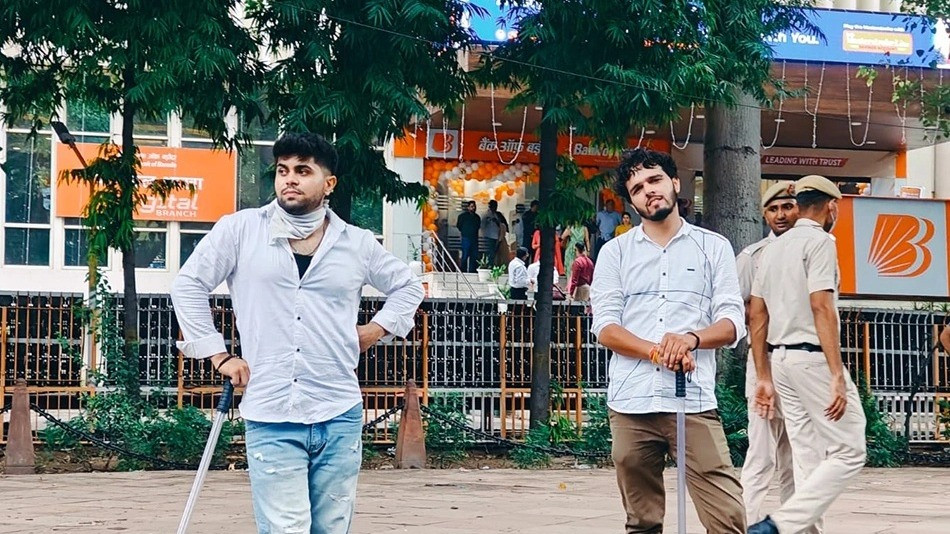
The presence of plainclothes police at a peaceful student protest has sparked legal concerns.
The presence of police in plain clothes during the Parliament march organised by students and the Cockroach Janata Party on Monday has raised several legal questions. This has led to serious discussions on the identification of officers, their accountability, and the legality of security measures.
According to the police manual,
it is mandatory for every police personnel on duty to wear a uniform. Only special investigation teams and intelligence agencies are allowed to work in plain clothes, while crowd control is entirely the responsibility of uniformed police.
Looking back in history, there is a mention of Adolf Hitler's private army in Germany, known as the SS (SS or Schutzstaffel). This organisation was formed in 1925 and later became a brutal paramilitary force. Are similar experiments happening in India? In this context, the important question is whether the deployment of police in plain clothes is legally correct and whether it violates the fundamental rights of citizens.
When thousands of protesters attempted to march from Jantar Mantar in New Delhi under "Parliament Chalo" on July 20, videos showed Delhi Police and Rapid Action Force (RAF) personnel in plain clothes or without nameplates. This raised questions about police identification and accountability.
This protest organised by the Cockroach Janata Party (CJP) demanded the resignation of Education Minister Dharmendra Pradhan and addressed the NEET paper leak. As protesters moved towards Parliament, the police used force, leading to violent clashes. Several people were injured in the incident, with one protester in critical condition admitted to the ICU at Ram Manohar Lohia Hospital. Videos that went viral on social media showed some unidentified individuals in plain clothes attacking protesters with sticks. CJP questioned the Delhi Police, "Who are these goons in plain clothes?" but no clear answer was received.
While some special operations require concealing identity, it is essential for general policing that identification is clear. Under Chapter XI of the BNSS, police personnel's identity should be disclosed to maintain public order. In this context, a senior lawyer stated that
if the identity of a police officer is not clear, the officer's order may not be legally valid.
The Supreme Court, in the case of D.K. Basu vs. State of West Bengal (1997), laid down detailed safeguards for arrests, where it is mandatory for the identity of the arresting officer to be clear. Although this case did not specifically mention crowd control, it reflects the judiciary's stance on police officers' identification.
Recently, the Andhra Pradesh High Court questioned how citizens are expected to recognise police officers in plain clothes. A former police officer mentioned that this practice began in sensitive areas like Jammu and Kashmir, Punjab, and Chhattisgarh, but it is now being seen in general policing as well. While this practice can be understood in special security situations, it has been controversial in maintaining general law and order.

Satish Verma
सतीश वर्मा पेशे से पत्रकार हैं। हिंदी की मुख्यधारा की पत्रकारिता में इन्हें 20 साल से ज्यादा का अनुभव है।