
National College: Bhagat Singh's school of revolution

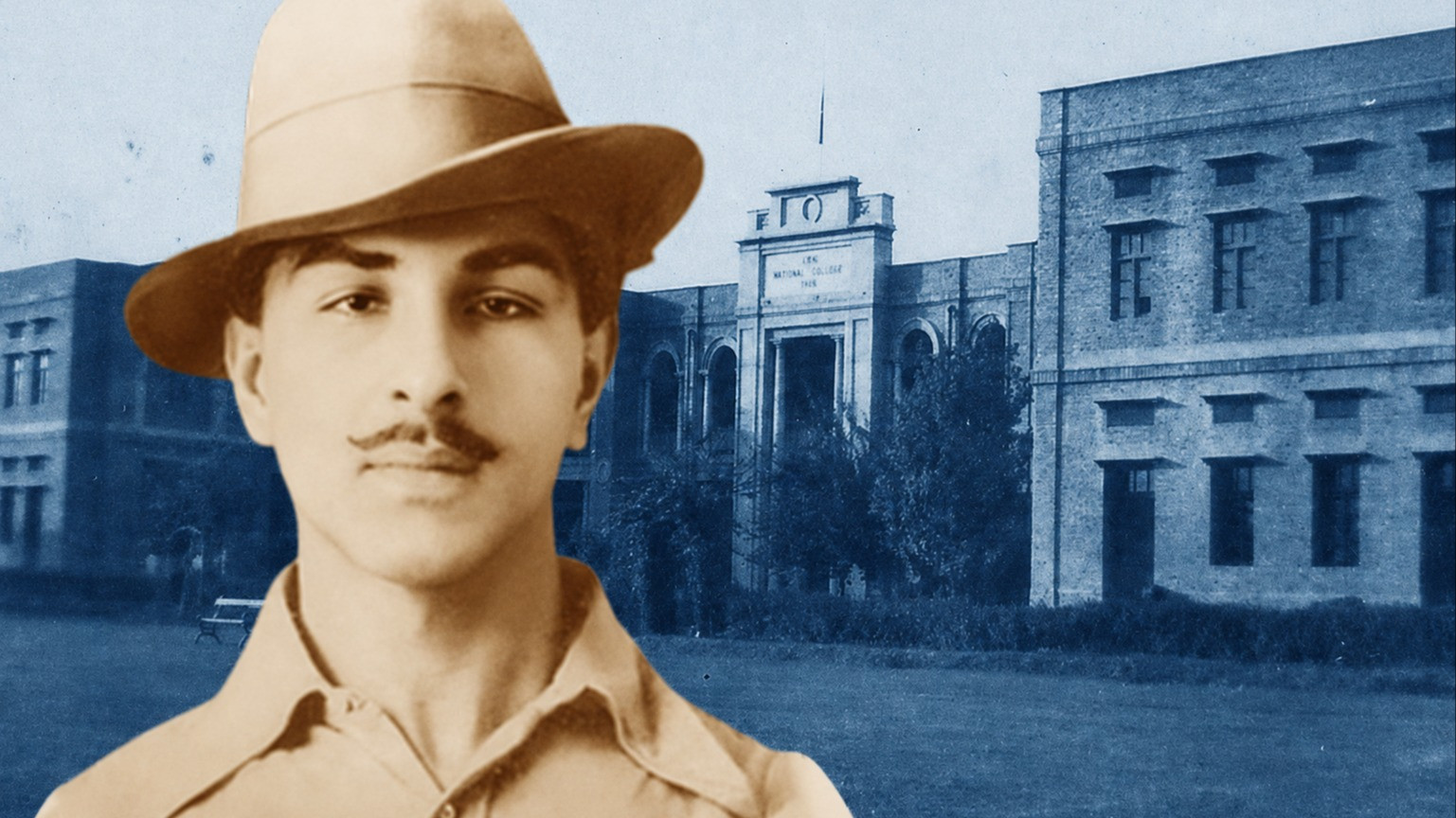
National College was a haven for students who left their previous institutions due to the Non-Cooperation Movement.
Bhagat Singh's contemporaries, who needed no introduction, such as Sukhdev, Bhagwati Charan Vohra, Yashpal, Jaidev Gupta, and Ram Kishan, all studied with him at National College. This had a profound and far-reaching impact on Bhagat Singh and the revolutionary movements, which can be understood by knowing the events that occurred in this context.
National College, Lahore was established by the Congress to promote the Non-Cooperation Movement to inspire students to boycott schools and colleges directly or indirectly controlled by the British government. National schools and colleges were established in various places such as Calcutta, Patna, Aligarh, Delhi, and Lahore. Some prominent national universities, like the National Muslim University in Aligarh, Gujarat Vidyapith, Bihar Vidyapith, Kashi Vidyapith, Bengal National University, Tilak Maharashtra Vidyapith, and Punjab Kaumi Vidyapith, also came into existence.
National College was for those students who had left their previous colleges due to the Non-Cooperation Movement, and many of these students were actively participating in this movement. The teachers here were filled with patriotism and inspired students towards national service rather than government jobs.
The curriculum included books on politics and history to increase students' engagement and awareness of national issues. A unique feature was that through lectures, students encountered patriotic personalities and leaders known at the national level, giving them direct experience of the country's challenges.
Bhagat Singh left DAV School in 1921 and joined National College, Lahore, which was affiliated with Kaumi Vidyapith, Lahore. At that time, he was in the tenth grade. According to his friend Jaidev Gupta, they were given two months to prepare for the entrance exam. Both studied by the light of a lamp until midnight and succeeded in the exam, opening the doors to the college for them.
Bhagat Singh's Struggle to Learn English
Bhai Parmanand, who first assessed Bhagat Singh's academic abilities, found that his English was weak. However, Bhagat Singh had a deep interest in subjects like history and politics, reading books far beyond his curriculum. Due to his grasp of these subjects, he was far ahead of his classmates.
Additionally, Bhai Parmanand was greatly impressed by the enthusiasm and eloquence of this new student, which clearly reflected Bhagat Singh's idealistic approach. Bhagat Singh was a serious and diligent student with a special interest in history and political science. His command of English was not very strong.
Yashpal highlighted how much Bhagat Singh struggled to strengthen his command over English. According to Yashpal, Bhagat Singh earned the trust of Pandit Indra Vidya Vachaspati through his hard work and dedication. Once, Bhagat Singh was tasked with translating an English telegram into Hindi for publication in ‘Arjun’. The telegram read, “Chaman lal editor defunct Nation Arrived At Lahore.” Bhagat Singh translated it as, “डिफंक्ट नेशन के संपादक श्री चमन लाल लाहौर पहुँच गए।”
Panditji asked him to reconsider the translation, but Bhagat Singh could not understand any mistake, as he had assumed “defunct Nation” to be the name of a newspaper. Upon Panditji's suggestion, when he checked the dictionary, he understood the correct meaning of “defunct”—“no longer existing, or not functioning.”
Yashpal further states that at that time, Bhagat Singh's understanding of English was not at the level it later became. This was evident in the task of throwing posters in the Central Assembly on April 8, 1929, and explaining to the revolutionaries. Later, when he stood for his trial in court, his preparation was so impressive that some people remarked that the documents seemed to be prepared by a lawyer. This was because Bhagat Singh had prepared them with full determination. Most of his studies were in English.
Bhagat Singh's Passion for Watching Films
Similarly, Bhagat Singh loved watching films. Once, he insisted his friend Jaidev Gupta accompany him to watch a movie. However, his friend expressed his inability to go, stating that he was unwell and suffering from dyspepsia, for which he needed to take some medicine. Bhagat Singh pondered deeply. On hearing the strange name of the ailment, he looked it up in a dictionary and found that it was merely a digestion problem. "To hell with your dyspepsia, you rascal!" he said, dragging him along to the cinema hall.
Bhagat Singh used theatre and writing as a medium for spreading ideas
Bhagat Singh was also very fond of writing. According to Yashpal, “Although Bhagat Singh primarily wrote in Hindi, he also attempted to write in Punjabi and Urdu.” To spread their ideas and awaken the masses, the students of National College adopted theatre as a medium. Our aim was to make people aware of their enslavement. A 'National Dramatic Club' was established in the college, in which Bhagat Singh participated with great enthusiasm.
Once, the club staged a play titled ‘The Rise of the Era of Emperor Chandragupta Maurya’, in which Bhagat Singh played the role of the hero Shashi Gupta. The play was very successful, and Bhagat Singh's acting was commendable. The audience applauded his performance wholeheartedly. All the teachers and fellow students in the college congratulated him for his brilliant acting. Bhai Parmanand blessed him, saying, “My Bhagat Singh will indeed prove to be the Shashi Gupta of the future.”
The club staged several other historical plays, such as ‘Maharana Pratap’ and ‘Mahabharata’, in which Bhagat Singh played major roles. The purpose of these plays was to awaken national sentiment and inspire people to stand against subjugation. According to Yashpal, “The manuscript of Mahabharata was available in Urdu, and its dialogues were rewritten to align with our objectives and renamed ‘Kishan Vijay’.
In it, the British were depicted as Kauravas and the patriots as Pandavas. Several Punjabi songs were also composed for it.” The lyrics of the song were as follows:
“Kade tun vi Hindya hosh sambhal oye. Tera ghar-bar videshi lut le gaye aur tu bekhabar so raha hai. O luttan wale hamare saath zyadaatiyan na kar, hum teri sab chaalakiyan samajh chuke hain.”
This song was composed to the tune of the famous 1907 song ‘Pagdi Sambhal O Jatta, Pagdi Sambhal O’, written by Banke Dayal. The government had banned such songs and considered those who sang them as agitators. Despite this, we continued to stage these plays. Once, during the Congress session held in Gujranwala in October 1925, we staged the play ‘Bharat Durdasha’.
There is a picture of Bhagat Singh standing with the Dramatic Club group, wearing a turban. This picture was taken after the staging of the ‘Bharat Durdasha’ play. This picture is still available today.
References
Malvinder Jeet Singh Vachhed,Azaadi Ke Parwane Krantikari Bhagat Singh Ki Shauryagatha, Repro India Limited