
Legal stance on use of pellet guns
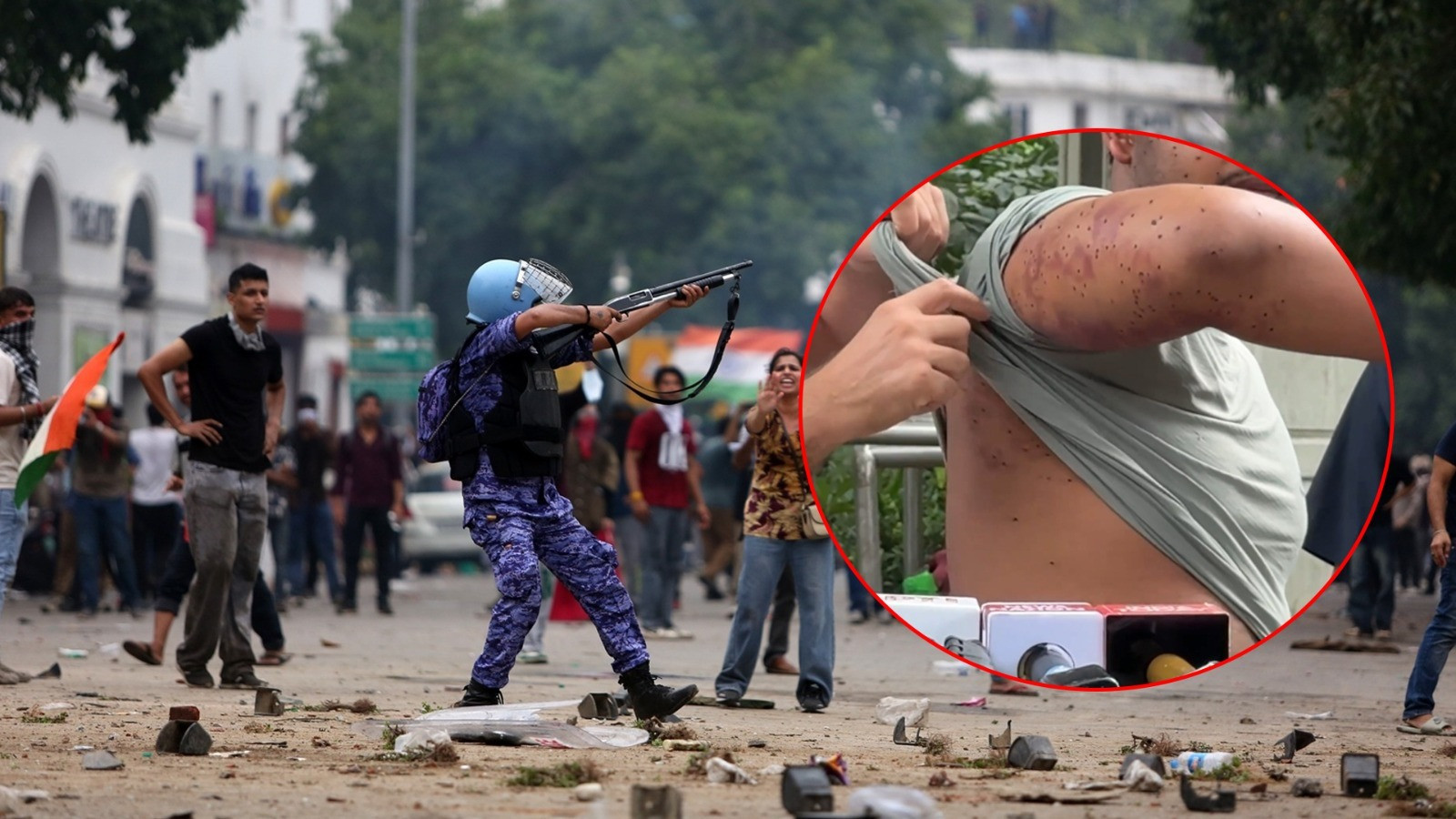
Controversy over pellet guns on students sparks political storm in India.
The controversy over the use of pellet guns on students has caused a political upheaval in the country. This issue has now become a political matter. Leader of Opposition in the Lok Sabha, Rahul Gandhi, has become aggressive towards Union Home Minister Amit Shah and is now directly demanding his resignation.
On 20th July, allegations of lathi charge, tear gas, and pellet gun use on protesters and students during the Parliament march have not only put the Delhi Police but also the central government in the crosshairs of the opposition. During the discussion in the Lok Sabha, several opposition MPs, including Rahul Gandhi, accused the government of excessive force against students and directly demanded accountability from Amit Shah.
The Hindu and Money Control report that legal experts have clear rules regarding the use of pellet guns for crowd control in India, outlining the circumstances under which such harsh measures can be adopted. According to Chhattisgarh's Additional Advocate General Ravi Sharma,
Indian law prescribes a graduated process for crowd control. The use of force does not depend on police discretion but can only be escalated when less severe measures fail.
He stated,
"Every stage of force usage is based on the three principles set out in the Ministry of Home Affairs' 1985 Code of Conduct, the Indian Civil Defence Code (BNSS), and the Supreme Court's Ramlila Maidan judgment. Force can only be used when necessary, proportionate to the actual threat, and minimal. As soon as the threat ends, the use of force should be immediately stopped."
According to Ravi Sharma, the law does not grant the police unlimited power against protesters. The police must first attempt persuasion, issue warnings, and adopt non-violent measures. Every step must be justified according to the circumstances at the scene. The police cannot directly resort to harsh actions. The police procedure is classified into various stages. Securing the area, assessing the situation, and determining whether it is an unlawful assembly under Section 189 of the Indian Penal Code (BNS) are part of this stage. No force is used at this stage. Then, in Stage One,
if dispersing the crowd is necessary, a clear and audible warning is given under Section 148 of the BNSS.
In Stage 2,
if people do not disperse, a formal warning of force usage is issued.
Then in Stage 3,
where possible, non-violent measures like cordoning, isolating troublemakers, or barricading are adopted.
Ravi Sharma stated that only if the crowd does not disperse despite repeated warnings can less lethal measures be adopted.
In Stage 4,
under the 2011 Bureau of Police Research and Development (BPRD) Standard Operating Procedure (SOP), water cannons and tear gas can be used.
Stage 5 mentions that,
if the crowd still does not disperse, a lathi charge can be conducted. The lathi strikes should be aimed at the soft parts of the body, and as soon as the crowd disperses, the action should be stopped.
The 2011 BPRD SOP outlines the procedure for using less-lethal measures during crowd control for security forces. Regarding the use of pellet guns, Ravi Sharma stated that it is not considered a standard crowd control tool. In the legal framework, it is the last stage of force usage.
He stated,
"The use of pellet guns can only be as a last resort (Stage 6). It can only be used when all less severe measures have failed, and there is an immediate serious threat to life or significant public property. The use of pellet guns in crowd control should be the last option."
There is no law in India that explicitly prohibits the use of pellet guns for crowd control by authorized security forces. Its use is governed more by the Standard Operating Procedures (SOP) of the Ministry of Home Affairs and agencies like the Rapid Action Force, where it is considered a last resort. There is no separate law controlling the use of pellet guns by the police for crowd control. Ownership of pellet guns by civilians is regulated under the Arms Act, 1959, and the Arms Rules, 2016, but no separate legal standards have been set for their use by the police in crowd control.
He explained,
"Section 43 of the BNSS (formerly Section 46 of the CrPC) allows the police to use necessary force for arrest, but such force should not cause death unless the accused is charged with an offence punishable by death or life imprisonment."
He mentioned that reports of deaths and permanent disabilities caused by pellet guns have surfaced. In such cases, it may be difficult for the government to prove that the force used was proportionate to the circumstances.
According to legal experts, if pellet guns have to be used, strict rules apply. The order can only be given by a magistrate or a designated senior officer. This can only be done when a lathi charge has failed, and there is an immediate serious threat to life or significant public property. A full and clear warning must be given first. If firing is necessary, the target should be below the waist and only towards the most aggressive part of the crowd. As soon as the crowd begins to disperse, firing should be immediately stopped. Thereafter, providing medical assistance to the injured, accounting for all rounds used, and documenting the entire action is mandatory. Ravi Sharma stated that throughout the process, supervision by senior officers, video recording, and the principle that the purpose of force is only to disperse the crowd, not to punish, remains in effect.

Satish Verma
सतीश वर्मा पेशे से पत्रकार हैं। हिंदी की मुख्यधारा की पत्रकारिता में इन्हें 20 साल से ज्यादा का अनुभव है।